Chapter 8
Part 8
Sable Holloway’s office smelled like old books, black coffee, and rain.
It was on the second floor of a brick building above a florist, with narrow windows overlooking Ashford’s main street. Callum came with me, but he waited in the reception area because I asked him to. Not because I wanted secrecy from him. Because I needed one room where my grandmother’s voice could reach me without anyone else’s breathing.
Sable was in her forties, with dark curls pinned at the back of her head and a calmness I trusted immediately. She placed a navy folder on the desk between us.
“Your grandmother was very specific,” she said. “She did not want to create a family war while she was alive. But she also did not want you erased.”
Inside the folder were documents I had never seen.
A small life insurance policy Grandma had left in my name, never claimed because my father had told everyone there was “nothing but debt.” A savings account with me listed as beneficiary. Copies of loans made to my father over the years, signed by him, witnessed by Bram Holloway, and unpaid. A revised will leaving Grandma’s yellow house not to my father, as he had implied for years, but to be sold, with a portion placed in trust for me.
The house had been sold nine years ago.
I looked up slowly.
“Sable,” I said, “I never received anything.”
“I know,” she replied.
Two words. Heavy as stone.
“What happened?”
She folded her hands. “Your father filed an earlier copy of the will. By the time questions arose, the estate appeared too small to contest without someone pushing. My father was ill then. He wrote to you twice.”
“I never got letters.”
“I suspected that.”
The room narrowed.
I remembered my mother collecting mail from my apartment “because she was nearby.” I remembered my father telling me not to worry about Grandma’s estate, that grief made people greedy, that asking questions would make me look ugly.
Ugly.
That word had kept me silent for years.
Sable slid another page forward. “There may still be legal remedies, especially regarding the insurance and beneficiary account. Some claims are old. Some are not. I won’t promise an outcome. But I can promise your grandmother tried to protect you.”
I looked down at Grandma’s signature.
Odessa Mae Vail.
The loops and slants were familiar enough to hurt.
“She called me little bird,” I said.
Sable smiled softly. “The letter in this file does too.”
I pressed my hand over my mouth.
For the next hour, Sable explained options. Calmly. Carefully. No drama. No revenge fantasy. Just facts, timelines, filings, signatures, certified mail, bank records.
It turned out my father’s wedding invoice had done more than humiliate me. It had opened a door he had spent years bracing shut.
Because once he claimed I owed him money for being raised, he invited questions about every dollar, every record, every family obligation he had buried under noise.
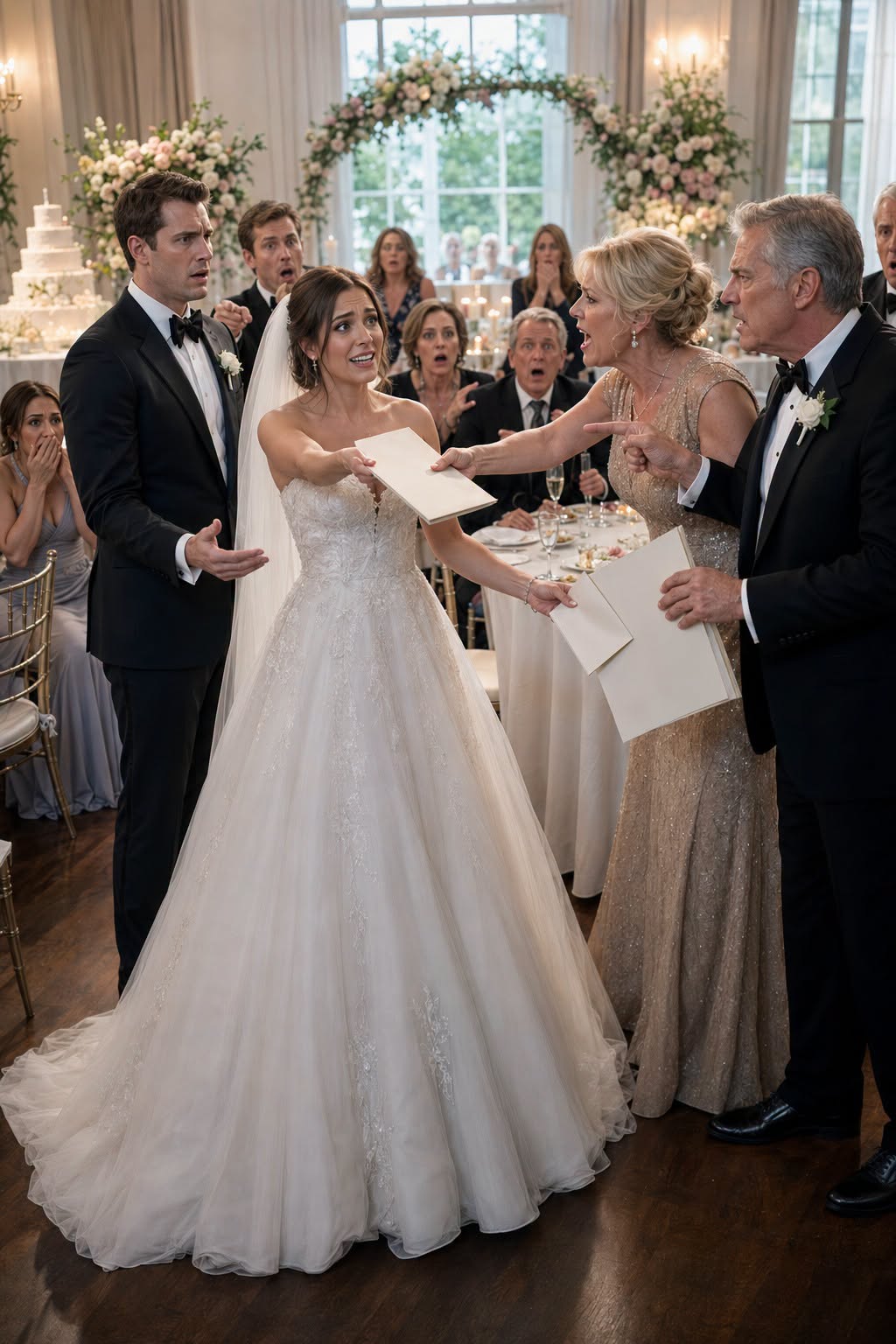
We did not sue immediately. That surprised people later. They expected fireworks because they had seen the wedding video. Yes, there was a video. Of course there was. By the time Callum and I returned from Maine, clips of my father handing me the invoice had traveled through family group chats like a kitchen fire.
But I waited.
I let Sable gather documents. I let her send formal requests. I let banks search archives. I let silence do what shouting could not.
My father called once.
I answered because Sable told me to document all communication.
“You need to stop digging,” he said.
No hello. No apology.
I sat at my kitchen table with the phone on speaker. Callum sat across from me, writing the date and time on a legal pad.
“Why?” I asked.
“Because you’re going to destroy this family.”
I looked out the window. Our neighbor was mowing his lawn. The ordinary sound made the moment feel even stranger.
“No,” I said. “I’m going to find out what happened.”
“You think you’re innocent?” he snapped. “You stood in front of everyone and made us monsters.”
“I stood in front of everyone and read receipts.”
His breathing grew harsh.
My mother came on the line then, voice thick with anger. “If you loved us, you would let this go.”
And there it was, the oldest hook.
I closed my eyes.
“I did love you,” I said. “That’s why you got away with so much.”
Neither of them spoke.
Then I added, “Please direct future communication to my attorney.”
I hung up before they could answer.
It took five months.
Five months of documents, statements, meetings, and family members choosing sides in the careful way people do when truth becomes inconvenient. Beck chose me. Aunt Junie chose me. Uncle Dorian called and apologized for not seeing enough. Others disappeared, which was its own kind of answer.
By spring, Sable had recovered the insurance payout with interest. The beneficiary account was traced. The estate issue was more complicated, but my father agreed to a settlement after Sable produced copies of his signed loan documents and the letters Bram Holloway had mailed to me.
The amount was not movie-level money.
It was not millions. It did not buy a mansion or a yacht or a new identity.
But it was enough to pay off my remaining student loans, create an emergency fund, and donate a portion to the hospice center that had cared for Grandma Odessa. It was enough to prove that my father had not just exaggerated. He had hidden things.
The day the settlement cleared, my mother sent one last email.
“We hope money makes you happy.”
I stared at it for a long time.
Then I typed back one sentence.
“Peace already did.”
After that, I blocked them.
Not forever in a dramatic, door-slamming way. Just firmly. Quietly. Like turning off a stove after being burned too many times.
A year later, Callum and I hosted our first anniversary dinner in our backyard. Nothing fancy. String lights, grilled chicken, lemonade in glass pitchers, grocery-store flowers in mason jars. Beck came early and helped Callum fix a wobbly table. Aunt Junie brought potato salad and cried when she saw Grandma Odessa’s recipe box on a shelf in my kitchen.
I kept it there now. Not hidden. Not locked away.
Inside were the records, yes. But also recipe cards. Cinnamon rolls. Lemon icebox pie. Chicken soup with too much pepper. Proof that family could feed you without billing you later.
After dinner, Callum and I danced barefoot on the patio while our friends clapped off-beat and Beck laughed so hard he spilled lemonade on his shirt.
For years, I believed love was something I had to earn by being useful, quiet, grateful, and easy to invoice.
I know better now.
My parents did raise me. That part is true. They fed me, clothed me, housed me, and gave me a last name. But they also taught me something they never intended.
They taught me that any love requiring repayment was never love I needed to keep.
So no, I did not forgive them in the way people like to demand at the end of painful stories. I did not invite them back because they were old. I did not soften the truth because it made other people uncomfortable. I did not pretend the wedding was a misunderstanding.
I built a life without their ledger.
And every morning, when sunlight moves across my kitchen and catches on that old green recipe box, I remember my grandmother’s words.
“You don’t have to keep proving you’re good, little bird.”
I don’t.
I never did.
May you like



THE END!
Disclaimer: Our stories are inspired by real-life events but are carefully rewritten for entertainment. Any resemblance to actual people or situations is purely coincidental.







