Chapter 5
Part 5
People think the truth arrives like thunder.
Sometimes it arrives like paper.
Thin paper. Faded ink. A receipt folded into quarters. A note written by an old woman who knew her son better than she wanted to.
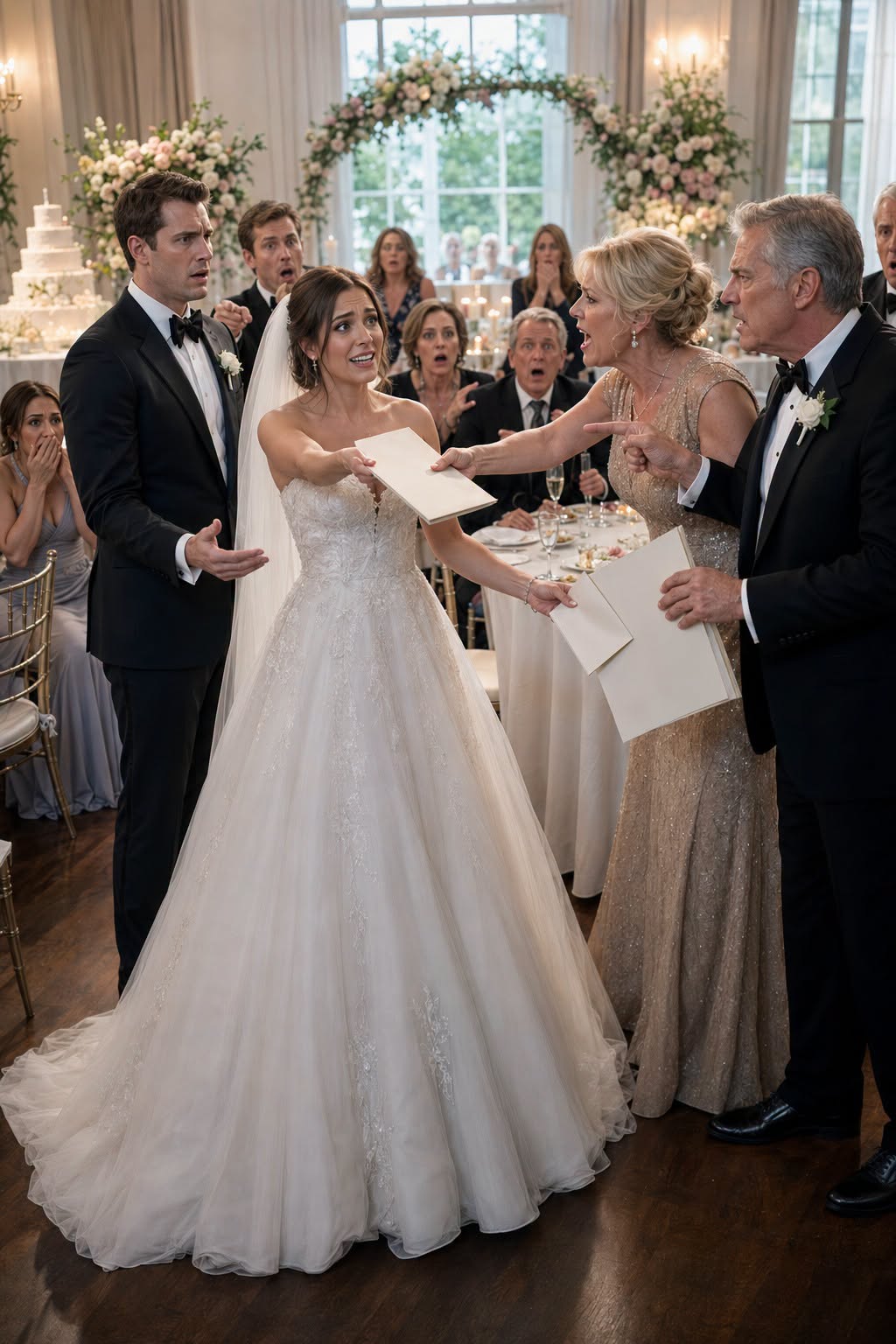
I opened Grandma Odessa’s green recipe box and took out the first card. It was not one of the worst ones. I chose carefully. Even in that moment, even after everything, some old foolish part of me still tried to protect my father from the full shape of himself.
“This is from March 12, twelve years ago,” I said.
My father’s jaw worked.
I read, “Arden paid store electric again. Silas said he would repay her after spring sales. I do not believe him.”
My mother pressed a hand to her throat.
I took out another.
“June 3. Arden worked open to close. No wages. Silas called it character building. She looked exhausted.”
A murmur spread through the room.
My father lunged verbally because he could no longer control physically.
“My mother was old,” he snapped. “She wrote all kinds of things.”
“She wrote dates,” I said. “Amounts. Check numbers. Names.”
My father looked toward the exits.
There it was, the red herring everyone had believed for years: that my grandmother had been confused, sentimental, maybe unreliable. My father had leaned on that idea whenever she challenged him. He called her dramatic. Forgetful. Too attached to me.
But Grandma had been sharper than any of us.
I pulled out a small stack of photocopies.
“These are not all of the records,” I said. “I’m not reading all of them today.”
My mother whispered, “Then why bring them?”
I looked at her. “Because I knew you might try to humiliate me, and I wanted to remind myself I wasn’t crazy.”
That sentence landed harder than any number I had read.
For years, their greatest talent had been making me doubt my own memory.
If I remembered working at the store unpaid, Dad called it “helping out.” If I remembered missing school events to watch Beck, Mom called me “dramatic.” If I remembered paying bills, they called it “temporary family support.” If I remembered crying in bathrooms after their phone calls, they called me “too sensitive.”
But there, under ballroom chandeliers and white roses, my memories had paper bodies.
My father grabbed the microphone again. His hand was shaking.
“All right,” he said loudly. “Enough. This was meant as a joke. Arden has always struggled to take a joke.”
The old accusation. The old trap. If I reacted, I proved him right. If I stayed silent, he rewrote the room.
I smiled slightly.
“A joke usually has a punchline,” I said. “Yours had a due date.”
Several guests gasped. Someone near the bar made a sound like they were trying not to clap.
My mother stepped forward, tears shining now. Not guilt tears. Performance tears.
“Is this what you wanted?” she asked. “To destroy your parents at your wedding?”
“No,” I said. “I wanted my parents to give a toast.”
She looked struck. For one second, I almost felt sorry for her. Then she said, “After everything we did, you still find a way to be cruel.”
Callum’s mother stood.
She was a small woman named Elowen Hart with silver-blond hair and a voice soft enough that people leaned in automatically.
“Maribel,” she said, “your daughter is not being cruel. She is responding to cruelty.”
My mother turned red.
My father pointed at Callum. “This is your influence.”
Callum did not raise his voice. “I helped Arden organize documents. I did not create them.”
“You think you know our family?”
“No,” Callum said. “But I know what shame looks like when someone tries to gift-wrap it.”
That was when Beck walked to the front.
He had been quiet too long. His face was pale, and his tie hung loose at his collar. My little brother, the boy I had once carried from the couch to bed because he fell asleep during cartoons, stood between our parents and me like he was finally seeing the furniture in a room after living there blindfolded.
“I need to say something,” he said.
My father groaned. “Beck, don’t start.”
But Beck took the microphone from him.
“I used to think Arden liked taking care of me,” he said. “I thought she was just better at everything. Better at homework, better at cooking, better at making Mom stop crying and Dad stop yelling.”
My eyes burned.
Beck looked at me. “I didn’t know they made you responsible for me. I didn’t know you were missing things. I didn’t know you were paying bills.”
My mother whispered, “You were a child.”
“So was she,” Beck said.
Those three words cracked something open in the room.
So was she.
I had spent twenty years being treated like a backup adult, an unpaid worker, a spare parent, a family wallet with a polite smile. Hearing Beck say it plainly made the air leave my lungs.
My father turned away, but there was nowhere for him to go.
Then Aunt Junie rose.
“I remember the winter Odessa called me,” she said. “She said Arden looked worn down. She said Silas was taking advantage.”
My father slammed his palm on the table. Silverware jumped.
“That is enough.”
No one moved.
Aunt Junie lifted her chin. “No, Silas. It wasn’t enough then. Maybe it should be enough now.”
The ballroom lights glowed warm against the white tablecloths. Outside the windows, the sun had lowered, turning the trees gold. It should have been the hour for dancing, cake, and photographs. Instead, my family history sat open on the head table beside my bouquet.
I picked up the final page of my own document.
My hands no longer shook.
“At the bottom,” I said, “using your method of assigning dollar values to family life, the estimated total of my unpaid contributions is $312,480.”
The number rippled through the guests.
My father stared at me.
My mother sat down as if her knees had vanished.
May you like



“And unlike yours,” I added, “mine does not include the cost of emotional damage, missed childhood, or learning too young that love had conditions.”
For once, even my father had no words.







