Chapter 2
Part 2
I had not planned to read it.
That is the truth, no matter what my parents later told people. I had not come to my own wedding looking for revenge. I had not hidden evidence under my chair because I wanted a public execution. I had brought the envelope for the same reason some people carry umbrellas when the sky looks uncertain. Not because they want rain, but because they have been soaked before.
Seven months before the wedding, my grandmother’s house had been cleaned out.
My grandmother, Odessa Vail, had lived in a narrow yellow house outside Ashford, Ohio, with a screened porch, rose bushes, and a kitchen that always smelled like cinnamon gum. She was my father’s mother, and she was the only adult in my childhood who never made affection feel expensive.
When she got sick, I was twenty-six. I had just started my first serious job, the kind where you buy two blazers and pretend you aren’t eating peanut butter sandwiches for dinner. Every evening, after work, I drove forty minutes to Grandma Odessa’s house. I washed dishes. I sorted pills without ever calling them by name because she hated sounding like a hospital. I changed sheets. I sat with her while game shows flickered blue across the living room wall.
My parents said they were too busy.
My brother Beck was still in high school, and I didn’t blame him. He was a kid. My father’s hardware store needed help. My mother said her back hurt. So I went. I went until the nights blurred together and my car smelled permanently like drive-thru coffee and hand lotion.
Grandma used to squeeze my wrist and say, “You don’t have to keep proving you’re good, little bird.”
I never knew what to say to that.
After she died, the house sat mostly untouched. My father said it was too painful to sort through. My mother said old houses made her allergies act up. Years passed. Then, in January, my father called and told me he had finally rented a storage unit for the remaining family items.
“You should come get whatever little sentimental things you want,” he said. “Nothing valuable, obviously.”
That “obviously” stayed with me.
I went on a cold Saturday morning. The storage unit was at the edge of town behind a tire shop, with dirty snow pushed into gray piles along the fence. My father gave me the key but did not come inside.
“Take what you need,” he said. “Just don’t make a mess.”
Inside, I found boxes labeled in my grandmother’s handwriting. Quilts. Christmas ornaments. Church cookbooks. Old photographs. I touched everything carefully, like dust could bruise.
Near the back, under a cracked lamp shade, I found a green metal recipe box.
I opened it expecting index cards.
Instead, I found folded receipts, old bank slips, handwritten notes, and one photograph of me at fourteen, standing behind the counter of my father’s hardware store with a price gun in my hand and a smile too tired for a child.
The first note was written in my grandmother’s looping script.
“Arden keeps saving them. One day she may need proof.”
I sat down on the concrete floor and read until my fingers went numb.
There were copies of schedules from the hardware store, summers when I had worked full-time without pay. Receipts from groceries I bought for my parents after college. Copies of electric bills with my checking account number printed at the bottom. A small calendar marked with nights I stayed with Grandma Odessa. There were notes about babysitting Beck, school pickups, sick days, parent-teacher meetings my mother had skipped but told everyone she attended.
At first, I cried.
Then I got angry.
Then I got practical.
Numbers have always calmed me. Numbers don’t flatter you. They don’t gaslight you. They don’t rewrite a memory and dare you to argue. A number is a small, cold object you can hold up to the light.
So I started building a timeline.
Not because I wanted money. Not because I believed love should be reimbursed. I built it because my whole life, my parents had acted like I was a debt they were kind enough not to collect. For once, I wanted proof that I had not been only a taker in my own family.
Callum found me at our dining table three nights later, surrounded by bank statements, photographs, and old calendars.
He didn’t ask me to stop.
He made tea, sat across from me, and said, “Tell me where to start.”
That was Callum. Steady. Brown-eyed. Patient in a way that never felt weak. He worked as a civil engineer, designing bridges and drainage systems, and he had a habit of studying problems before touching them. When I told him my father sometimes joked that he expected a “return on investment” after the wedding, Callum’s jaw tightened.
“Do you think he’ll actually do something?” he asked.
“I don’t know,” I said.
That was only half true.
Two weeks before the wedding, my mother called me while I was checking final guest counts.
“Your father wants to make a small speech,” she said.
“Of course,” I replied.
“He’s been working on something special.”
Her voice had that bright, brittle sound, like glass tapped with a spoon.
“What kind of special?”
“Oh, don’t ruin it.” She laughed. “You’ve always been so suspicious.”
Behind her, I heard my father say, “She’ll finally understand.”
I stood in my kitchen holding the phone, watching rain streak down the window above the sink.
That night, I printed one copy of my timeline and slid it into the gray envelope.
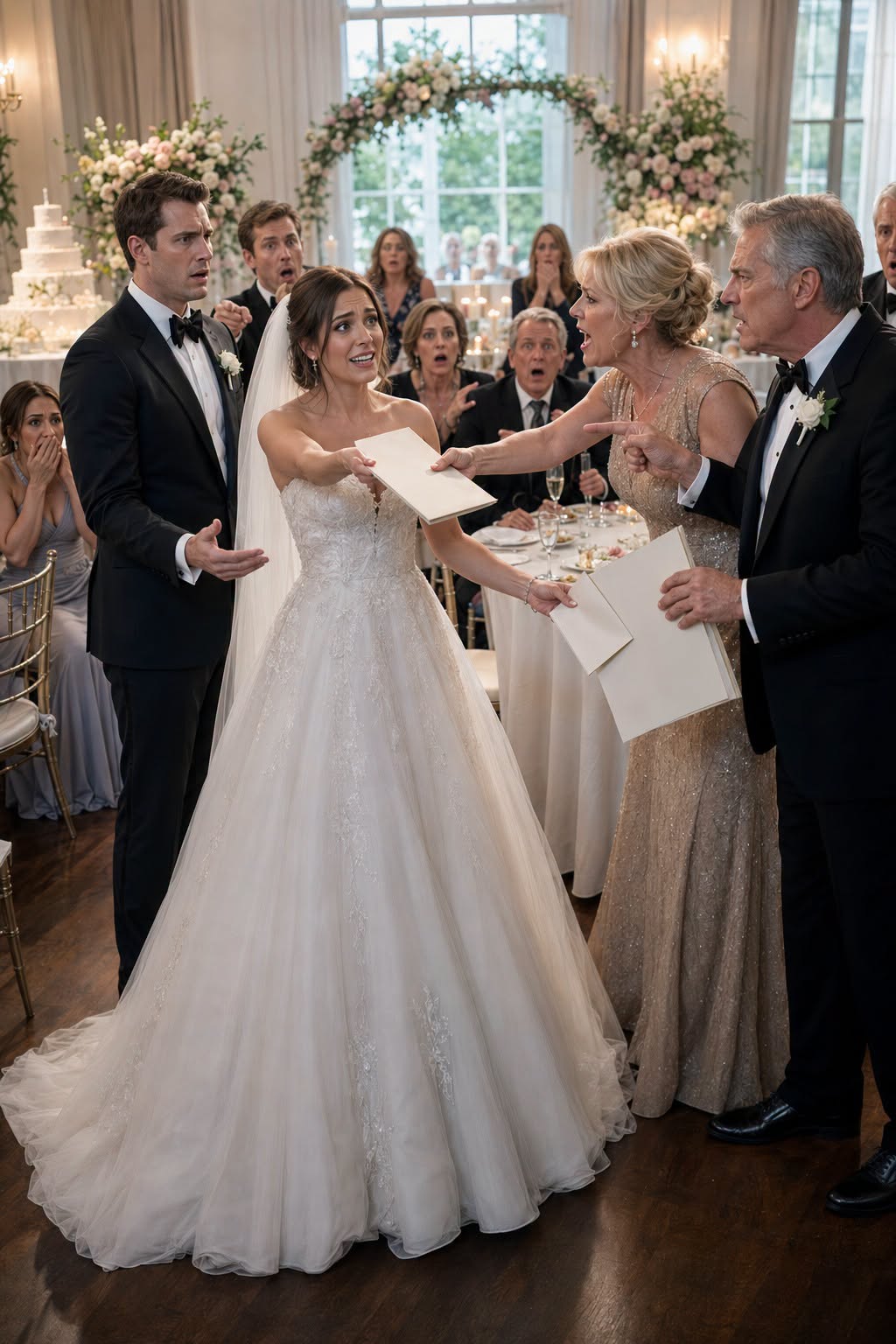
Still, standing at my wedding, with two hundred guests watching and my father’s invoice trembling slightly in my hand, I hoped I would not need it.
Hope is stubborn that way. It keeps showing up with flowers after the funeral is already over.
I looked at my parents. Then I looked at Callum.
He gave one small nod.
I turned toward the room.
“I wasn’t planning to share this today,” I said. “I actually hoped we could celebrate love without turning family into a ledger.”
My father laughed under his breath. “Don’t be dramatic.”
I lifted the first page.
“This is not an invoice,” I said. “It’s a record.”
My mother’s face changed first. The proud smile thinned. Her hand moved toward my father’s sleeve.
“Arden,” she warned.
But for once, I did not stop when my mother said my name like a leash.
“For years,” I continued, “I was told that raising me created a debt. Since my parents chose to present that idea publicly, I think the full accounting should also be public.”
I glanced down at the first entry.
“Age fourteen,” I said. “Unpaid childcare.”
Beck’s head came up.
May you like



My father’s mouth tightened.
And the room leaned in.







