Chapter 6
Part 6
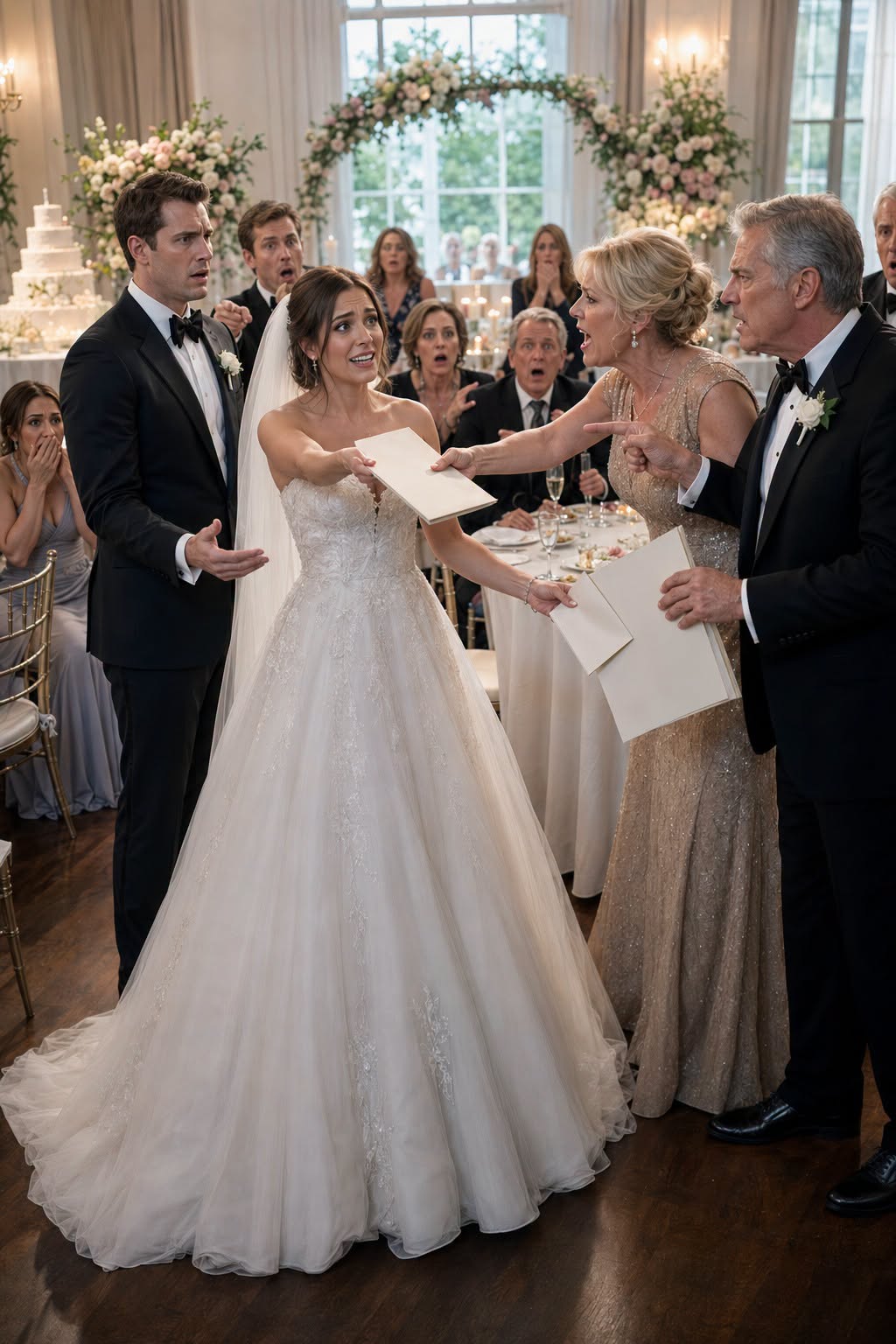
I slid the final page across the table toward him.
Not thrown. Not slapped down. Just slid, with two fingers, across white linen scattered with rose petals and torn bits of ribbon.
“If family is business,” I said, “then according to your own rules, you owe me $72,480 after offset.”
My father stared at the page.
Behind him, the wedding cake stood untouched, five tiers of vanilla cream and sugared flowers. The tiny bride and groom topper smiled stupidly at the whole room.
Nobody laughed now.
My mother finally found her voice. “You cannot seriously expect us to pay that.”
“I don’t,” I said.
She blinked.
“I never did.”
My father looked up sharply, suspicious of mercy because he had never understood it.
“I don’t want a check,” I said. “I don’t want reimbursement. I don’t want repayment for watching Beck, working at the store, caring for Grandma, paying bills, or showing up every time you called me selfish for wanting a life.”
Callum squeezed my hand.
“I want the debt to end.”
My father scoffed weakly. “You’re the one with spreadsheets.”
“Yes,” I said. “Because spreadsheets were the only language you respected.”
That hurt him. I saw it. Not deeply enough to change him, maybe, but enough to bruise his pride.
I picked up his invoice.
The paper felt expensive. Thick. Smooth. He had spent time on it. Maybe he had imagined applause. Maybe he had pictured Callum laughing awkwardly and promising to “take care of it.” Maybe he had imagined me blushing, humiliated but obedient, tucking the bill away like a daughter who knew her place.
Instead, I tore it in half.
The sound was small and clean.
My mother gasped.
I tore it again. Then again.
White pieces fell onto the table like ugly confetti.
“I am not paying for being born,” I said.
Then I picked up my own counter-invoice.
My father watched carefully, as if expecting me to demand a signature.
Instead, I tore that too.
The guests seemed startled by that part.
Maybe they expected me to keep it framed. Maybe they thought I would send it by certified mail. But the point had never been to become my parents. The point was to stop letting them turn love into a ledger.
“This ends today,” I said. “I won’t bill you. You won’t bill me. You won’t joke about what I owe. You won’t tell my husband he married into a debt. You won’t use money, childhood, or Grandma’s memory to shame me again.”
My father’s eyes narrowed. “And if we don’t accept your terms?”
A strange calm moved through me.
“Then you won’t be part of my life.”
My mother made a wounded sound. “On your wedding day?”
“Especially on my wedding day.”
The room stayed silent. I could hear ice melting in glasses. Somewhere, a child whispered and was hushed.
My father looked around, searching for allies. He found none willing to meet his eyes.
“You’ll regret this,” he said.
That sentence once would have folded me in half.
I looked at Callum, then at the guests, then back at my father.
“No,” I said. “I think I’ll grieve it. That’s different.”
His face hardened.
“Fine,” he said. “If you want to humiliate your mother and me, we’ll leave.”
He expected me to stop him. I saw it in the pause after “leave.” My whole childhood had trained me to chase that pause, to run after slammed doors, to apologize before I understood my crime.
I did not move.
My mother rose slowly. Tears streaked her makeup now, but even those tears seemed angry.
Beck stepped toward her. “Mom.”
She turned on him. “Don’t.”
He stopped.
My parents walked out of my wedding reception while every person watched. My father’s shoulders were rigid. My mother clutched her purse like it was keeping her upright. At the doorway, she turned back once.
“You have no idea what family means,” she said.
I looked at the torn invoices on the table.
“I’m starting to learn.”
Then they were gone.
For several seconds, the room remained frozen in the shape of their exit.
Then Callum took the microphone.
He did not make a speech. He simply said, “I love my wife. I am proud of my wife. And there is still cake.”
The room exhaled.
Someone laughed softly. Then someone clapped. Not loud at first. Just a few hands, uncertain but warm. Then more joined. Aunt Junie wiped her face. Beck came to me and hugged me so hard my ribs hurt.
“I’m sorry,” he whispered.
I held him. “You were a kid.”
“So were you,” he said again.
That time, I let myself cry.
Not the collapsing kind. Not the kind my mother could turn into proof of weakness. Just two tears sliding down before I wiped them away and breathed.
The band started again, gently at first. The wedding planner, a woman named Petra who looked like she had handled hurricanes with a clipboard, cleared the torn paper from the head table. Callum’s mother fixed my veil. My boss brought me a glass of water and said, “For what it’s worth, your presentation skills are excellent.”
I laughed. Actually laughed.
And then Callum led me to the dance floor.
Our first dance was not perfect. My eyes were swollen. My hands were cold. Half the guests were still pretending not to stare. But Callum held me like there was no audience, no invoice, no wound older than our marriage.
Halfway through the song, he leaned down and whispered, “You don’t owe me anything either.”
May you like



I closed my eyes.
That was when the real wedding began.







