Chapter 8
### Part 8
One year after Miss Crane called me, I took the day off work.
I did not announce it like an anniversary. Pain does not always need candles. But my body knew before my calendar did. I woke before dawn, listening to the quiet breathing of the house, and remembered the garage window, the brown paper bag, my son’s blank face through glass.
I went downstairs and made coffee.
Then I packed Orson’s lunch.
By then, he had opinions. Very strong opinions. No soggy bread. Grapes only if firm. Trail mix without raisins because “raisins are grapes that gave up.” A cookie on Wednesdays if the week had been emotionally reasonable.
That Tuesday got two cookies.
He came into the kitchen wearing mismatched socks and a hoodie with a faded rocket on the front.
“You’re up early,” he said.
“So are you.”
“I smelled waffles.”
“I made toast.”
He gave me a disappointed look worthy of a food critic.
“Toast smells like betrayal.”
I laughed.
That sound still surprised me sometimes. Easy laughter. The kind that did not check over its shoulder.
Nyra came in behind him and kissed the top of his head. Her hair was damp from the shower, and she had mascara under one eye because mornings were democratic in their cruelty.
“Big spelling test today?” she asked.
“Vocabulary,” he said. “Different beast.”
I zipped his lunchbox and slid it across the counter.
He opened it immediately.
“Inspection?” I asked.
“Quality control.”
He found the note and read it.
This one said, “You are allowed to take up space.”
Dr. Bell had helped us with that phrase months earlier. Orson had whispered once that Grandpa liked him better when he was quiet. So we practiced the opposite.
He folded the note and put it back.
“Good one,” he said.
High praise from a nine-year-old.
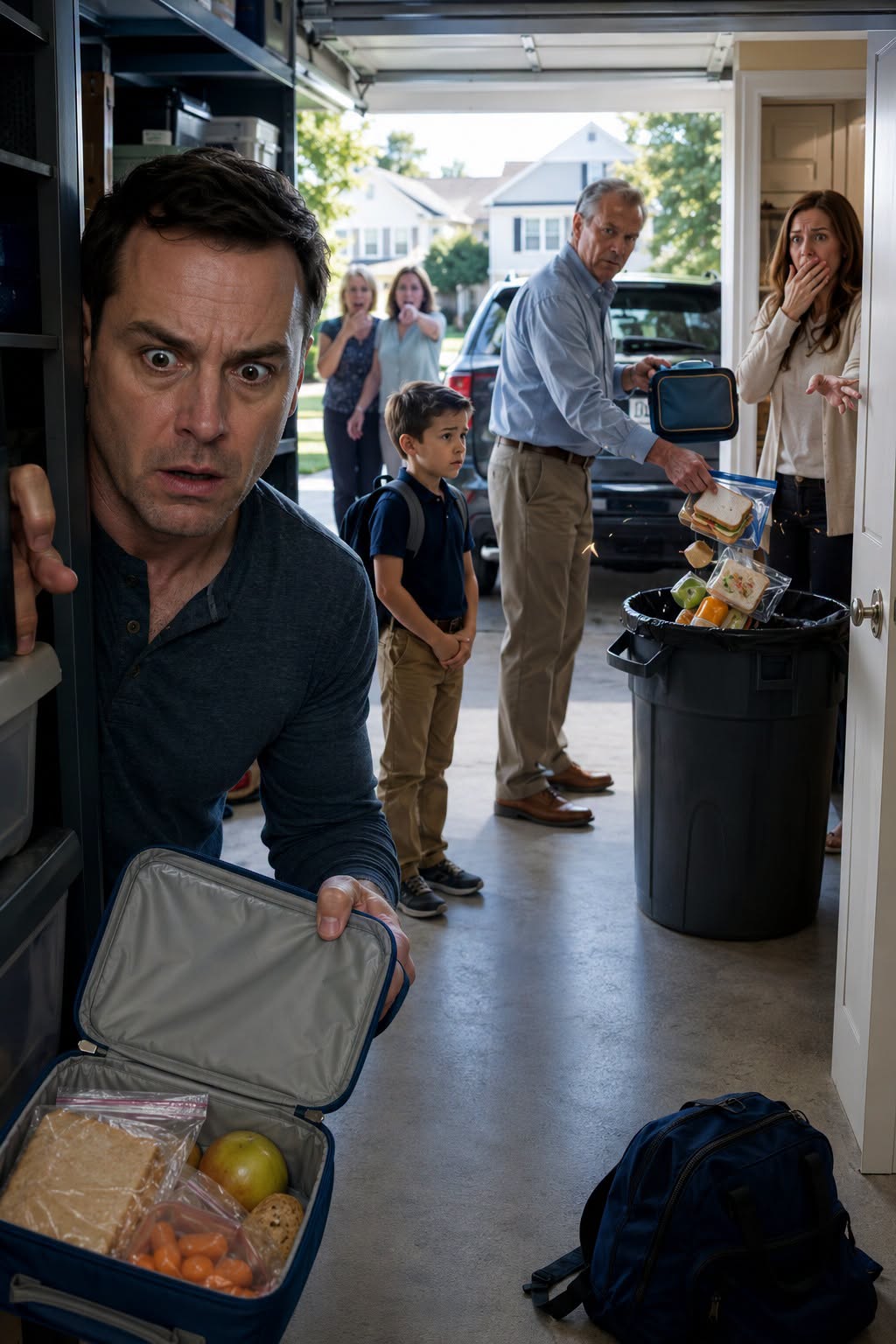
After they left for school, I went to the garage.
The workbench was cluttered again in a normal way. Rocket paint. A bike tire pump. A jar of screws. Baseball cleats Orson kept forgetting to take inside. In the corner, the side window looked toward the kitchen, same as it had that day.
For a long time, I stood where I had stood before.
I used to think protection meant strength in the obvious ways. A locked door. A raised voice. A body placed between danger and the person you love. Sometimes it is those things.
But that year taught me protection could also be patience.
A folder.
A timestamp.
A calm voice when your blood is shouting.
A refusal to become the villain someone else wrote for you.
Thaddeus had counted on my anger. He had studied me just enough to underestimate me. He saw a man from a working-class family who wore department-store ties until his thirties and assumed I would be easy to provoke. He saw my love for Orson and assumed love made me reckless.
He was wrong.
Love made me precise.
At noon, Miss Crane sent me a photo.
Not of Orson’s face. She knew better than to turn my child into a symbol. Just the open lunchbox on his desk. Half-eaten sandwich. Empty cookie wrapper. Yellow note folded beside the chocolate milk.
Below it, she wrote, “He asked me to tell you he ate the grapes first because they were perfect.”
I sat at my desk smiling like an idiot.
Across from me, a client under federal investigation was explaining why twelve consulting payments to his cousin’s shell company were perfectly legitimate. I nodded, took notes, and thought about grapes.
That evening, we had dinner at home.
Nothing dramatic. Baked chicken, rice, green beans Orson negotiated down to four bites. Nyra talked about a hospital account in Milwaukee. I talked about a suspicious invoice trail. Orson talked for eleven uninterrupted minutes about a playground argument involving soccer rules, a girl named Sloane, and whether “no takebacks” applied if someone sneezed during the agreement.
After dinner, the doorbell rang.
The three of us went still.
Old fear is rude. It visits without being invited.
I checked the camera.
Evaleigh stood on the porch holding a small paper bag.
Nyra relaxed first. “I forgot. She said she might drop off the library book.”
“Do you want me to get it?”
She considered. “No. I will.”
Orson followed her to the door but stayed behind the hallway line we had agreed on.
Boundaries can be invisible and still solid.
Evaleigh handed over the book and the bag.
“I made oatmeal cookies,” she said. Then quickly, “For all of you. No pressure. No secrets.”
Orson looked at me.
I nodded once.
He took the bag. “Thanks, Grandma.”
Evaleigh’s eyes filled, but she smiled instead of crying.
“You’re welcome.”
She did not step inside. She did not ask to. She waved and walked back to her car.
Progress, I had learned, was often less about what people did and more about what they finally stopped doing.
Later, after Orson went upstairs, Nyra and I sat on the back steps with mugs of tea cooling in our hands.
The air smelled like wet leaves and distant fireplaces.
“My mother asked if she could attend Grandparents Day at school,” Nyra said.
I looked at her.
“What did you say?”
“I said not this year.”
“How did she take it?”
“She said, ‘I understand.’ And then she did not argue.”
I nodded.
“That must have felt good.”
“It felt sad,” she said. “But clean.”
Clean was underrated.
Nyra leaned against me.
“Do you ever think about what would have happened if Miss Crane hadn’t called?”
“Yes.”
She closed her eyes.
“Me too.”
I did not tell her all the versions I had imagined. Orson growing more withdrawn. Thaddeus filing more motions. A teacher repeating concern in the wrong setting. Me finally discovering the letters and reacting in exactly the way Thaddeus wanted. A courtroom where my son’s fear was presented as proof against me.
Those futures did not happen.
Because one teacher noticed a lunchbox.
Because one child held on long enough.
Because one father came home early and looked through a garage window instead of walking through the front door shouting.
That last part had taken me months to accept. I wanted to hate myself for not seeing sooner. But guilt, Dr. Bell once told me, becomes useful only when it turns into attention. After that, it is just another room you lock yourself inside.
So I paid attention.
To Orson’s silences. To Nyra’s grief. To my own instinct to turn every wound into a case file. To the difference between justice and obsession.
I still took cases. I still followed money through lies. But I also started doing pro bono work for parents dealing with coercive relatives and custody manipulation. Sable sent people my way when numbers mattered. Hidden payments. Suspicious trusts. Legal harassment disguised as concern.
I helped where I could.
Not because I was noble.
Because I knew what it felt like to open your child’s lunchbox and find a war inside.
At bedtime, Orson asked me to sit with him.
He was almost too big for the rocket sheets now, but refused to give them up.
“Dad?”
“Yeah?”
“Do you think Grandpa remembers what he did?”
I was quiet for a moment.
“I don’t know.”
“Because of his brain?”
“Maybe.”
Orson stared at the ceiling stars.
“Is it bad if I don’t want to see him even if he’s sick?”
“No.”
“People at school say you’re supposed to be nice to sick old people.”
“Being kind doesn’t mean giving someone access to hurt you.”
He turned that over.
“Do you hate him?”
I could have lied. I could have given him something soft and useless.
Instead, I told him the truth carefully.
“I hate what he did. I hate that he made you afraid. I hate that he tried to turn love into a weapon. But I don’t spend my days hating him. That would still give him a room in our house.”
Orson nodded.
“Do you forgive him?”
“No.”
His eyes moved to mine.
“No?”
“No.”
“Is that okay?”
“Yes. Understanding is not the same as forgiveness. Pity is not the same as trust. And protecting yourself is not cruelty.”
He looked relieved, as if some adult rule he had feared did not exist after all.
“Would you do it again?” he asked.
“All of it?”
“The court stuff. The recordings. The article. Everything.”
I thought of Thaddeus’s ruined reputation. Evaleigh’s tears. Nyra burning the letter. Orson’s empty lunchbox. The note saved in his backpack.
“Yes,” I said. “I would do it again.”
“Even if people said it was mean?”
“Even then.”
“Why?”
“Because you were hungry and scared, and someone did that to you on purpose.”
His chin wobbled once, but he did not cry.
I brushed his hair back from his forehead.
“My job is not to look nice to people who hurt you,” I said. “My job is to keep you safe.”
He hugged me then, hard and sudden.
“I’m glad you’re my dad.”
There are sentences a man keeps in his bones.
That one became mine.
After he fell asleep, I went downstairs.
The lunchbox sat on the kitchen counter, washed and open, ready for morning. It was just a lunchbox again. Blue fabric. Scuffed corner. One zipper pull shaped like a planet.
For a while, it had been evidence.
Before that, a weapon.
Now it was ordinary.
I picked it up and felt its familiar weight.
Tomorrow, I would pack it again. Sandwich. Fruit. Snack. Note. Nothing dramatic. Nothing poisoned. Nothing hidden. Just food from a father to his son.
That was what Thaddeus had never understood.
Family was not a name. It was not pedigree. It was not control dressed up as concern. It was not a courtroom strategy or a speech about standards.
Family was the person who noticed you had stopped eating.
The person who came home early.
The person who stayed calm long enough to save you properly.
I turned off the kitchen light and checked the lock once, not because I was afraid, but because care is built from small repeated things.
Upstairs, my wife and son slept safely.
Outside, the street was quiet under the pale porch lights.
And in the dark kitchen, beside the lunchbox, the yellow notes waited for morning.
No secrets.
No fear.
No one standing between my child and the love packed for him.
Game over.
This time, we all got to eat.
May you like



THE END!
Disclaimer: Our stories are inspired by real-life events but are carefully rewritten for entertainment. Any resemblance to actual people or situations is purely coincidental.







