Chapter 2
### Part 2
I read the letter twice, not because I needed to, but because rage makes people sloppy and I refused to become sloppy in front of my son.
Thaddeus wrote like a man standing at a podium. Every sentence sounded polished, moral, and poisonous.
He said I valued money over family. He said men like me knew how to hide things. He said my work had made me secretive and cold. He said my “background” could never give Orson the kind of upbringing a Rook child deserved. He said Nyra had married beneath herself because she was young and stubborn, and one day she would wake up ashamed.
At the bottom, in blue ink, he had added a note by hand.
“Do not show this to your father. He will only lie. Your mother already knows more than she admits.”
I looked at Orson. He was twisting the hem of his hoodie until the fabric stretched.
“How many letters?” I asked.
His eyes filled.
“Buddy, I’m not mad at you.”
“He said secrets can protect people.”
“Secrets can also hurt people.”
His tears slipped over. “Every day.”
My chest tightened so sharply I had to breathe through my nose.
“Every school day?”
He nodded.
I set the letter down, slowly and carefully, because if I kept holding it I might crush it beyond usefulness. Then I pulled my son into my arms.
He came apart immediately.
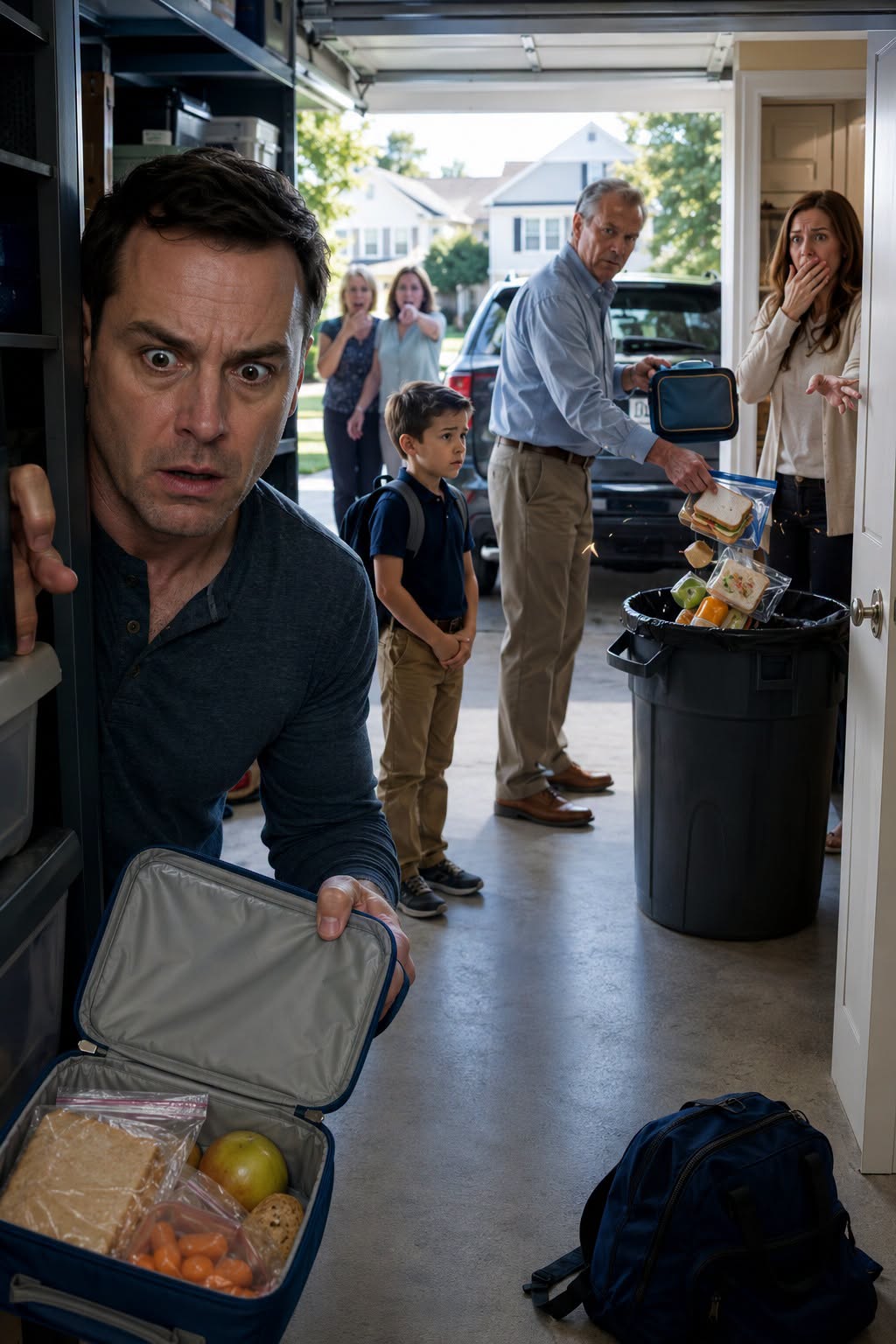
For three weeks, he had been carrying adult poison in a Spider-Man lunchbox. Three weeks of sitting through lunch hungry because he was scared of eating the food I packed. Three weeks of reading letters before bed because his grandfather told him obedience was loyalty. Three weeks of thinking his mother knew.
I held him at the kitchen table while the refrigerator hummed and the October light faded blue against the windows.
When he could breathe normally again, I made grilled cheese and tomato soup. Nothing fancy. Just butter in a pan, cheddar melting at the edges, steam rising from the bowl. He ate like a child who had forgotten hunger was allowed.
“Is Mom in trouble?” he asked.
“No.”
“Does she know?”
“I don’t think so.”
He stared at the soup. “Grandpa said she was scared to tell me.”
“Grandpa lied.”
The relief on his face almost broke me.
After dinner, I sat with him on the living room floor. We built half of a Lego lunar base while I asked questions that sounded casual and wrote every answer inside my head.
Thaddeus came after school. Sometimes every day. Sometimes Evaleigh drove him, but she stayed in the car. He took the lunch I packed, threw it away, replaced it, and gave Orson a letter. He told Orson to hide the letters in the vent behind his bed.
My son had obeyed.
Not because he believed Thaddeus.
Because Thaddeus told him that if he didn’t, “a judge might send your father away angry.”
That sentence told me this was bigger than a bitter old man meddling in a family.
Judges do not appear in casual grandparent lectures unless paperwork is already moving somewhere.
At 8:30, after Orson brushed his teeth, I followed him into his room. It smelled like laundry detergent, pencil shavings, and the plastic scent of model kits. He knelt by the wall vent near his bed, unscrewed one corner with the tiny screwdriver from his science kit, and pulled out a stack of envelopes.
Twenty-one letters.
I photographed each one under the desk lamp.
I did not let Orson read them again.
Instead, I put them in a folder and tucked him into bed.
“Dad,” he whispered as I turned off the lamp.
“Yeah?”
“Are you going to leave?”
The question cut through every defense I had.
I sat on the edge of his mattress and took his hand. “No. I am not leaving you. Not because of a letter. Not because of a lie. Not because some grown man got confused about who gets to make choices in this family.”
His small fingers squeezed mine.
“What are you going to do?”
I looked at the glow-in-the-dark stars on his ceiling. Nyra and I had stuck them there when he was five. Half were crooked because Orson had insisted space was not supposed to look organized.
“I’m going to protect you,” I said.
“From Grandpa?”
“From anyone who thinks they can hurt you.”
He nodded, but his eyes were still too old.
When he finally fell asleep, I went downstairs and called Nyra again.
This time she answered on the first ring.
“Callan, what happened? I just got your message.”
I told her everything.
At first, she did not speak. I heard hotel air conditioning on her end, the distant ding of an elevator, a muffled voice in a hallway.
Then she said, “No.”
I closed my eyes.
“Nyra.”
“No. My father wouldn’t do that.”
“He did.”
“He can be controlling. He can be arrogant. But he loves Orson.”
“He loves ownership.”
“That is not fair.”
I looked at the folder on the kitchen table. Twenty-one envelopes. Twenty-one little knives.
“Fair disappeared when he told our son a judge might send me away.”
Silence.
I sent her the video.
Then I sent photos of three letters.
I waited.
When she came back on the line, her voice sounded different. Smaller, but harder.
“I’m getting the first flight home.”
“Good.”
“Don’t confront him without me.”
I looked toward the window. Across the backyard, the garage stood dark, the same place where I had watched the first visible piece of this thing unfold.
“I’m not confronting anyone yet.”
“What does that mean?”
“It means your father is not acting randomly. Random people rant. Strategic people document. He’s building toward something.”
“You think there’s a legal angle.”
“I know there is.”
After we hung up, I pulled my laptop onto the kitchen table. For other people, panic is noise. For me, panic turns into columns. Dates. Names. Motives. Pressure points.
I searched public court records first.
It took less than eighteen minutes.
Rook v. Voss.
Filed ninety-two days earlier in Cook County.
Petition for grandparent visitation and emergency welfare review.
The petition alleged that I was emotionally volatile, overly secretive, frequently absent, and “potentially harmful to the minor child’s psychological development.” It claimed Nyra was under “marital pressure” and unable to advocate independently. It cited Orson’s “recent anxiety” as evidence that he needed regular unsupervised access to his maternal grandparents.
Dismissed for lack of standing.
But not dead.
A pending motion to reconsider stated that “additional evidence concerning the father’s unfitness” would soon be submitted.
I stared at the screen until my reflection appeared in the black space around the document.
Thaddeus had not been feeding my son lunch.
He had been feeding him testimony.
He wanted Orson scared, confused, hungry, and suggestible. He wanted teachers concerned. He wanted me angry. He wanted Nyra doubting herself. And eventually, he wanted a judge to hear that Orson was afraid of his father.
A good fraud always creates its own evidence.
My father-in-law had started manufacturing his.
I opened a blank document.
At the top, I typed one word.
“Rook.”
Then beneath it, I wrote three headings.
“Motive.”
“Method.”
“Exposure.”
By 4:12 in the morning, I understood enough to know two things.
First, Thaddeus Rook had spent months planning to take control of my son.
Second, he had made one fatal assumption.
May you like



He thought because I loved Orson, I would react like an emotional father.
He forgot I was also an investigator.







