Chapter 4
### Part 4
I did not sleep that night.
At midnight, I spread everything across the dining room table. Letters in chronological order. Video stills. The court petition. Audio transcript. Orson’s lunch calendar. Miss Crane’s email confirming her observations. Dr. Bell’s intake note.
Nyra made coffee neither of us drank.
The house sounded different after betrayal. Pipes clicked louder. The refrigerator seemed to hum with accusation. Every shadow in the hallway looked like a question we should have asked sooner.
At 2:00 a.m., Nyra came downstairs in sweatpants and an old Northwestern hoodie. She stood in the dining room doorway and looked at the table.
“I keep remembering things,” she said.
I looked up.
“Dad asking whether Orson had ever said he wanted a different bedroom. Dad asking if your work made you angry. Dad telling me children sometimes reveal fear through appetite.”
“When?”
“August.”
I wrote it down.
Her mouth twisted. “I thought he was just being Dad.”
“That’s what he counts on.”
She sat across from me.
“My mother called twice.”
“Did you answer?”
“No.”
“Good.”
“She left a voicemail.”
I watched her.
Nyra played it on speaker.
Evaleigh’s voice came through shaky and breathless. “Honey, your father says Callan is turning you against us. Please don’t make decisions while emotional. We only want what is best for Orson. Your father has always understood children better than anyone. Call me.”
The voicemail ended.
Nyra stared at the phone as if it had become something dirty.
“She knows enough,” I said.
“She doesn’t know everything.”
“She knows enough to ask questions.”
That was the cruel thing about enablers. They often survived by knowing exactly how much not to know.
By morning, I had contacted a family law attorney named Sable Merritt. She had a reputation for making charming manipulators look exactly as dangerous as they were. Her office sat above a bakery in Oak Park, which meant the waiting room smelled like cinnamon rolls while parents handed over evidence of ruined lives.
Sable was small, silver-haired, and wore red glasses on a chain around her neck. She reviewed the timeline without interrupting.
When she finished, she removed her glasses.
“Your father-in-law is not simply seeking visitation,” she said. “He is attempting to manufacture parental unfitness.”
“Yes.”
“He used food deprivation by proxy, emotional coercion, false statements, and legal intimidation against a minor child.”
Nyra gripped my hand under the table.
“He threw away the food,” I said. “He didn’t stop Orson from eating entirely.”
Sable looked at me over the papers. “Mr. Voss, your son went hungry because an adult placed him in fear. Courts understand that distinction.”
I let out a breath I had been holding for three days.
“What happens now?” Nyra asked.
“We file for an emergency protection order. We notify the prior court that the petition was part of a coercive pattern. We report to child protective services. We notify the school in writing that Thaddeus and Evaleigh Rook are not authorized for pickup, contact, or information.”
“My mother too?” Nyra asked softly.
“For now, yes.”
Nyra closed her eyes.
I did not comfort her out of that decision. Comfort can become pressure when someone needs to choose clearly.
After a moment, she opened her eyes.
“Yes,” she said. “My mother too.”
Sable nodded. “There is one more option. Not necessary, but useful.”
“What option?”
“Invite them to a controlled conversation. Neutral location. No child present. Give him a chance to deny, minimize, or confess. Manipulators often cannot resist explaining themselves when they believe they’re morally superior.”
I almost smiled.
“That was already in my plan.”
Sable’s mouth curved. “I suspected it might be.”
We chose Sunday evening.
Nyra called her parents herself. Her voice did not shake. She told them we needed to discuss Orson’s welfare and that we would meet at a conference room in my office building. She did not accuse. She did not reveal evidence. She did not answer questions.
When she hung up, she went into the bathroom and threw up.
I found her sitting on the tile floor afterward, arms around her knees.
“I hate him,” she whispered.
I sat beside her.
“I hate that I still hear his voice in my head telling me I’m being dramatic.”
“That voice is why he got this far.”
She nodded.
“What if Orson hates me for this later?”
“For protecting him?”
“For cutting off his grandparents.”
I thought of my own childhood. My father had been a tired man with rough hands and a gentle voice. He did not know Latin phrases. He did not give speeches. But he had once driven through a snowstorm at midnight because I called from a sleepover and said I wanted to come home. He never asked me to justify fear.
“Kids don’t hate safe doors,” I said. “They hate locked ones.”
Sunday came cold and bright.
We took Orson to his best friend’s house before the meeting. He knew only that Mom and Dad had to handle grown-up things. He hugged me longer than usual before running toward the porch.
“Don’t let Grandpa yell at you,” he said.
“I won’t.”
“Promise?”
I looked him in the eye. “I promise.”
The conference room at my office had glass walls, a long walnut table, and a view of the river turning black under the evening sky. I chose it because it had cameras in the hallway, security at the front desk, and no sentimental memories attached.
Sable sat beside us, legal pad open.
At exactly 6:58, Thaddeus and Evaleigh arrived.
Thaddeus wore a charcoal suit. Of course he did. He looked prepared to discipline a school board.
Evaleigh wore pearls and clutched her purse like a flotation device.
“Where is Orson?” Thaddeus asked before sitting.
“Safe,” I said.
His jaw tightened.
Nyra gestured to the chairs. “Sit down.”
“Do not speak to your mother and me like defendants,” he said.
Sable looked up. “That is an interesting choice of word.”
He glanced at her. “And you are?”
“Sable Merritt. Counsel for Callan and Nyra Voss.”
Evaleigh made a small sound.
Thaddeus sat.
The room seemed to shrink around the four of us.
I placed one lunchbox on the table.
Orson’s.
Thaddeus stared at it.
“I want to talk about what you put inside my son’s lunchbox,” I said.
His face remained smooth. “I have no idea what you mean.”
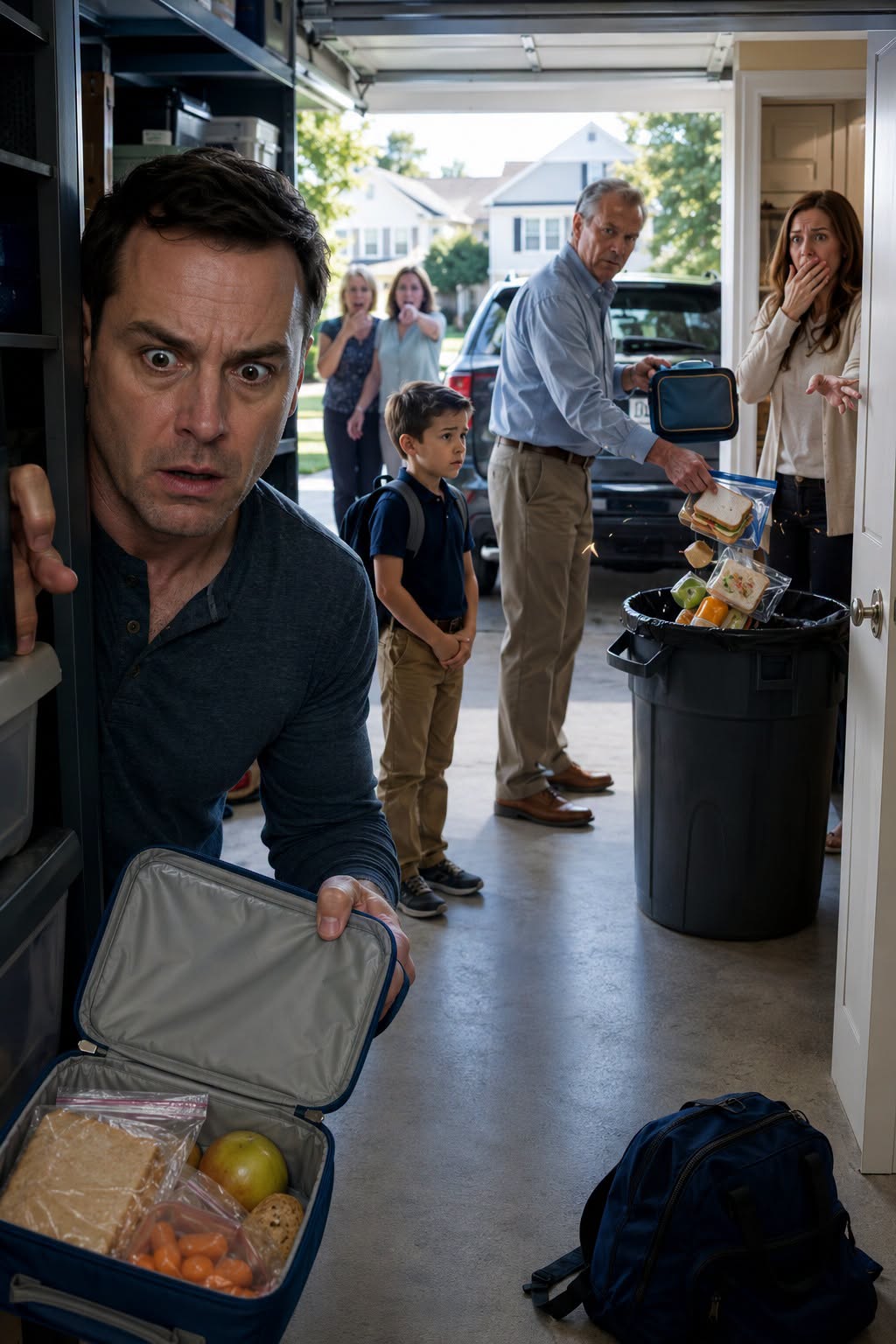
I slid a photograph across the table. A still from the garage video. His hand over the trash can. My lunch falling out.
Evaleigh leaned forward, confused.
“Thaddeus?”
He did not look at her.
“I was concerned about the nutritional quality of the food.”
Nyra laughed once. It was not a happy sound.
“You threw away his father’s notes,” she said.
“I removed inappropriate emotional influence.”
My wife went very still.
Sable wrote something down.
I slid the first letter across the table.
“Did you write this?”
Thaddeus glanced at it. “Orson needed context.”
“Context?” Nyra said.
“He needed to understand that his father is not beyond question.”
“He is eight.”
“And already being shaped by mediocrity.”
There it was. Not all of it, but enough of the rot showing through the polished wood.
Evaleigh whispered, “Thaddeus, stop.”
He ignored her.
I folded my hands.
“You filed a petition behind our backs.”
“I filed a lawful petition.”
“You coached my son to lie.”
“I prepared him to speak truth despite pressure.”
“You told him a judge might send me away.”
“I told him courts protect children from unsuitable environments.”
Nyra stood so fast her chair hit the glass wall behind her.
“Unsuitable?” she said. “You mean my home? My husband? My family?”
Thaddeus looked at her, and for the first time his control slipped into irritation.
“I mean the life you accepted because you were too proud to admit you chose poorly.”
The silence after that was absolute.
Even Evaleigh stopped breathing for a second.
Nyra’s voice dropped. “Say that again.”
Thaddeus straightened, as if invited to lecture.
“You had every advantage. Education. Name. Standards. And you attached yourself to a man who counts other people’s money for a living and calls it a career. Then you gave him access to a Rook grandchild.”
Sable’s pen stopped moving.
I felt strangely calm.
Not numb. Not detached.
Clear.
“Thank you,” I said.
Thaddeus turned toward me. “For what?”
“For saying plainly what you were too careful to write.”
His face tightened.
Sable slid a document toward him.
“These are proposed terms,” she said. “Withdraw all filings. Cease contact with Orson. No school contact, no gifts, no letters, no third-party messages. You will sign an acknowledgment of conduct. In exchange, my clients will consider limiting the initial public filings.”
Thaddeus looked at the paper and smiled.
It was a terrible smile. Full of certainty.
“You think I fear paperwork?”
“No,” I said. “I think you fear exposure.”
His eyes hardened.
“You have no idea what I can still do.”
I leaned forward.
“You’re wrong. I know exactly what you can do. I know because men like you always confuse authority with intelligence. You can threaten. You can posture. You can appeal to reputation. You can call in favors from people who remember you behind a podium. But you cannot undo your own voice.”
For the first time, a flicker crossed his face.
I tapped my phone.
His voice filled the room.
“Soon we won’t need your permission anymore, Orson. Once your father reacts, everything will fall into place.”
Evaleigh began crying.
Thaddeus stared at the phone.
Nyra stood beside me, shaking with fury.
“You used my child as bait,” she said.
Thaddeus’s face flushed dark red.
“I used strategy to protect him.”
“No,” I said. “You used fear to control him.”
He stood.
“This meeting is over.”
Sable looked at him calmly. “Then we proceed.”
He pointed at me.
“You will regret humiliating me.”
I met his eyes.
“No, Thaddeus. That’s where you’re still confused.”
May you like



He paused at the door.
“You humiliated yourself. I only kept the receipts.”







