Chapter 1
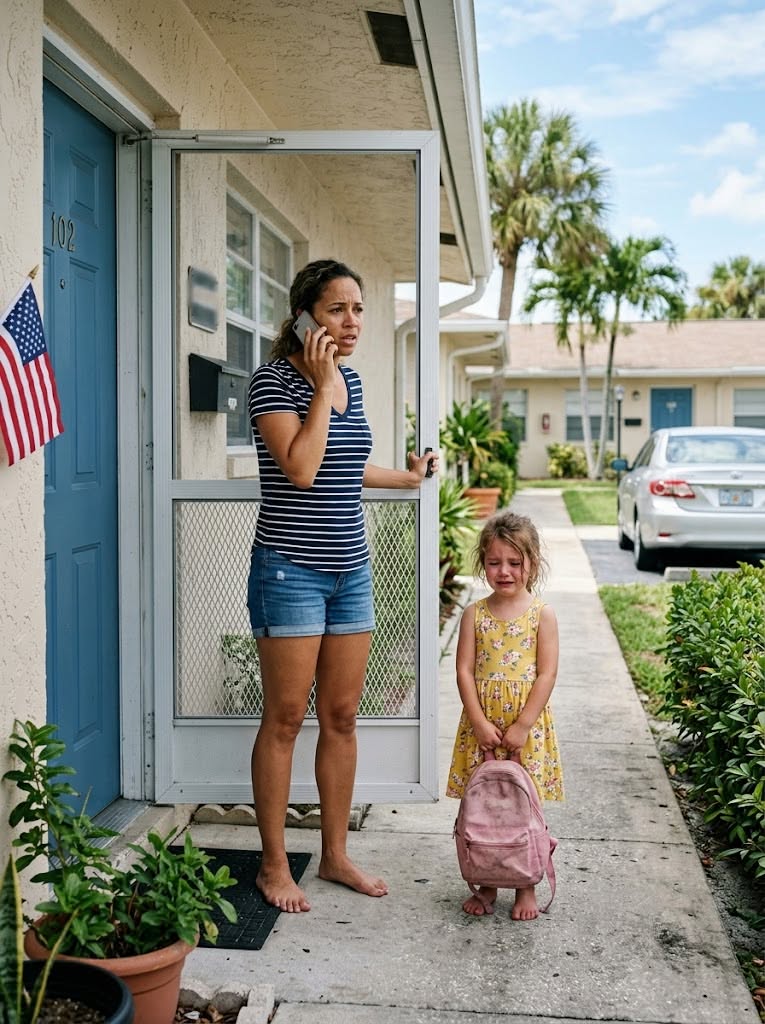
During a Miami family vacation, my parents and sister left my 7-year-old daughter crying on a stranger’s doorstep because they decided her absent biological father deserved access—but when I brought Ella home, cut off every mortgage payment, utility transfer, and cash gift they depended on, Briana’s school suspension, my parents’ forced downsizing, and Preston’s exposed lies proved they had not “helped” anyone; they had abandoned the one child I would never let them touch again.
“They left me,” Ella sobbed into a stranger’s phone, and the kitchen around me went silent.
I gripped the counter so hard my knuckles hurt. My seven-year-old daughter was supposed to be on a family vacation in Miami with my parents, my sister Briana, and her cousins.
Instead, an unknown woman was telling me Ella was crying outside an apartment door.
“Put her on,” I said.
There was shuffling, a soft voice, then my child. “Mommy?”
“I’m here,” I said fast. “I’m right here.”
“They left me,” she cried. “Grandma and Grandpa went to the beach with Paige and Lucas. Aunt Briana said I needed my real dad. I don’t want to be here.”
My stomach dropped through the floor.
The address belonged to Preston, my ex-husband. The man I had kept away from Ella for a reason. The man my parents still admired because he used to pay bills and flash money like character.
But Preston had not even opened the door.
A woman had.
A stranger.
I forced my voice steady for Ella. “Stay with the lady who called me. Do not leave with anyone else. I’m sending someone safe.”
Then I called my aunt Paula in Miami, the one person in my family who had ever felt like shelter. She answered on the first ring. I gave her the address, and she was already moving before I finished the sentence.
Only after that did I call my mother.
She picked up cheerful. “Dana. Oh good. Don’t worry. Everything’s fine.”
Fine.
“You left my daughter on someone’s doorstep.”
“Not someone,” she said smoothly. “Her father.”
“A woman answered the door. Not him.”
The silence that followed told me they knew exactly how bad it looked.
Then my mother recovered. “You’ll thank us later. This is what’s best for Ella.”
Briana cut in, sharp and smug. “You kept her from him long enough. She needs her real father. We’re helping.”
Helping.
That was the word they chose for leaving a little girl crying at a stranger’s apartment while they took the other kids to the beach.
“She was terrified,” I said. “Do you even care?”
“You’re too sensitive,” my mother snapped. “You always turn everything into drama.”
I stared at the wall, phone hot against my ear, and listened to them justify what no decent adult could explain.
Then I ended the call.
No screaming. No begging. Just a decision settling cold and clean in my chest.
Within an hour, Steven and I had booked the earliest flight. He did not ask whether I needed him. He heard the story and said, “You’re not doing this alone.”
By the time we reached Miami, Paula had already brought Ella to her small bungalow with peeling shutters and lace curtains. It was not fancy. It was not beachfront. But when my daughter ran into my arms, that little house felt safer than every expensive place my family had ever entered.
Ella clung to my shirt like I might vanish.
“I’m here,” I whispered into her hair. “I’m not leaving.”
Steven wrapped his arms around both of us, and Paula stood in the doorway with her jaw tight.
“Stay here tonight,” she said. “You need family. Real family.”
That word hit differently after what my parents had done.
The next morning, sunlight came through Paula’s kitchen curtains while Ella colored at the table with old crayons. Her hands still shook when a car door slammed outside.
Paula poured tea and said, “I wish I could say I’m surprised.”
I looked at her.
“Your parents always thought they knew best,” she said. “This time they just got more dangerous.”
She was right.
My parents had been deciding my life for years. They pushed me into things I never wanted, ignored what I said, and wrapped control in one phrase: “You’ll thank us later.”
They loved Briana harder, praised her louder, excused her faster. If she hummed, she was talented. If I excelled, I was expected to be grateful.
Then Preston came along with expensive gifts and mortgage checks, and my family acted like I had won the lottery.
They did not care that behind closed doors he was cold. That he cheated. That he thought money made every betrayal acceptable.
When I left him, I walked away with almost nothing because I did not want to drag Ella into his orbit. My parents did not call that protection.
They called it selfish.
Because leaving Preston meant their golden goose was gone.
Still, I kept sending money. Mortgage help for my parents. Utility payments when they were short. Little extras for Briana’s kids, Paige and Lucas.
I told myself I was keeping peace.
Really, I was paying rent on being tolerated.
After Miami, I opened my laptop at Paula’s kitchen table and logged into every account.
No speech. No warning.
Mortgage transfer: canceled.
Utility help: canceled.
Briana’s little emergency money: canceled.
Each click felt like taking oxygen back.
Steven watched from the doorway and nodded once.
That night, Ella slept between us, waking every few minutes to ask, “You’re still here, right?”
Every time, I answered, “Yes.”
And every time, my decision got sharper.
My parents would never be alone with her again. Briana would never get another chance to call abandonment “help.” I did not need a shouting match to make that real.
I just closed the door.
Three days after we got home, I was folding laundry when Briana’s name lit up my phone.
I almost ignored it.
Then I answered.
Her voice came through ragged, furious, and scared.
“What did you do?”
I sat down slowly.
“What are you talking about?”
“I’ve been suspended, Dana,” she snapped. “My principal says parents are talking. They said I’m a risk around kids. You called my school, didn’t you?”
The laundry basket sat at my feet, half full of tiny shirts, and suddenly the room felt too still to breathe.
For one second, I could not speak.
Because I had not called anyone.
And somehow, the truth had already found them.










