Chapter 7
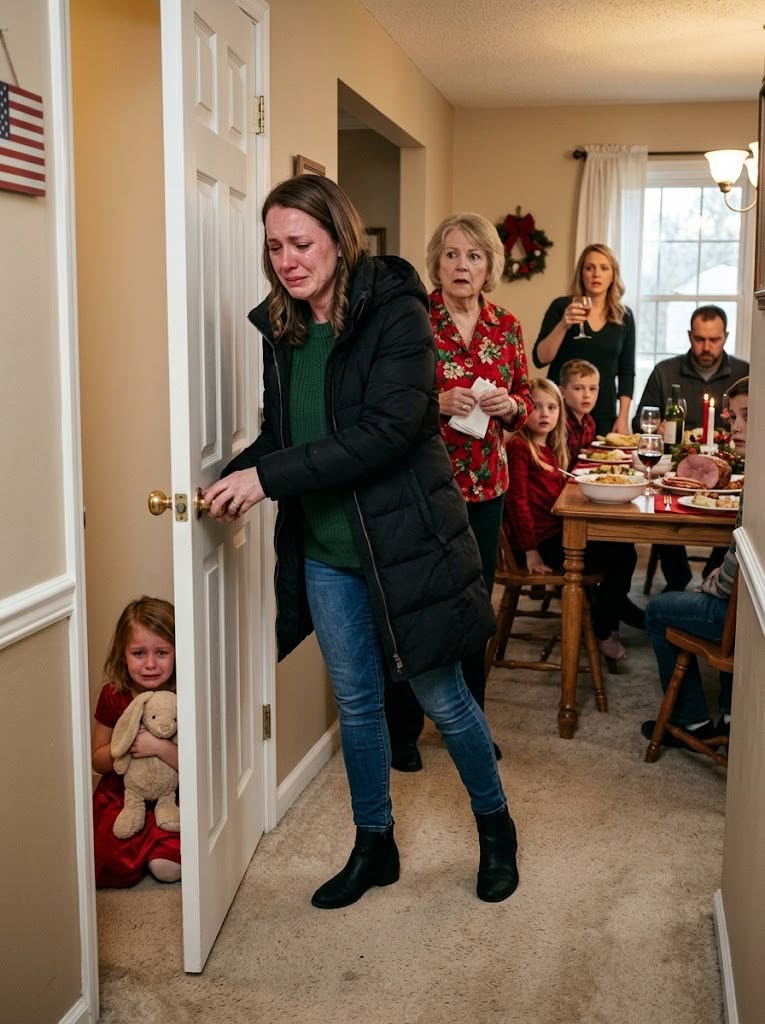
Then she looked out the window at the gray afternoon and held her rabbit tighter.
That night, Mom called seventeen times.
Caroline called six.
Aunt Joanne sent a message that said I was tearing the family apart.
I read it standing in the laundry room while the dryer thumped behind me.
Then I typed back one sentence.
The family was already broken when a six-year-old went hungry behind a locked door.
I sent it.
Three dots appeared.
Then disappeared.
Then appeared again.
No reply came.
The mortgage did not magically fix itself.
The utility notices did not vanish.
The grocery stipend did not restart.
My mother learned something I had learned at six years old in her house.
When someone controls the door, they control the room.
Only this time, the door was financial.
And my hand was on the key.
A week later, Caroline came to my porch alone.
I watched her through the front window before I opened the door.
She looked smaller without my mother beside her.
Her hair was pulled back badly, and she kept twisting her wedding ring.
“I didn’t know Mom was going to the school,” she said.
I believed her.
That did not excuse her.
“You knew Lucy was in that room,” I said.
Caroline swallowed.
“She was being difficult.”
“She was hungry.”
“She talked back.”
“She was six.”
The same words again.
This time, Caroline did not have a comeback.
She looked past me into the house.
Lucy’s crayons were scattered on the coffee table.
Her boots were by the door.
Her rabbit sat on the couch with a tiny blanket tucked over it.
Caroline’s mouth trembled.
“Mom said if we gave in, she’d never learn respect.”
I stepped back from the doorway.
“Respect is not fear with better manners.”
Caroline looked down.
For a moment, I thought she might cry.
Then she said, very quietly, “The mortgage is really late.”
There it was.
Not Lucy.
Not Christmas.
Not shame.
The mortgage.
I closed the door.
After that, the calls slowed.
Not because they were sorry.
Because consequences make cruel people busy.
Mom had to call her bank.
Caroline had to explain why she could not cover what I had been covering.
Aunt Joanne had to decide whether she was worried enough to open her own wallet.
No one was.
That was the part that almost made me laugh.
They had all been concerned when my money stopped.
They had all been outraged when my mother cried.
But when actual help required their own checkbooks, the family suddenly believed in boundaries.
Lucy got better slowly.
Not dramatically.
Children do not heal in movie scenes.
They heal in little tests.
She asked for seconds at dinner and watched my face before taking them.
She asked if she was allowed to bring a snack to her room.
She asked if being bad meant people could lock doors.
Every time, I answered as plainly as I could.
You can always eat.
You can always come get me.
Adults do not get to scare you and call it teaching.
Spring came late that year.
The snow melted off the driveway in dirty strips.
The mailbox flag stuck twice before Evan fixed it.
Lucy started leaving her rabbit on the couch instead of carrying it from room to room.
One Friday, she came home from school with a drawing.
It showed our house.
Four people.
One stuffed rabbit.
A big yellow sun.
There was no grandmother in it.
No aunt.
No locked room.
At the bottom, in careful kindergarten letters, she had written HOME.
I stood in the kitchen holding that paper while the refrigerator hummed and the dryer buzzed from the hallway.
Evan came in and saw my face.
He did not ask what was wrong.
He just looked at the drawing and put one hand on my back.
For years, I thought keeping peace meant staying quiet.
I thought love meant paying bills, smoothing over insults, swallowing the smaller piece, and teaching my children to be polite in rooms where no one protected them.
But that Christmas taught me the truth.
Peace is not the absence of yelling.
Sometimes peace begins the moment you stop funding the people who hurt you.
Sometimes it begins with a locked door opening.
Sometimes it begins with a hungry child being carried out into the cold by the one person who finally refuses to leave her there.
My mother told Lucy she needed to learn her place.
She did.
Her place was at our table.
Full plate.
Unlocked door.
May you like



Loved without conditions.
And the same family that taught her to wonder whether she deserved dinner had to watch me prove, piece by piece, that my daughter would never again have to earn the right to be fed.







