“They tore up the old man's invitation.”
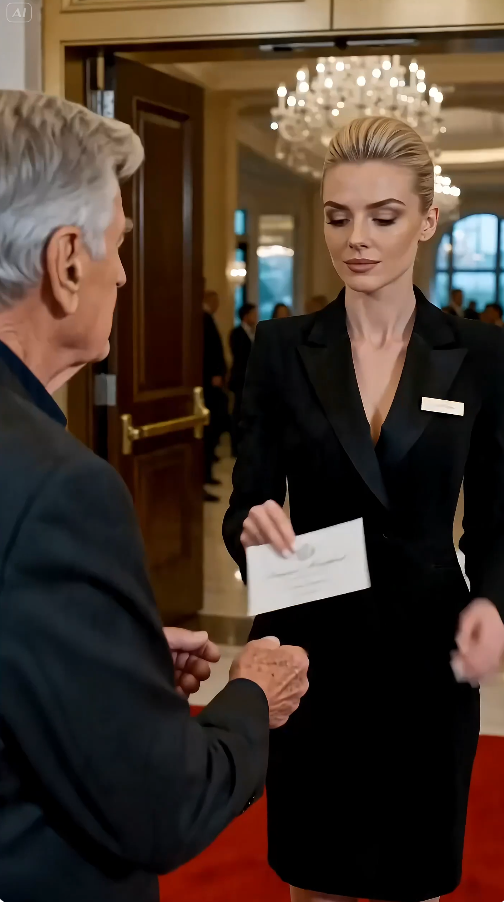
The banquet hall fell silent when the giant screen revealed the old man’s face.
A tribute photo filled the wall behind the stage.
Founder.
Arthur Whitmore.
The same old man standing near the entrance with a torn invitation in his trembling hands.
The Event Organizer froze beside the red carpet.
Only moments earlier, she had snatched the invitation from him, ripped it in half in front of the guests, and let the pieces fall at his worn shoes.
“Nice fake invitation.”
The old man had bent down slowly, his knees stiff, his fingers careful as he gathered the ruined paper from the carpet.
He had looked at the gold company logo printed across the invitation with a pain no one understood.
“That invitation was signed before you were hired.”
The Event Organizer had rolled her eyes and pointed toward the exit.
No one helped him at first.
The guests watched behind crystal glasses and silver plates.
Then a Young Staff member stepped forward, knelt beside him, and picked up the torn pieces with both hands.
Her face was pale, but her hands were steady.
“Sir, please don’t stand outside.”
The old man looked at her as if kindness had become rarer than wealth.
Then the Chairman stepped onto the stage to begin the anniversary ceremony.
He saw the old man near the entrance.
His face went white.
The microphone slipped slightly in his hand.
Behind him, the screen showed the company’s original founder from forty years ago.
The same eyes.
The same quiet posture.
The same man.
“Sir... when did you arrive?”
The Event Organizer stopped breathing.
The torn invitation in the Young Staff member’s hand suddenly became the most important object in the room.
Arthur Whitmore had not entered the banquet hall to make anyone kneel.
He had entered because the invitation arrived at his small apartment three weeks earlier in a cream envelope sealed with the company crest.
Whitmore & Crown Global.
Fortieth Anniversary Gala.
Lifetime Founder Tribute.
Arthur held the envelope for a long time before opening it.
His name was printed in gold.
Not Mr. Whitmore.
Not Founder Emeritus.
Just Arthur Whitmore.
That was how he knew the invitation had not been generated by the new office system.
It had been prepared from an old archive list.
A list that still remembered him as a person.
His signature had once appeared on every hiring letter, every scholarship award, every charity grant, and every apology the company owed when growth moved faster than conscience.
Now his signature meant nothing to the people guarding the door.
Arthur was seventy-six years old.
His suit was clean but old.
His shoes had been polished by his own hands that morning.
His hair was white, his shoulders thinner than the photographs displayed in the company lobby, and his walking cane had a crack near the handle.
He did not arrive in a limousine.
He arrived in a taxi that dropped him beneath the glowing entrance canopy.
The hotel was full of glass, gold, and people who smiled only at badges.
Arthur stood outside for a moment and looked up at the company banner.
Forty Years of Excellence.
He remembered the first office.
A rented room above a pharmacy.
Three desks.
One broken heater.
A coffee machine that leaked when it rained.
He remembered hiring the first receptionist because she had corrected a typo on his business card before asking for a job.
He remembered sleeping under his desk because payroll came before rent.
He remembered telling every manager that the company would never become too rich to greet people kindly.
That memory was why the coldness at the door hurt more than he expected.
The Event Organizer stood near the entrance with a tablet in her hand and a headset at her ear.
Her name badge read Marissa Vale.
Her dress was black.
Her smile was polished.
Her eyes moved over Arthur’s coat, cane, and taxi receipt before they moved to his face.
He held out the invitation.
She took it between two fingers, as if the paper might stain her.
The guests passing behind her barely looked at him.
Some assumed he was lost.
Some assumed he was staff.
Some assumed he had wandered in from the street because wealth teaches many people to mistake age for inconvenience.
Marissa glanced at the invitation.
The embossed seal was real.
The old signature across the bottom was real.
Arthur watched recognition almost reach her face.
Then pride stopped it.
She turned the invitation over and saw that his name was not in her tablet system.
That was enough for her.
She lifted the paper where nearby guests could see it.
“Nice fake invitation.”
Then she tore it in half.
The sound was soft.
The humiliation was not.
The pieces drifted down onto the red carpet.
Arthur did not move at first.
Forty years of his life lay between polished shoes and champagne reflections.
The logo he had designed with his late wife was split through the center.
The gold seal had been ripped across the crown.
A younger version of himself might have corrected her immediately.
A more powerful version might have made a call.
But Arthur had come to observe, not to command.
So he bent down.
Slowly.
Painfully.
His cane slid slightly on the carpet.
The room watched.
No one spoke.
He picked up the first piece.
Then the second.
His fingers paused over the signature at the bottom.
It was not his signature.
It belonged to Eleanor Park.
The company’s first employee.
The woman who had signed the founder invitations before she died the previous winter.
Eleanor had known Arthur would not come if the invitation looked too official.
So she had signed it herself.
She had written a small note on the back in her old careful handwriting.
Please come home once before they forget why we built it.
Arthur had read that note every night for three weeks.
Now it was torn through the middle.
He looked up at Marissa.
“That invitation was signed before you were hired.”
Marissa did not answer with words.
She only tilted her chin toward the exit.
That gesture said more than any insult could have.
Leave.
You do not belong.
Arthur gathered the pieces against his chest.
He turned toward the entrance.
The banquet hall was warm behind him.
Outside, the lobby lights looked colder.
That was when Lily Carter stepped forward.
She was a junior event assistant.
Twenty-three years old.
Temporary badge.
Cheap black flats.
Hair pinned in a hurry.
She had been told all week not to interfere with VIP flow.
She had been told important guests hated delays.
She had been told her job was to refill name cards, straighten sponsor gifts, and remain invisible.
But she had seen the old man’s hands shake.
She had seen the torn crest.
She had seen the note on the back of the invitation when he picked it up.
Something in her refused to let him be pushed into the lobby like trash after a party.
Lily knelt beside him and gently lifted one torn corner that had slipped beneath the velvet rope.
She placed it carefully on top of the other pieces.
“Sir, please don’t stand outside.”
Arthur looked at her.
For the first time that night, his eyes softened.
Lily did not know who he was.
That was what made the kindness clean.
She guided him not to the front table, not to the VIP row, not to the spotlight.
She led him to a quiet chair near the side wall where he could rest.
She brought him water without making a performance of it.
She placed the torn invitation on a folded napkin so the pieces would not scatter.
Marissa glared from the entrance.
Lily felt the warning in that look.
Her contract could end before dessert.
Her rent was due the next week.
Her younger brother still needed help with community college fees.
But she stayed beside the old man until his breathing steadied.
Across the room, the banquet continued to glitter.
Executives laughed silently behind their hands.
Board members adjusted cufflinks.
Award recipients checked their reflections in dessert spoons.
On every table stood a small booklet describing the company’s history.
The first page mentioned Arthur Whitmore.
The second page showed a photograph of him in his forties, smiling beside the first warehouse.
Most guests had not read it.
They only knew the company as a name on buildings, contracts, and quarterly reports.
They did not know the man who once refused a government deal because it would have displaced fifty families.
They did not know he sold his vacation home to keep factory workers paid during a recession.
They did not know he left the company after a board fight over whether people were assets or expenses.
The official story said he retired.
The truth was quieter.
Arthur walked away when the company stopped listening to the principles written into its first employee handbook.
Respect the client.
Respect the worker.
Respect the guest.
Respect the stranger.
Profit without dignity is only a larger kind of poverty.
For fifteen years, he stayed away.
He watched from newspapers as the company expanded.
He watched as new executives spoke about legacy in rooms built by people whose names were no longer remembered.
He watched as his wife passed away without one director coming to the funeral.
Eleanor Park had come.
She was old then.
She had placed a company pin in his palm and told him that some roots remain even when branches forget.
After Eleanor died, the invitation arrived.
Arthur almost threw it away.
Then he saw her handwriting.
So he came.
Not to reclaim power.
Not to embarrass anyone.
To see whether the company still had a soul.
By the time dessert was being served, he had his answer.
Then the lights dimmed.
The Chairman stepped onto the stage.
Thomas Gray had joined the company twenty years after Arthur left daily operations.
He had heard stories from older employees.
He had seen Arthur only twice in person.
Once at a charity hospital opening.
Once at Eleanor’s funeral, where Arthur stood in the back and left before the speeches ended.
Thomas had spent months preparing the anniversary tribute.
He wanted to honor the founder properly.
He wanted the board to remember the man before the brand.
He did not know the founder was sitting near the side wall with a torn invitation on a napkin.
The screen behind him brightened.
The tribute photo appeared.
Arthur Whitmore at forty-two.
Sleeves rolled up.
Hands on a blueprint.
Eyes full of stubborn hope.
The room turned toward the stage.
Then Thomas saw the old man.
Not the photograph.
The man.
Arthur sat beneath the side lights, smaller than the image behind the Chairman but unmistakable.
Thomas stopped mid-step.
His face went pale.
The room followed his gaze.
The illusion shattered.
Guests looked from the screen to the side wall.
From the side wall to the torn invitation.
From the torn invitation to Marissa.
The silence became heavy enough to bend heads.
Thomas descended from the stage.
He walked faster with each step.
When he reached Arthur, he bowed.
Not theatrically.
Not for cameras.
With real shame.
“Sir... when did you arrive?”
Arthur did not answer immediately.
His eyes moved across the room.
He saw the executives who had watched his humiliation without standing.
He saw the guests who suddenly understood that silence can be a form of participation.
He saw Marissa, whose confidence had collapsed into fear.
Then he looked at Lily.
She stood beside him with the torn invitation in both hands.
She looked terrified now, not because she had done wrong, but because doing right often feels dangerous when power has been trained to punish it.
Arthur slowly stood.
Thomas reached to help him, but stopped before touching his arm.
Arthur lifted the torn invitation from Lily’s hands.
The ripped halves trembled slightly.
He walked to the center of the room with his cane tapping softly against the floor.
No guest spoke.
No camera flash broke the moment.
Even the servers near the wall stood still with trays lowered.
Arthur placed the torn invitation on the nearest table.
The gold crest faced upward.
The tear ran straight through the company name.
It looked like an accusation.
He turned toward Marissa first.
Then toward the room.
“Respect the guests, or leave the company.”
The sentence landed harder than anger.
Marissa lowered her head.
Thomas closed his eyes.
The board members looked at one another with the discomfort of people realizing that the founder had not come to accept praise.
He had come to test the house he built.
And the house had failed at the door.
Thomas ended the prepared speech before it began.
The tribute video did not play.
The awards paused.
The band remained silent.
Instead, the Chairman escorted Arthur to the front table himself.
Arthur did not take the center seat.
He gave it to Lily.
The guests watched as the temporary staff member sat where sponsors and directors had expected to pose for photographs.
Arthur sat beside her.
Only then did dinner continue.
But nothing tasted the same after truth entered the room.
Over the next hour, old employees approached Arthur silently.
Some placed hands over their hearts.
Some bowed their heads.
Some cried without words.
Arthur recognized a few faces.
A former warehouse manager.
A retired receptionist.
A driver who had once slept in his truck during winter deliveries until Arthur created overnight lodging for staff.
Each face reminded him that a company is not built by announcements.
It is built by people who arrive early, stay late, and hope the people above them still remember they are human.
Marissa remained near the entrance, still as a statue.
No one humiliated her publicly.
Arthur would not allow cruelty to dress itself as justice.
But Thomas quietly removed her headset.
The gesture ended her authority before the night ended.
By morning, an internal review began.
The event team’s training records were examined.
Guest treatment policies were rewritten.
Executive hospitality standards were rebuilt from the first handbook Arthur had written forty years earlier.
The old handbook had been kept in the archive room, boxed between obsolete tax files and broken nameplate stands.
Lily found it two days after the gala.
On the first page, in Arthur’s handwriting, was a line that would later be printed in every lobby of every company building.
The person at the door decides what kind of company we are.
Thomas offered Lily a permanent role in corporate guest relations.
She almost refused because she thought it was pity.
Arthur sent her a handwritten note on plain paper.
It said nothing about charity.
It described courage as the act of protecting someone before knowing whether they are important.
Lily accepted the job.
Six months later, she created a new hospitality program for all company events.
Every temporary worker received authority to stop mistreatment at the door.
Every guest was greeted by name when possible and with dignity when not.
No invitation could be dismissed by a tablet alone.
No person could be removed because they looked poor, old, tired, or out of place.
The program was named after Eleanor Park.
Arthur attended the launch quietly.
This time, no one blocked him.
The lobby guard held the door open with both hands.
Arthur looked at the young man and nodded.
He carried a restored copy of the torn invitation in a small frame.
Lily had repaired it using archival paper, leaving the tear visible through the center.
She had asked whether he wanted the damage hidden.
Arthur had shaken his head.
Some tears should remain visible.
They remind people where respect failed.
The framed invitation now hangs in the company’s main hall, beside the founder’s photograph.
Visitors often stop to read the small plaque beneath it.
The plaque does not mention Marissa.
It does not mention the gala scandal.
It does not mention shame.
It says only that the invitation was torn on the night the company remembered its first rule.
Respect arrives before recognition.
Years later, people still told the story of the old man whose invitation was ripped at the door.
Some told it as a corporate legend.
Some told it as a warning.
Lily told it differently.
She told new staff that the old man did not become worthy when the screen revealed his face.
He had been worthy when he stepped inside.
He had been worthy when his invitation fell in pieces.
He had been worthy when everyone thought he was nobody.
That was the lesson Arthur wanted the company to keep.
Not that founders deserve respect.
Not that powerful guests should be treated carefully because they may punish you.
The lesson was simpler.
The person you dismiss at the door may be the reason the building exists.
May you like



But even if they are not, they are still a person at your door.
And that should have been enough.







