“They threw the poor old man out of the luxury hotel… then his master key opened the owner’s office.”
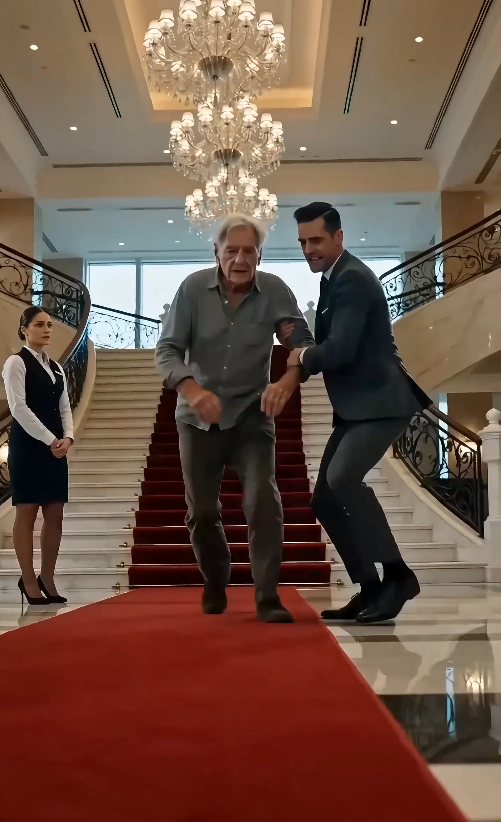
The old man’s shoes scraped across the marble as the hotel manager dragged him away from the red carpet.
The lobby of the Sterling Grand Hotel glittered with chandeliers, gold columns, fresh orchids, and guests wearing watches that cost more than most people’s cars.
Outside, rain streaked the glass doors.
Inside, every eye turned toward the frail man in the worn brown coat.
His name was Arthur Sterling.
But no one in the lobby knew that.
To them, he looked like a beggar who had wandered into a five-star hotel by mistake.
The manager, Derek Shaw, gripped Arthur’s sleeve hard enough to wrinkle the old fabric.
He smiled at the VIP guests while humiliating the man as if cruelty were part of luxury service.
“This lobby is for paying guests, not beggars.”
Arthur did not fight him.
He only looked around at the floor he had once helped polish, the ceiling he had once paid to restore, and the staff uniforms he had personally designed decades earlier.
“I only came to check how my hotel treats people.”
A few guests laughed.
Derek laughed louder.
Near the private elevator, a VIP guest named Brett Langley stepped forward in a navy suit and crocodile shoes.
He had arrived that morning with six suitcases, a loud voice, and the confidence of a man who believed money made him untouchable.
He reached into his pocket, took out a handful of coins, and tossed them onto the marble in front of Arthur.
The coins scattered under the chandelier light.
“Take the coins and leave.”
Arthur looked down at the coins.
Then he looked at Brett’s smug face.
“Keep them. You may need them sooner.”
The laughter stopped for half a second.
Then Derek tightened his grip and pulled Arthur toward the entrance.
At the reception desk, a young employee named Emma Collins stepped out from behind the counter.
She had seen Arthur enter quietly.
She had also seen him pause near the old founder’s portrait with tears in his eyes.
Something about him felt wrong.
Not suspicious.
Important.
She picked up an umbrella and moved toward him, but Derek snapped his head in her direction.
Emma froze.
Her job was new.
Her rent was due.
Her mother’s medical bills were stacked on her kitchen table.
Still, she took one step forward.
Before she could speak, Arthur slipped one hand into his coat and pulled out a black master key card edged in gold.
He walked past Derek, past the coins, past the stunned guests, and pressed the card to the private elevator panel marked OWNER ACCESS ONLY.
The light turned green.
The elevator doors opened.
Emma gasped.
“That key only belongs to the owner.”
Arthur Sterling had built the Sterling Grand Hotel before luxury became a performance.
Fifty years earlier, he had been a bellhop at a rundown city hotel in Chicago.
He carried bags for businessmen who never looked at his face.
He scrubbed stains from carpets after weddings.
He slept in a rented room above a laundromat and sent half his pay to his younger sister.
He learned hospitality from the bottom.
Not from business school.
Not from inheritance.
From aching feet, rude guests, and the quiet dignity of workers who kept smiling because their families needed groceries.
When Arthur opened his first hotel, he wrote one rule on the staff room wall.
No guest is poor until we make them feel poor.
His wife, Margaret, wrote the second rule beneath it.
No worker is invisible.
Together, they built the Sterling Grand from one struggling building into a national hotel brand.
The Chicago flagship became their crown jewel.
Every hallway carried part of their story.
Margaret chose the orchids.
Arthur chose the marble.
They both chose the portrait in the lobby, not because they wanted admiration, but because Margaret said every staff member should know the hotel had once belonged to people who worked with their hands.
For decades, Arthur walked the lobby every morning.
He learned the names of housekeepers.
He ate in the staff cafeteria once a week.
He kept a small office on the top floor with a plain wooden desk he refused to replace.
Then Margaret died.
After her funeral, the hotel felt too beautiful to enter.
Arthur stepped away from daily operations and placed the chain under a board of executives.
They promised to preserve the Sterling standard.
They promised kindness would remain policy.
They promised Margaret’s rules would not become decoration.
But promises made in boardrooms often decay quietly.
Arthur began receiving letters.
Some were anonymous.
Some came from former staff.
One said elderly guests were being refused assistance if they looked underdressed.
One said the new manager mocked workers with accents.
One said a woman with a declined card had been forced to cry in the lobby while her sick child waited in the rain.
Arthur did not want to believe it.
Then he received a letter written in careful handwriting from Emma Collins, a receptionist in training.
She did not know she was writing to the owner.
The staff suggestion box had been designed decades ago to reach corporate.
Emma wrote that the lobby had become a stage for wealthy guests and a battlefield for everyone else.
She wrote that Mr. Shaw rewarded employees for flattering VIPs and punished them for helping anyone who looked poor.
She wrote that a homeless veteran had been turned away during a storm despite empty rooms reserved for community emergency use.
She wrote that the founder would be ashamed.
Arthur read the letter in Margaret’s old chair.
He read it three times.
Then he opened the drawer where he kept his original black master key.
It was not a regular access card.
It was coded to the owner’s office, the private elevator, old executive safes, and emergency override systems.
Only Arthur and the legal trustee held active copies.
The next morning, Arthur put on the worn coat Margaret had loved because she said it made him look like the bellhop he used to be.
He left his driver at home.
He took the bus.
He walked three blocks in the rain.
And he entered the Sterling Grand Hotel not as the owner, but as the kind of man Derek Shaw would either protect or destroy.
The test lasted less than two minutes.
Arthur asked the front desk whether the hotel still honored the emergency shelter agreement on storm nights.
Emma looked up immediately.
She recognized the phrase from old training manuals that no one else seemed to read.
Before she could answer, Derek appeared.
He looked Arthur over once and decided the hotel had nothing to gain from him.
That was all it took.
A lifetime of values collapsed under one manager’s glance.
Derek told Arthur to leave.
Arthur asked calmly to speak with someone who knew the hotel’s policies.
Derek reached for his sleeve.
Guests turned.
Phones came out.
Brett Langley laughed from near the elevator.
Emma’s face tightened behind the desk.
She knew what Derek was doing was wrong.
She also knew Derek had fired two employees in the past month for embarrassing the hotel in front of high-value guests.
One had offered food to a woman waiting for a delayed charity transport.
Another had helped a janitor use the guest restroom after a cleaning spill soaked his uniform.
Derek called both incidents brand damage.
Emma called them human decency.
When Derek dragged Arthur across the marble, Emma felt something break inside her.
She stepped out from behind the desk with an umbrella.
Derek saw her and gave her the look that meant one more move could cost her job.
Arthur saw it too.
That was when he decided the test was over.
He did not raise his voice.
He did not announce his name.
He only walked to the private elevator.
The black master key did what titles, money, and pride could not do.
It told the truth without asking permission.
The green light flashed.
The doors opened.
“That key only belongs to the owner.”
Emma’s words spread through the lobby like thunder.
Derek’s hand fell from Arthur’s sleeve.
Brett Langley stopped smiling.
The guests stared from Arthur’s old coat to the private elevator.
Arthur stepped inside, then turned back.
His eyes rested first on Emma.
Then on Derek.
Then on the coins still scattered on the floor.
The elevator rose.
No one moved until the doors closed.
On the top floor, Arthur entered his old office for the first time in eighteen months.
Dust had gathered on Margaret’s framed photograph.
Someone had replaced the plain wooden visitor chairs with white leather ones.
Someone had removed the staff thank-you notes from the bulletin board.
Someone had placed a champagne cooler beside the window.
Arthur stood very still.
The office had not been redecorated.
It had been erased.
He walked to the desk and opened the lower drawer.
Inside was the original employee charter, signed by him and Margaret on the day the hotel opened.
He pressed the intercom button.
The entire lobby sound system crackled alive.
Every guest, worker, and executive in the building heard the old man’s voice.
He did not introduce himself with anger.
He introduced himself with history.
He gave his full name.
Arthur James Sterling.
Founder and majority owner of the Sterling Grand Hotel Group.
The lobby erupted.
Derek grabbed the reception counter for balance.
Brett looked toward the coins as if they had become snakes.
Emma covered her mouth.
Arthur ordered the board representatives, security director, human resources chief, and all available staff supervisors to the grand ballroom within fifteen minutes.
Then he ended the announcement.
Derek tried to recover quickly.
He told the guests there had been a misunderstanding.
He told Emma to return to the desk.
He told security not to escalate.
But the power had shifted.
People who had feared him ten minutes earlier now looked at him as if a curtain had been pulled back.
Emma did not move.
She picked up the coins from the floor, placed them in a small dish, and set the dish on the counter.
Brett glared at her.
She did not apologize.
Fifteen minutes later, the grand ballroom filled with staff.
Housekeepers stood beside chefs.
Valets stood beside executives.
Front desk workers stood in the back because they were used to being invisible in important rooms.
Arthur entered through the side door wearing the same wet coat.
He did not change.
He wanted every person there to remember what Derek had seen and what Derek had missed.
On the stage behind him, a screen displayed the original Sterling staff rules.
No guest is poor until we make them feel poor.
No worker is invisible.
Some older employees began crying before Arthur spoke.
He asked Emma to come forward.
She hesitated.
Derek’s face hardened.
Emma walked to the stage anyway.
Arthur held up her letter.
He did not read her name aloud at first.
He read the parts that mattered.
A veteran turned away.
A mother humiliated.
Employees punished for kindness.
VIPs rewarded for cruelty.
A manager treating compassion as a threat to luxury.
The ballroom became so quiet that people could hear rain against the tall windows.
Then Arthur asked Derek to stand.
Derek tried to explain.
He spoke of brand standards.
Security expectations.
Guest comfort.
Revenue tiers.
Arthur listened without expression.
Then he asked one question.
He asked whether Margaret Sterling’s emergency room policy had been canceled.
Derek did not answer.
Because it had not been canceled.
He had simply ignored it.
The Sterling Grand maintained two rooms every night for stranded families, domestic violence emergencies, injured travelers, or people referred by partner shelters.
It was a policy Margaret created after a mother and child froze to death outside a hotel in winter decades earlier.
Derek knew.
He had chosen not to use it because emergency guests rarely tipped.
Arthur dismissed him in front of the ballroom.
Not with shouting.
Not with revenge.
With documentation.
Violation of guest dignity policy.
Violation of employee retaliation rules.
Misuse of management authority.
Failure to honor emergency shelter agreements.
Immediate termination.
Derek’s face went red.
He looked toward the board representatives.
None of them defended him.
They were too busy calculating how much they had ignored.
Security escorted Derek from the ballroom through a side door.
No applause followed.
Arthur would not allow humiliation to become entertainment, even when the guilty deserved consequences.
Then Arthur turned to Emma.
He announced that until a permanent appointment was reviewed, Emma Collins would serve as acting lobby manager.
A murmur moved through the staff.
Emma looked stunned.
She was twenty-six.
She had been a receptionist for only seven months.
Arthur explained why.
She had done what management failed to do.
She had noticed.
She had cared.
She had risked her job before she knew the old man had power.
That was the only kind of leadership the Sterling Grand could still trust.
Emma cried quietly.
The housekeepers applauded first.
Then the bellmen.
Then the kitchen staff.
Then the whole ballroom.
Brett Langley tried to leave during the applause.
Arthur stopped him from the stage.
He did not insult Brett.
He only asked security to review the VIP guest conduct policy.
Brett had thrown coins at an elderly man in the lobby.
The act was captured on camera.
His reservation was canceled.
His membership status was suspended pending review.
His luggage was sent to the curb with more courtesy than he had shown Arthur.
The coins remained in the dish at reception.
Emma later placed them in a small glass case beside a copy of Margaret’s rule.
Not as a trophy.
As a warning.
By evening, the story had spread across the hotel.
Guests whispered in elevators.
Staff hugged in service corridors.
Employees who had planned to quit stayed past their shifts just to see whether the change was real.
Arthur spent the rest of the day walking the building.
He visited housekeeping first.
Not the executive suite.
Housekeeping.
He apologized to women and men who had cleaned rooms while being treated like background objects.
He asked what they needed.
They told him about understaffing, broken carts, skipped breaks, and managers who cared more about guest reviews than injured backs.
Arthur wrote everything down.
Then he visited the kitchen.
The laundry.
The valet office.
The security room.
The maintenance basement.
Everywhere he went, people stood straighter, not because they feared him, but because someone finally saw them.
Emma shadowed him the whole time.
She expected him to tell her what to do.
Instead, he asked what she would change first.
Her answer came quickly.
No one should be removed from the lobby based only on clothing.
Every person asking for help should be offered a seat before being questioned.
Emergency rooms should be listed in staff procedure sheets, not hidden in old manuals.
Security should protect dignity, not pride.
VIP status should never excuse abuse.
Arthur smiled for the first time that day.
Margaret would have liked Emma.
The board meeting that night was brutal.
Arthur asked why no executive had noticed the rising complaints.
They spoke of quarterly growth.
He spoke of rot.
They spoke of premium guest experiences.
He spoke of a hotel losing its soul while selling luxury candles in the gift shop.
Two executives resigned within a week.
Three more were replaced.
A full audit began.
Former employees were contacted.
Several received apologies, back pay, and reinstatement offers.
Some returned.
Some refused.
Arthur accepted both.
A company cannot demand forgiveness from people it should not have harmed.
Emma’s temporary role became permanent after ninety days.
She did not become a perfect manager.
No one does.
But she became a listening one.
She changed the lobby training program.
New employees were required to spend one shift with housekeeping, one with valet, one with kitchen, and one with night security before working the front desk.
She said no one should welcome guests without understanding the hands that made welcome possible.
The emergency shelter program reopened publicly.
The hotel partnered with hospitals, veterans’ groups, and crisis centers.
Two rooms became ten.
Then twenty across the hotel chain.
Guests complained at first.
Some said a five-star hotel should not mix with desperate people.
Arthur responded through a public statement written in his own hand.
He said luxury without humanity was just expensive emptiness.
The statement went viral.
Not because it was polished.
Because it sounded true.
The old man in the worn coat became famous for a week.
Reporters asked whether the lobby incident had been staged.
Arthur said cruelty did not need staging.
It only needed permission.
He also refused to let the story become only about him.
Every interview mentioned Emma.
Every article included Margaret’s rules.
Every hotel in the Sterling Group received framed copies of the employee charter.
The owner’s office was restored too.
The white leather chairs were removed.
The staff notes returned.
Margaret’s photograph was cleaned and placed on the desk.
Arthur kept his worn coat hanging beside the door.
Not for drama.
For memory.
Months later, Derek Shaw tried to sue for wrongful termination.
The case disappeared after lobby footage, staff complaints, and policy violations were submitted.
Brett Langley posted angry comments online about declining standards.
His own video of throwing coins resurfaced each time.
Eventually, he deleted his accounts.
No one needed Arthur to punish him further.
His own behavior had done enough.
One winter night, almost a year after the incident, an elderly woman entered the Sterling Grand in a soaked sweater.
She had missed a train connection and lost her wallet.
The new front desk agent did not ask whether she could pay.
He offered a towel first.
Then a chair.
Then tea.
Emma watched from across the lobby.
Arthur watched from the mezzanine above.
Neither interrupted.
The system worked when no one important had to force it.
That night, Arthur called Emma to the owner’s office.
He gave her a small envelope.
Inside was not money.
It was a copy of her original letter, framed with a handwritten note from Arthur beneath it.
The note said that one honest employee had saved the hotel from becoming beautiful and dead.
Emma hung it in the staff training room, not in her office.
She said everyone needed to know that telling the truth upward was part of the job.
Years passed.
The Sterling Grand became more profitable, not less.
Guests returned because they trusted the place.
Workers stayed because they were respected.
The hotel still had chandeliers, orchids, marble, and suites that cost more than rent in some neighborhoods.
But it also had chairs near the lobby entrance for anyone waiting out rain.
It had a discreet pantry for emergency guests.
It had a staff council with real authority.
It had a rule that every manager had to work one overnight shift each quarter under another department head.
Executives hated that rule.
Arthur loved it.
On the fiftieth anniversary of the hotel, the board planned a gala in Arthur’s honor.
He refused a statue.
He refused a portrait unveiling.
He accepted only one ceremony.
In the lobby, beneath the original founder’s portrait, Arthur unveiled a new display.
Inside the glass case were three objects.
The black master key.
The coins Brett threw.
The worn brown coat.
Beside them was a plaque.
A door is only grand if it opens with dignity.
Emma, now general manager of the flagship hotel, stood beside Arthur.
She wore the same name badge style she had worn as a receptionist.
Arthur leaned on a cane.
His voice was weaker than before.
But when he looked across the lobby, the staff became silent out of respect, not fear.
He told them that a hotel is judged twice.
Once by how it treats those who can pay.
Again by how it treats those who cannot.
Only the second judgment reveals the truth.
When Arthur died two years later, the lobby filled with employees from every level of the company.
Housekeepers stood in front.
That had been Emma’s decision.
Arthur’s family approved.
His funeral program included Margaret’s two rules.
No guest is poor until we make them feel poor.
No worker is invisible.
Emma became president of Sterling Hospitality five years after the lobby incident.
On her first day, she wore a simple black suit and carried the old master key in her pocket.
It no longer opened every door.
The technology had changed.
But she kept it as a reminder that power is useless if it only opens rooms and not eyes.
She returned to the lobby that evening and saw a young bellhop helping a man in torn shoes find shelter from the rain.
No one laughed.
No one reached for coins.
No manager dragged him away.
Emma stood beneath the chandelier and smiled through tears.
The poor old man had been thrown out of the luxury hotel, then his master key opened the owner’s office.
May you like



But the real ending was not the fired manager, the shocked VIP guest, or the black card that proved Arthur Sterling owned the building.
The real ending was that one old coat exposed a beautiful hotel’s ugly heart, and the receptionist who chose compassion before power turned every Sterling lobby into a place where dignity always checked in first.







