“They threw the old veteran out of the honor party… then his medal stopped the room.”
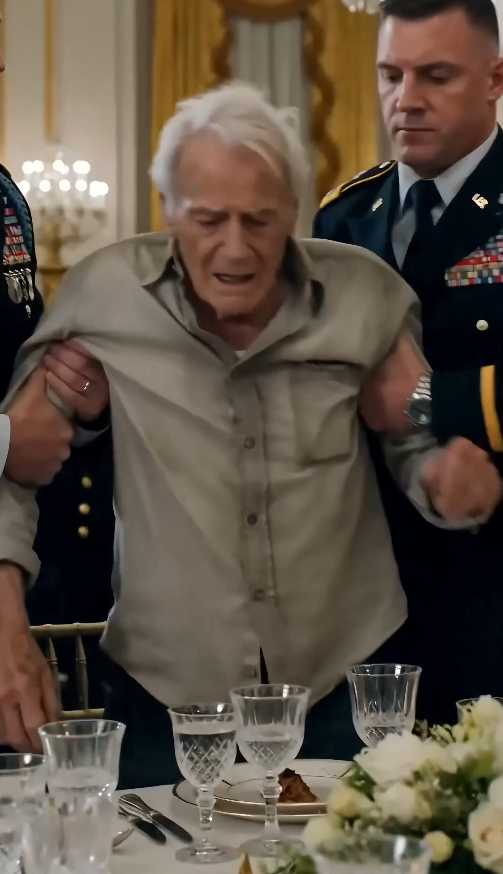
The old veteran was being dragged away from the honor table when the medal fell from his coat pocket.
It hit the polished ballroom floor with a small metallic sound.
Yet that sound stopped the entire room.
Before that, no one had looked at him twice.
He was an old man in a faded army jacket, worn shoes, and a shirt buttoned wrong at the collar.
His gray hair was uneven.
His hands shook.
His name was Arthur Miller, but the security guard did not ask for it.
The room was full of American flags, gold-trimmed banners, framed photographs of soldiers, and wealthy donors clinking glasses beneath chandeliers.
The gala was called A Night for Heroes.
Arthur had arrived alone.
He only wanted to sit down for a minute because his bad knee was burning from the long walk from the bus stop.
The guard grabbed his arm before he could lower himself into an empty chair at the front table.
“This seat is reserved for heroes.”
Arthur looked at the place card on the table.
He looked at the flag folded inside the glass display nearby.
Then he looked at the young guard with tired eyes.
“I only wanted to sit for a minute.”
A VIP guest in a navy suit turned from his champagne and studied Arthur with open contempt.
“Heroes don’t look like that.”
Arthur’s face did not change.
“Some heroes come home with nothing.”
The guard pulled him toward the exit.
Arthur stumbled.
His coat pocket caught on the chair.
A small wooden case slipped free, fell open, and released the old medal inside.
The master of ceremonies stepped down from the stage to see what had fallen.
He froze.
His hand went to his mouth.
The old medal was tarnished, but the ribbon and engraving were unmistakable.
It belonged to the soldier whose story had inspired the entire ceremony.
The MC lifted his microphone with a trembling hand.
“That man is the reason this ceremony exists.”
Arthur Miller had not worn the medal in public for forty-three years.
He kept it in a wooden case in the top drawer of a small dresser in his apartment.
The dresser leaned to one side.
The apartment smelled faintly of old coffee, dust, and the winter coat he could not afford to replace.
On the wall above his bed hung one photograph.
Seven young soldiers stood shoulder to shoulder in a desert camp, their faces bright with the kind of youth that does not yet understand what it will lose.
Arthur stood in the middle.
He was twenty-two in the picture.
Strong.
Smiling.
Unbroken.
Beside him was his best friend, Marcus Reed, who had once told Arthur that if they made it home, they would open a repair shop together and never listen to anyone shout orders again.
Marcus did not make it home.
Neither did four of the others in the photograph.
Arthur did.
That fact had followed him longer than any applause.
The medal had been awarded for one night he still could not fully describe without feeling the heat in his lungs.
His unit had been trapped after an ambush.
Communications failed.
Two men were wounded.
Arthur crossed open ground three times under fire to pull men back, then carried the radio pack up a ridge long enough to call for rescue.
By dawn, the survivors were alive because of him.
The country called it heroism.
Arthur called it the worst night of his life.
At the ceremony years ago, a general pinned the medal to his uniform while cameras flashed.
Arthur stood straight.
His mother cried.
His wife, Helen, held his hand so tightly that her ring pressed into his skin.
Everyone said he should be proud.
Arthur felt only the weight of the men missing from the stage.
After Helen died, the world became quieter.
His pension stretched poorly.
His son moved across the country and called when guilt reminded him.
Arthur’s knee failed.
His hearing faded.
He stopped attending veteran events because people wanted clean stories.
They wanted courage without nightmares.
Sacrifice without loneliness.
Medals without the names of the dead attached to them.
Then a letter arrived.
It was printed on thick paper with a gold seal.
The city’s Veterans Legacy Foundation was hosting a gala to honor the soldiers of Arthur’s old unit.
Arthur’s name appeared near the bottom as a special invitee.
The letter said transportation would be provided.
Transportation never came.
Arthur waited outside his apartment building for forty minutes in the cold.
He wore his old jacket because his suit no longer fit.
He put the medal case in his pocket because Helen had once told him that hiding honor did not bring the dead back.
When no car arrived, he took the bus.
He walked six blocks from the stop to the hotel.
By the time he reached the ballroom, his knee was swollen and his breathing was shallow.
At the entrance, the registration table was crowded.
A young volunteer could not find his name because the guest list had been sorted by donor level, not veteran status.
Arthur tried to explain.
The music was too loud.
The volunteer looked nervous.
The security guard saw the worn coat, the old shoes, and the shaking hands.
He saw a problem before he saw a person.
Arthur stepped inside anyway when someone opened the ballroom doors.
He saw the front table with an empty chair.
He saw a sign that read Reserved for Honored Heroes.
He walked toward it because he could not stand another minute.
That was when the guard caught him.
The VIP guest who mocked him was named Richard Blake.
Richard owned a chain of luxury car dealerships and had donated enough money to have his name printed on the program.
He liked being photographed near uniforms.
He liked speaking about patriotism at dinners where waiters refilled his glass.
He had never served.
That did not stop him from deciding what a hero should look like.
When Richard said heroes did not look like Arthur, several guests laughed quietly.
Not loudly.
Just enough.
The kind of laugh people use when cruelty comes from someone important.
Arthur heard it.
He had heard worse.
But this laughter hurt in a different place.
Not because they insulted him.
Because the room was full of flags.
Because the men in the photograph deserved better company.
Because the word hero had become decoration.
Then the medal fell.
The MC, David Lawson, had grown up hearing Arthur Miller’s name.
His father had been one of the soldiers Arthur saved.
David was a child when his father told the story of the man who carried a radio through fire and refused to leave anyone behind.
David had become host of the gala because his family owed its existence to that night.
He had never met Arthur in person.
He knew the old photograph.
He knew the citation.
He knew the medal.
When he saw the case on the floor, the room around him blurred.
He picked it up carefully.
The inscription confirmed what his heart already knew.
Arthur James Miller.
For extraordinary valor.
David looked toward the old man being held near the exit.
The guard’s hand was still on Arthur’s sleeve.
David felt shame rise so hot in his chest that he almost could not speak.
“That man is the reason this ceremony exists.”
The room stopped breathing.
The guard released Arthur as if burned.
Richard lowered his champagne glass.
People turned toward the giant screen behind the stage, where the next segment of the program had already begun.
A black-and-white photograph appeared.
Seven young soldiers.
Arthur in the center.
The same eyes.
The same jawline.
The same man.
Only time had taken the uniform, the strength, the polished shoes, and the faces of friends around him.
David walked to Arthur and placed the medal case back in his hands.
Then David did something no one expected.
He stood at attention.
Slowly, one uniformed officer near the stage stood too.
Then another.
Then every veteran in the room rose.
The sound of chairs moving across the floor became a wave.
Some civilians stood awkwardly.
Then fully.
Then the entire ballroom was on its feet.
Arthur looked at them with confusion first.
Then pain.
Honor can hurt when it arrives after humiliation.
David offered him his arm and guided him toward the stage.
Arthur moved slowly.
Each step seemed to pull the room deeper into silence.
Richard stood near the front table, pale now.
The empty chair he had watched Arthur being removed from was no longer just a seat.
It was an accusation.
David helped Arthur onto the stage.
The lights were too bright.
Arthur squinted.
He had not stood before a crowd in years.
His hands shook around the wooden case.
David held the microphone but did not push it toward him.
He understood that men like Arthur had already said enough by surviving.
Instead, David told the room what his father had told him.
He told them that Arthur Miller had saved six men in one night.
He told them that one of those men came home, married, had children, and became David’s father.
He told them that every person in his family existed because Arthur refused to leave the wounded behind.
Then David looked at Richard.
He did not need to name him.
Everyone knew.
The VIP guest who had decided heroes should look polished now stood beneath the flags looking smaller than the medal in Arthur’s hand.
Richard stepped forward.
His voice cracked as he apologized.
Arthur listened.
He did not smile.
He did not perform forgiveness for the comfort of the room.
He only nodded once.
That nod was not absolution.
It was discipline.
The discipline of a man who had seen too much to waste his remaining years on hatred.
David invited Arthur to sit at the honor table.
Arthur did not move at first.
He looked at the empty chairs around it.
Then he asked whether the names of the men who did not come home would be read.
David lowered his head.
They had planned a video montage.
Arthur asked again, softer this time.
The program changed immediately.
The music stopped.
The auction paused.
The donors waited.
David brought the old unit photograph onto the screen.
Arthur stood beside it and pointed, one by one, to each young face.
Marcus Reed.
Eddie Collins.
Paul Harris.
James Wheeler.
Thomas Bell.
Samuel Ortiz.
He did not tell long stories.
Only small ones.
Marcus could fix any radio and sang badly on purpose.
Eddie saved every letter from his mother.
Paul drew cartoons in the margins of maps.
James carried hot sauce in his boot.
Thomas wanted to become a school principal.
Samuel was afraid of thunderstorms but never admitted it.
The room wept because the dead had stopped being symbols.
They had become men again.
When Arthur finished, he sat at the honor table.
Not alone.
David placed the unit photograph beside him.
An empty chair was left for Marcus.
Another for Eddie.
Another for Paul.
Another for James.
Another for Thomas.
Another for Samuel.
The table that had been reserved for heroes finally looked like one.
After the ceremony, no one rushed to restart the gala.
The evening changed shape.
The speeches became shorter.
The checks became quieter.
The foundation president announced that a portion of the night’s donations would be redirected from decorative events to emergency housing, medical care, and transportation for aging veterans.
Arthur had not asked for that.
But everyone understood that honoring veterans while leaving them to take buses in worn shoes was hypocrisy dressed in flags.
Richard Blake stood again before the night ended.
This time, he did not speak about patriotism.
He pledged to fund transportation for every veteran invited to future events.
Then he removed his VIP badge and placed it on the table.
Arthur watched him.
Perhaps the apology was public because the shame had been public.
Perhaps it was sincere.
Time would prove which.
Arthur did not care to guess.
A young waitress approached him near the end of the night.
She asked if he wanted more coffee.
He said yes.
She brought it in a real ceramic cup instead of the paper cup he had been handed at the entrance.
Small dignities matter most to people who have been denied larger ones.
Before Arthur left, David asked if he could drive him home.
Arthur almost refused out of habit.
Then his knee throbbed.
He accepted.
In the car, David apologized again.
Arthur looked out the window at the city lights.
He said the room did not forget him that night.
It forgot what men like him become after the photographs fade.
David understood.
The next morning, the gala video spread online.
People focused on the dramatic moment the medal fell.
The guard letting go.
The MC’s face.
The room rising to its feet.
But the part Arthur replayed in his mind was not the standing salute.
It was the laughter before it.
He knew that laughter had happened to other old soldiers.
Other poor men.
Other people whose sacrifices were no longer dressed in proof.
So when the foundation asked Arthur to advise them, he said yes.
He asked for three changes.
No veteran would ever be placed on a guest list by donor level.
Every honored veteran would be contacted directly and provided transportation.
Every ceremony would include practical support before speeches.
The foundation agreed.
Arthur insisted that Maria Thompson, the young volunteer who had tried to help him at registration before being overruled, be added to the planning committee.
She had been the only person at the door who looked uncertain because her conscience was still working.
Arthur remembered that.
The security guard also wrote to him.
His name was Kevin Ward.
He said he had followed the visual rules he had been given.
Arthur responded with one sentence.
A rule that teaches you not to see people needs to be broken.
Kevin kept that note in his wallet.
Months passed.
Arthur’s life did not become magically easy.
He still woke up at night sweating.
His knee still hurt.
His apartment still leaned toward winter.
But people began showing up.
David visited every Sunday.
Maria helped arrange medical appointments.
The foundation repaired Arthur’s heating system before the first snow.
A local school invited him to speak, but Arthur refused the auditorium.
He asked to sit in a classroom instead.
He brought the photograph of his unit.
He did not begin with the medal.
He began with Marcus’s bad singing.
The students listened more closely than adults often did.
One boy asked whether Arthur felt like a hero.
Arthur looked at the photograph for a long time.
He said heroes are usually people who had less time to be afraid than everyone else.
The teacher cried.
The boy nodded as if that answer made sense.
The next year, the honor party was held again.
But it was different.
The ballroom still had flags.
Still had flowers.
Still had music.
But the first rows were not reserved for donors.
They were reserved for veterans, nurses, caregivers, widows, and families of the fallen.
There was a transportation desk.
A medical benefits table.
A housing assistance booth.
A quiet room for anyone overwhelmed by noise.
Arthur arrived in the same faded army jacket.
This time, the security guard opened the door for him before he reached it.
Kevin stood there in uniform.
He greeted Arthur by name.
Arthur nodded.
Inside, Richard Blake was setting chairs.
Not posing.
Working.
He had funded the transportation program for the entire year.
Whether from shame or change, the result was real.
Arthur accepted that.
David asked Arthur to sit at the honor table again.
Arthur said only if the old unit photograph came too.
It did.
The medal remained in its wooden case.
Arthur still did not like wearing it.
But that night, he placed it on the table in front of the empty chairs.
Not to prove himself.
To keep his promise.
The promise he made long ago when Marcus died in his arms and asked Arthur not to let them become only names.
For years, Arthur thought he had failed that promise because survival had become silence.
Now, every year, their names were read.
Their stories were told.
Their empty chairs were set.
When Arthur died three years later, the city held his memorial in the same ballroom.
His medal rested beside the unit photograph.
There were no VIP tables.
No donor-only section.
Veterans from shelters sat beside generals.
Nurses sat beside CEOs.
Students sat on the floor when chairs ran out.
David spoke first.
He said Arthur Miller had saved his father’s life in war and then saved their foundation’s soul in old age.
Maria spoke next.
She said Arthur taught them that dignity is not something you award to people once a year.
It is something you practice at the door.
Kevin stood near the entrance, no longer just checking badges.
He was watching faces.
He had trained every guard under him to ask before assuming, to help before removing, and to remember that a hero might arrive tired, poor, confused, angry, or alone.
Richard Blake did not speak.
He sat in the back and cried quietly.
At the end of the memorial, the room stood.
No one had to tell them.
The salute was silent.
Long.
Uncomfortable in the right way.
Then a recording played.
Arthur’s voice, captured from a classroom visit, filled the ballroom.
He said some heroes come home with nothing, but they should not have to stay that way.
After the service, the foundation announced the Arthur Miller Homecoming Fund.
It provided rent support, transportation, counseling, medical navigation, and emergency aid for aging veterans whose medals could not pay bills.
The first grant went to a man who had been sleeping in his truck outside a veterans clinic.
The second helped a widow keep her apartment.
The third bought hearing aids for a former medic who had stopped attending events because he could not hear speeches anyway.
The medal remained at the foundation office for one month each year.
Not in a locked display far above eye level.
On a table beside the unit photograph, low enough for children to see.
Beside it was a sign with Arthur’s own words.
Some heroes come home with nothing.
Make sure they do not leave that way.
Years later, when students toured the foundation, guides told the story of the old man in the faded jacket.
They told how he was dragged from the honor table.
How his medal fell.
How the room finally saw him.
But David always corrected them gently.
He said the medal did not make Arthur a hero.
It only forced the room to admit what had been true before it fell.
They threw the old veteran out of the honor party, then his medal stopped the room.
May you like



But the real ending was not the standing salute, the apology, or the seat at the honor table.
The real ending was that an old soldier who came home with almost nothing forced a room full of honored guests to understand that respect means nothing if it only begins after proof hits the floor.







