“They threw the old man out of the company party… not knowing he built it.”
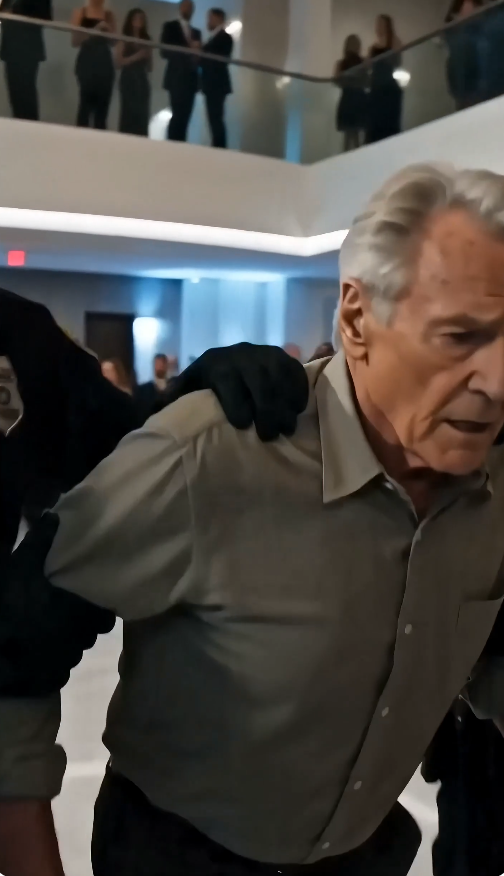
The security guard dragged the old man toward the glass doors while the anniversary video began playing on the giant screen behind them.
The ballroom glittered with champagne towers, blue stage lights, and gold letters celebrating fifty years of Hartwell Industries.
Executives in black suits laughed near the front tables.
Investors lifted crystal glasses.
A young director named Preston Vale watched the old man being pulled across the marble floor and smiled like the humiliation had improved the evening.
The old man wore a faded brown coat, worn shoes, and a company pin so old that most people mistook it for junk.
His name was Samuel Hartwell.
No one at the door recognized him.
No one at the front table stood for him.
The security guard tightened his grip on Samuel’s arm.
“This event is for executives only.”
Samuel looked up at the high ceiling, the banners, the polished logo, and the young people celebrating a history they had never touched.
“I was here before the company had walls.”
Preston laughed loudly enough for nearby guests to turn.
He walked over with a glass of champagne and looked Samuel up and down.
“Then you should know where the exit is.”
Samuel’s eyes moved to the stage.
The anniversary screen showed a black-and-white photograph of a young man standing beside a rented garage in 1974.
The young man had the same eyes as the old man being pushed toward the door.
“I came to see what my dream became.”
The master of ceremonies stepped onto the stage with a microphone.
He turned toward the screen, smiled, and read the next line from the program.
“Please welcome our founder.”
The room applauded before anyone understood.
Then the spotlight searched the stage and found no one.
The old photo enlarged behind them.
Samuel Hartwell, Founder and Chairman Emeritus.
The applause died halfway through.
Every guest turned toward the glass doors.
Because the founder they were supposed to honor was the old man they had just thrown out.
Fifty years earlier, Samuel Hartwell did not own a suit.
He owned a toolbox, a borrowed workbench, and a key to a leaking garage behind a closed bakery in Milwaukee.
He had been twenty-eight years old with grease under his nails and two dollars left after paying rent.
His wife, Ruth, worked nights at a diner so Samuel could repair industrial parts during the day.
Their first employee was not an engineer.
He was a teenager named Joe who swept metal shavings from the floor after school for sandwich money.
Hartwell Industries began with nothing glamorous.
No boardroom.
No investors.
No marble floors.
Just three people who believed machines should be built to last and workers should be treated like human beings.
Samuel’s first rule was simple.
Nobody who built the company would ever be looked down on inside it.
He wrote that rule on a piece of cardboard and nailed it near the garage door.
Respect walks in before profit.
For years, the company grew slowly.
Then quickly.
One factory became three.
Three became plants across the country.
Samuel became known for visiting break rooms before boardrooms.
He remembered forklift drivers by name.
He paid hospital bills quietly.
He fired managers who humiliated janitors.
He gave stock to employees before consultants told him it was expensive.
Ruth told him the company had a soul because he refused to sell it piece by piece.
When she died, Samuel kept her diner apron framed in his office.
He never remarried.
The company became his second family.
But time moves without asking permission.
Samuel’s knees weakened.
His hands shook.
Doctors began saying words like rest and transition.
So Samuel stepped back from daily leadership.
He trusted the board to protect what he had built.
For a while, they did.
Then the company hired people who knew numbers but not names.
They renovated the headquarters lobby.
They replaced the old employee wall with a digital brand display.
They removed the cardboard sign from the archived founder’s room because someone said it looked unprofessional.
Samuel heard stories.
Workers afraid to report injuries.
Older employees pushed out before pensions vested.
Security trained to keep away anyone who did not look important.
A young executive named Preston Vale became the symbol of the new culture.
Preston was thirty-two, brilliant, polished, and cruel in the way insecure men call efficiency.
He talked about legacy while cutting the people who created it.
He called floor workers outdated.
He called loyalty a cost center.
He called Samuel’s old rules sentimental baggage.
The board tolerated him because profit rose for three quarters.
Samuel stayed silent longer than he should have.
Then a letter arrived.
It came from a woman named Maria Lewis, a payroll clerk who had worked at Hartwell for seventeen years.
She wrote that she knew Samuel might never see her letter, but she had to try.
She wrote that the company still used his name while forgetting his rule.
She wrote that people cried in bathrooms after meetings.
She wrote that an old machinist named Frank had been escorted out after forty-one years because his badge failed during a system update.
She wrote that the fiftieth anniversary party was being planned as a celebration of values the staff no longer felt.
At the bottom, Maria copied Samuel’s old cardboard sign from memory.
Respect walks in before profit.
Samuel read the letter three times.
Then he called his attorney.
He still owned a controlling block of voting shares through the Hartwell Trust.
The board knew it.
Preston did not understand how much power the old man still had.
Samuel asked for an internal review.
The report confirmed everything Maria said.
Retaliation.
Humiliation.
Unsafe shortcuts.
Misuse of founder programs.
Executive bonuses tied to layoffs disguised as innovation.
Samuel could have acted from his house.
He could have signed documents quietly.
Instead, he decided to attend the anniversary party unannounced.
Not as the founder in a tailored suit.
As the kind of man Hartwell Industries had begun with.
An old worker in a worn coat.
If the company still recognized dignity, someone would open the door.
If it did not, he wanted to see that too.
On the night of the party, Samuel arrived alone by taxi.
The headquarters glowed like a palace.
He stood outside for a moment in the cold, looking through the glass at the lobby Ruth had never lived to see.
A young receptionist glanced up but did not recognize him.
He gave his name at the check-in table.
The event worker searched the list and frowned.
The printed program listed Samuel Hartwell as a surprise guest, but his name had been marked private under the board’s staging schedule.
The worker did not know what to do.
Then Maria Lewis saw him from across the lobby.
She recognized him from old photos.
Her eyes widened.
She started toward him, but Preston intercepted her with a sharp look.
Samuel noticed.
He noticed the fear in her shoulders.
He noticed the security guard already moving toward him.
He noticed that the company had become the kind of place where a clerk hesitated before helping an old man.
That hurt more than being refused entry.
The guard asked for identification.
Samuel gave it.
The guard glanced at the old driver’s license, then at Samuel’s coat, and decided the card mattered less than appearance.
Preston came over with two junior executives behind him.
He asked whether there was a problem.
The event worker said the old man claimed to be Samuel Hartwell.
Preston laughed.
Not because he truly knew.
Because cruelty often laughs before it verifies.
He told security to remove Samuel before donors arrived.
Maria stepped forward and said the man might be important.
Preston snapped that janitors and clerks did not manage guest access.
Maria lowered her eyes.
Samuel saw her shame.
He remembered Ruth handing coffee to exhausted workers in the old garage.
He remembered the cardboard sign.
He let the guard take his arm.
Inside the ballroom, the celebration had already begun.
Samuel was pulled past tables named after company milestones.
The Founders Table sat near the stage.
It was empty except for floral arrangements.
Nobody had saved a chair for the man whose name was printed on every banner.
The guard repeated the line.
“This event is for executives only.”
Samuel answered with the truth.
“I was here before the company had walls.”
Preston heard and turned the moment into performance.
He wanted the room to see him defending exclusivity.
He wanted investors to think he controlled the space.
“Then you should know where the exit is.”
Samuel did not argue.
He looked around at what his dream had become.
The logo was brighter.
The people were colder.
The party was richer.
The spirit was poorer.
“I came to see what my dream became.”
Then the MC spoke.
“Please welcome our founder.”
The screen changed.
Samuel’s young face filled the ballroom.
A photograph from 1974.
A rented garage.
A handwritten sign behind him.
Respect walks in before profit.
Someone gasped.
Maria covered her mouth.
Preston stopped smiling.
The board chairman stood so quickly his chair struck the floor.
Samuel gently removed the guard’s hand from his arm and turned back toward the ballroom.
No one blocked him now.
The crowd parted as he walked to the stage.
Every step was slow.
Not weak.
Heavy.
As if fifty years were walking with him.
The MC’s face had gone white.
He handed Samuel the microphone with shaking hands.
Samuel looked at the audience.
He saw old employees crying near the back.
He saw younger managers staring at their shoes.
He saw Preston trying to calculate whether an apology would save him.
Samuel did not begin with anger.
He began with memory.
He told them about the garage.
About Ruth washing uniforms in their bathtub.
About Joe sweeping the floor for sandwiches.
About the first machine that broke because Samuel had been too proud to ask for help.
He told them the company had never been built by executives alone.
It had been built by hands.
By backs.
By names nobody printed on gala invitations.
He said a company party that throws out the people who built the company is not a celebration.
It is a warning.
The room remained silent.
Samuel then asked Maria Lewis to come forward.
Maria froze.
The guests turned.
Preston’s face tightened with panic.
Maria walked slowly to the stage, unsure whether she was about to be punished.
Samuel took the folded letter from his coat pocket.
He held it up.
He told the room that one employee had done what executives were too comfortable to do.
She had told the truth.
Maria began crying before she reached him.
Samuel thanked her in front of everyone.
Then he asked Mr. Avery, his attorney, to join them.
A man in a dark suit stepped from the side of the stage with a black folder.
Preston whispered something to the board chairman, but the chairman did not move.
Mr. Avery opened the folder.
Inside were the findings of the internal review.
Inside were the signed resolutions from the Hartwell Trust.
Inside was the immediate termination notice for Preston Vale.
Samuel turned toward Preston.
He did not raise his voice.
He said the company did not need leaders who confused cruelty with standards.
The termination was effective immediately.
Security looked unsure for the first time that night.
Samuel looked at the same guard who had removed him and told him not to touch Preston unless Preston refused to leave.
Respect, even now, had rules.
Preston tried to speak.
The microphone was not his.
He tried to appeal to the board.
No one met his eyes.
He tried to blame policy.
Samuel said policies are written by people, and people are responsible for what they allow.
Preston walked out through the same doors where Samuel had been dragged moments earlier.
No one applauded.
The silence was better.
Samuel then announced a leadership review.
Executive bonuses would be frozen.
The pension cases would be reopened.
The employee wall would be restored.
The founder’s cardboard sign would return to the lobby, not as decoration, but as policy.
Maria Lewis would lead a new employee dignity council with direct access to the board.
The old machinist Frank would be invited back, pension intact, apology in writing.
The room changed again.
This time, not from shock.
From recognition.
People began standing.
First the older workers.
Then the factory supervisors.
Then the clerks.
Then the executives who understood survival required choosing the right side quickly.
Samuel did not enjoy the standing ovation.
He accepted it because it belonged partly to the people who had waited too long to be seen.
After the speeches, the party did not continue as planned.
The champagne towers were removed.
The velvet ropes were taken down.
The kitchen staff were invited into the ballroom.
The cleaning crew were brought in from the service hallway.
Samuel asked that every remaining chair be filled by anyone who worked under the Hartwell roof.
For the first time that night, the ballroom looked like the company.
Not its brochure.
Its people.
Maria sat at the Founders Table beside Samuel.
She tried to refuse the seat.
Samuel told her Ruth would have insisted.
They served dinner to employees first.
Executives waited.
Some looked uncomfortable.
Good, Samuel thought.
Comfort had taught them too little.
Over the next weeks, the changes were not easy.
Public relations teams tried to soften the story.
Samuel refused.
He gave one interview and said the company had embarrassed itself because it forgot humility.
That sentence spread faster than the gala video.
Former employees began writing letters.
Some angry.
Some grateful.
Some with stories Samuel could barely stand to read.
The review grew deeper.
More managers were removed.
Some resigned before they could be questioned.
The board attempted to persuade Samuel to make changes quietly.
Samuel reminded them that the humiliation had not been quiet when it happened to workers.
Quietness was no longer available.
Maria became the most unexpected figure in the company.
She did not seek power.
That was why Samuel trusted her with some of it.
She held listening sessions in break rooms.
She visited factories.
She asked workers what they had been afraid to say.
At first, people were suspicious.
Then the first results came.
Safety repairs.
Back pay corrections.
Restored benefits.
Written apologies.
Managers retrained or removed.
The cardboard sign returned to the lobby under glass, but Samuel insisted on adding a second sign beneath it.
If this sign ever becomes decoration instead of discipline, we have failed again.
Six months later, Samuel returned to the headquarters for the reopening of the founder’s room.
This time, no one stopped him at the door.
The security guard who had dragged him out was waiting near the entrance.
His name was Kevin.
He had written Samuel a letter after the gala, apologizing and explaining that he had followed orders because he was afraid of losing his job.
Samuel accepted the apology, but not carelessly.
He asked Kevin what he would do if another old man in a worn coat arrived without the right badge.
Kevin said he would ask questions before making judgments.
Samuel nodded.
That was enough for a beginning.
At the ceremony, Frank the machinist stood beside Maria.
He wore his old company jacket.
His pension had been restored.
He had not returned to work because his hands hurt too much now, but he came to see the wall where his name had been placed with every employee who had served more than twenty-five years.
He touched the letters and cried.
Samuel cried too.
That day, he announced the Ruth Hartwell Fund for employees in crisis.
Medical emergencies.
Housing loss.
Childcare support.
Legal aid for workers facing unfair treatment.
Maria helped design it.
Samuel funded it personally.
He said Ruth had once fed employees when payroll was late, and the company could afford to remember her properly.
Years passed.
Samuel did not return to daily leadership.
He was old, and he knew it.
But he returned often.
Sometimes in a suit.
Sometimes in the same brown coat.
He liked watching who opened doors.
The company became less glamorous for a while.
Profits dipped when shortcuts ended.
Then trust returned.
Workers stayed.
Quality improved.
Customers noticed.
Hartwell Industries grew again, slower and stronger.
Maria eventually became chief ethics officer.
Then chief operating officer.
Years later, when Samuel could no longer walk without assistance, she was named CEO by unanimous board vote.
At her appointment ceremony, she placed the old cardboard sign on the stage beside the official podium.
Samuel sat in the front row in a wheelchair.
He was ninety-one.
His hands shook.
His eyes were bright.
Maria began her speech by telling the truth.
She said the company had once thrown its founder out because he looked poor.
She said that shame had become their rescue.
She said Hartwell Industries would never again measure worth by clothing, title, age, accent, or badge color.
Samuel looked toward the back of the room.
He imagined Ruth standing there in her diner apron, arms folded, smiling because the company had finally remembered its soul.
After the ceremony, Maria brought Samuel to the lobby.
The employee wall stretched farther than he expected.
Names filled the marble panels.
Engineers.
Drivers.
Clerks.
Janitors.
Machinists.
Receptionists.
Managers.
Cooks.
Security guards.
People who had walked into the dream and made it real.
Samuel touched the glass over Ruth’s name.
Then Joe’s.
Then Frank’s.
Then Maria’s new plaque.
He did not say much anymore.
But he smiled.
That was enough.
When Samuel died the following winter, the company did not hold a private executive memorial.
Maria opened the factory gates.
Thousands came.
Workers wore uniforms, old jackets, safety vests, office badges, and Sunday coats.
The memorial was held in the main manufacturing hall because Samuel had requested it years before.
No velvet ropes.
No VIP section.
No executives-only entrance.
At the front, beneath his photograph, stood the original toolbox from the garage and the cardboard sign that had outlived every logo redesign.
Respect walks in before profit.
Maria spoke last.
She said Samuel did not build a company so people could worship the founder.
He built it so ordinary people could stand taller when they entered work.
Then the employees filed past the toolbox, one by one.
Kevin the security guard came too.
He placed his old badge beside it.
Frank placed a wrench.
Maria placed the letter she had once written in desperation.
The letter that brought Samuel back.
The letter that saved more than she knew.
They threw the old man out of the company party, not knowing he built it.
May you like



But the real ending was not the founder reveal, the fired executive, or the stunned ballroom.
The real ending was that an old man returned in a worn coat to test the soul of his dream, found it wounded but not dead, and left behind a company that finally remembered the first rule nailed to a garage wall before it ever had walls of its own.







