"They Put the Little Girl on Stage for Auction — Then Her Father Walked In as the Man They All Feared"
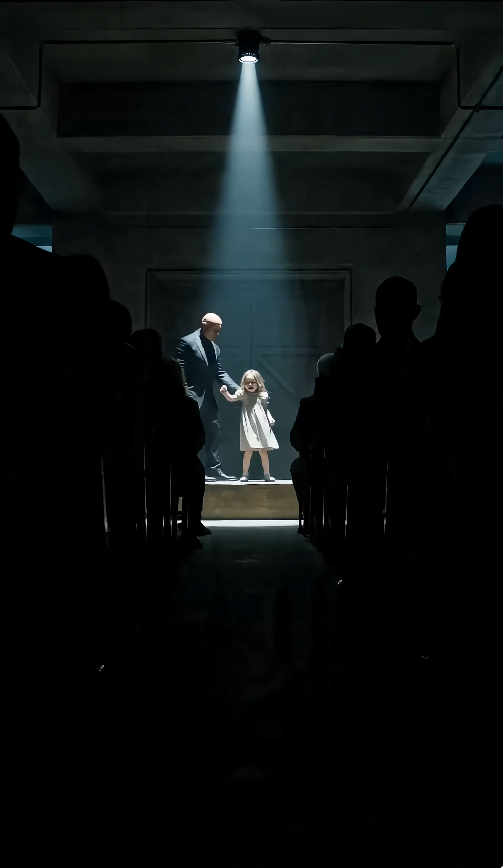
The auctioneer pulled the little girl onto the small stage by her arm.
Harsh white lights dropped over her like punishment.
She was seven years old, barefoot, wearing a pale blue dress that had once been clean. Her brown curls were tangled from crying. One ribbon hung loose at the side of her head. Around her wrist was a tiny plastic bracelet from a children’s museum, the kind a parent buys during an ordinary afternoon before the world breaks open.
The room beneath the city was not ordinary.
It sat three floors below a private luxury club, behind a steel door, past a corridor where no cameras were supposed to work. The ceiling was low. The walls were dark wood. The guests sat in velvet chairs with numbered cards in their hands, diamonds at their throats, polished shoes on the concrete floor, faces half-hidden by shadow and shame.
The auctioneer forced the child beneath the stage light.
He was calm, silver-haired, elegant, and empty-eyed.
“Starting bid begins now.”
The little girl looked toward the locked steel door at the back of the room.
Her whole body shook, but her voice cut through the silence with impossible certainty.
“My daddy will come!”
A wealthy guest in the front row leaned back and laughed.
“Not down here, sweetheart.”
The crowd did not laugh with him.
But no one stopped him either.
The auctioneer smiled as numbered cards began to rise.
That was when every light in the basement flickered.
Once.
Twice.
Then the steel door at the back began unlocking from the outside.
The first sound was soft.
A metal click.
Then another.
Then a deeper release, heavy enough to travel through the floor.
The crowd slowly turned.
The little girl stopped crying.
The door burst open.
A man in a black suit walked in calmly, removing one leather glove.
He did not rush.
He did not shout.
He looked directly at the auctioneer.
And the auctioneer’s face went pale because he recognized him.
The man stepped into the light.
“Auction’s over.”
The little girl ran from the stage and threw herself into his arms.
Every guest lowered their head.
Not out of respect.
Out of fear.
Six days earlier, Olivia Mercer had disappeared from a birthday party.
It happened in a place where parents believed money could buy safety. The party was held on the top floor of the Halden Children’s Museum, with security at every elevator, private staff at every entrance, and a cake so tall the children had to stand on chairs to see the candles.
Olivia’s father, Thomas Mercer, had been there for the first half hour.
He remembered every second afterward as a punishment.
He remembered tying her museum bracelet around her wrist. He remembered her asking for extra frosting. He remembered kneeling to fix the small ribbon in her hair. He remembered receiving the call that pulled him away.
A business emergency, they said.
A signature needed within the hour.
A driver waiting downstairs.
Thomas had spent ten years teaching himself never to be controlled by panic. He was wealthy, disciplined, quiet, and difficult to impress. He built Mercer Systems from nothing into the security firm most private banks and old families used when they wanted doors to stay shut and secrets to stay buried.
That was the irony that nearly killed him.
His daughter had vanished from a building protected by one of his own systems.
For twelve minutes, no one noticed.
Then the nanny found Olivia’s little shoes near the service hallway.
After that, the world became noise.
Police. Staff. Parents. Museum directors. His ex-wife collapsing against the wall. Guards replaying footage that suddenly skipped six crucial minutes. Elevators showing false logs. Doors reporting locked when someone had clearly opened them.
Thomas stood in the middle of it all, very still.
People mistook stillness for shock.
It was not shock.
It was calculation.
Someone had used his own technology against him.
And whoever had taken Olivia knew him well enough to make him blame himself first.
By midnight, the ransom message arrived.
Not money.
Silence.
Thomas was told not to contact federal authorities, not to activate private teams, not to speak publicly, and not to interfere in certain transactions scheduled that week. The message included a picture of Olivia asleep on a narrow cot, still wearing the museum bracelet.
Thomas looked at the photo for a long time.
Then he noticed what the sender had missed.
A reflection in the metal bedframe.
A half-circle window.
A painted ceiling beam.
He knew the place.
Not the exact room.
But the building.
The Laurier Club.
A private members’ society hidden inside an old stone tower downtown, owned on paper by shell companies, protected for decades by wealth, secrecy, and the kind of men who never touched dirt but profited from every hole in the ground.
Thomas had refused a contract from the Laurier Club two years earlier.
They had asked him to update their underground security.
He had toured the lower levels once.
He had seen the steel doors.
He had seen the private elevator.
He had seen enough to walk away.
He had also copied the architectural map.
At the time, he told himself it was a precaution.
Now it was a prayer.
He did not go to the police at first because the kidnapper had expected him to. They were watching official channels. They were watching his phone. They were watching his house.
So Thomas became what grief sometimes makes a father become.
Patient.
He let them think he was obeying.
He sat through calls.
He answered emails.
He allowed board members to see him pale and silent.
He let the city believe one more rich man’s tragedy was being handled behind closed doors.
But beneath that silence, every door in the Laurier Club began opening in his mind.
He found the skipped camera frames.
He found the false elevator logs.
He found the guard whose bank account had received money from a private foundation connected to the club.
Then he found the invitation list.
The event was not called an auction.
People like that never use ugly words when beautiful ones can cover the smell.
It was called a private placement evening.
A discreet gathering.
A philanthropic exchange.
Thomas read the names until he reached one that made his hand close around the paper.
Senators’ donors.
Tech heirs.
Foreign buyers.
A judge’s son.
A hospital chairman.
People who sat on charity boards in daylight and entered basements after midnight.
And at the bottom of the list, written as an internal note, was a name he knew.
Mercer child.
He understood then why they had taken Olivia.
Not only because they wanted leverage.
Because someone in that room wanted to prove that even the man who built the locks could not protect what he loved.
On the sixth night, Thomas let them think they had won.
He arrived downtown alone.
No visible guards.
No police cars.
No sirens.
Only a black suit, one leather glove, and a grief so focused it looked like calm.
But the city around him was not empty.
A woman selling flowers across the street wore a concealed radio.
A delivery truck idling behind the alley carried federal agents.
A maintenance van beneath the east entrance held his private recovery team.
The club’s own cameras were no longer theirs.
Thomas had spent years building systems for powerful men who believed control meant owning the door.
They had forgotten something.
Every door remembers who made it.
Inside the basement, Olivia stood on the stage while cards lifted around her.
The auctioneer had prepared the room like theater. Harsh lights. Small stage. Velvet chairs. A polished desk with numbered records. A sealed exit for guests who planned to leave without being seen.
The child was supposed to break.
She was supposed to become proof that no one was coming.
Instead, she stared at the steel door with tears shining on her face and believed the one thing her father had promised her every night of her life.
That if she ever got lost, he would find her.
The lights flickered because Thomas had taken control of the lower grid.
The locks clicked because the club’s emergency overrides answered to code older than the men who bought them.
The steel door opened because grief had learned the architecture.
When Thomas stepped inside, the auctioneer recognized him instantly.
Not as a father.
As the man who had once walked through that same basement, looked at the security layout, and refused to become part of it.
The auctioneer’s face lost all color.
The guests turned away as if hiding could make them anonymous.
Then Thomas said the only words he needed.
“Auction’s over.”
Olivia ran before anyone could stop her.
She crossed the stage, slipped once on the edge, recovered, and hurled herself into his chest. Thomas caught her with both arms and dropped to one knee under the force of her. Her small hands locked behind his neck. Her face pressed into his shoulder.
For one second, the room, the criminals, the cameras, the fear, all vanished.
There was only his daughter breathing against him.
Alive.
Shaking.
Home.
Thomas stood with Olivia in his arms.
Behind him, armed agents moved into the basement. No one shouted. No one needed to. The guests saw the red dots of recording lights hidden in the ceiling corners and understood the night had already ended before the door opened.
Some tried to cover their faces.
Some froze with numbered cards still in their hands.
The cruel guest in the front row stared at the floor as if it might open and spare him.
It did not.
The auctioneer remained beside the stage, hands limp, expression emptied by the knowledge that every name, every number, every lifted card had been recorded.
Thomas did not look at any of them for long.
He would remember their faces later.
For now, he carried Olivia through the steel door, past the corridor, past the false walls, past the place where wealthy people had believed darkness belonged to them.
Outside, dawn had not yet arrived.
Rain silvered the alley. Blue lights flashed without sirens. A medic wrapped a blanket around Olivia while she refused to let go of her father’s sleeve.
Thomas stayed beside her through every check, every question, every careful movement. When a doctor finally said she was physically safe, Thomas sat down for the first time in six days and covered his face with both hands.
Olivia climbed into his lap.
She still did not speak.
She did not need to.
Her small wrist rested against his chest, the museum bracelet still there.
That bracelet became evidence.
So did the cards.
So did the guest list.
So did the recordings from the basement, the club records, the financial transfers, the encrypted messages, and the years of favors that unraveled when powerful people realized silence would not save them.
The arrests spread wider than anyone expected.
Not because the world suddenly became just.
Because Thomas made the evidence impossible to bury.
He gave copies to federal investigators, international agencies, and three journalists who had spent years chasing rumors about the Laurier Club. He testified behind closed doors. Then publicly. Then again whenever someone tried to soften the story into scandal instead of crime.
Olivia’s mother took her away from the city for a while.
Thomas followed later, after the first hearings.
He found them in a coastal house with white curtains and a garden full of wind-bent grass. Olivia was sitting on the porch steps with a box of crayons, drawing the same picture over and over.
A black door.
A little girl.
A man walking in.
Thomas sat beside her and watched her color the door red, then blue, then yellow.
He did not ask her to stop.
Healing does not always look like forgetting.
Sometimes it looks like drawing the door again until the ending stays the same.
Weeks became months.
The city wanted to celebrate Thomas as a hero, but he rejected every award. He did not feel heroic. He felt late. He knew parents without money had lost children into systems that did not move for them, into rooms no one searched quickly enough, into files that grew cold while officials waited for proof.
So he changed what his fortune was for.
Mercer Systems stopped taking private contracts from families who wanted secrecy more than safety. Thomas built a child recovery fund that did not require parents to be rich, respected, or believed before help arrived. He funded emergency response teams, legal support, trauma care, and technology designed not to protect mansions, but to expose hidden doors.
The Laurier Club was torn apart from the inside.
Its underground rooms were sealed permanently.
The stage was removed.
The steel door was melted down.
A year later, Thomas took Olivia back to the children’s museum.
She asked to go.
Her mother was afraid.
Thomas was too.
But Olivia put on a yellow dress, tied her own ribbon crookedly, and held his hand all the way through the entrance. At the ticket counter, she asked for a bracelet.
The attendant fastened it gently around her wrist.
Thomas had to look away.
Inside, Olivia went straight to the miniature city exhibit, where tiny trains moved through glass tunnels and bridges lifted for painted boats. She watched them in silence.
Then she took her father’s hand and placed it over the bracelet.
He understood.
A promise renewed.
That night, when she fell asleep, Thomas stood in the doorway of her room and listened to her breathe.
For months, he had believed the worst moment of his life was seeing her on that basement stage.
But the truth was harder.
The worst moment had been the day before, when he realized what kind of world needed a father to be powerful before his child could be found.
That became the final truth he carried.
Olivia had survived because her father had the money, knowledge, and access to break open the door.
So Thomas spent the rest of his life making sure other doors opened for children whose parents had none of those things.
People would always remember the story as the night a little girl was put on stage and her father walked in.
But Olivia remembered it differently.
She remembered the lights flickering.
The steel door opening.
The room going silent.
And the one thing she had known even when everyone laughed.
May you like



Her daddy came.
And after he carried her out, he kept coming back for everyone else.







