“They locked the boy in a warehouse… not knowing his father owned the city.”
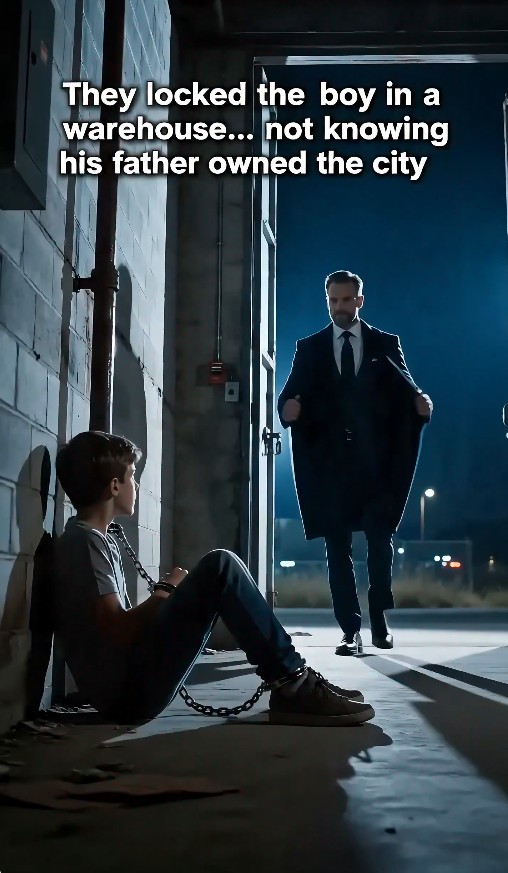
The kidnapper’s smile disappeared the moment he looked through the crack in the warehouse door.
Outside, the entire street was black with vehicles.
Police cruisers blocked both ends of the industrial road.
Armored SUVs idled beneath the rain.
Red and blue lights flashed across the rusted walls.
Men in tactical gear moved silently between shipping containers.
And standing in the middle of it all was one man in a dark wool coat.
Caleb Sterling.
The boy’s father.
The man the kidnappers had called just ten seconds earlier.
The man who had answered with only two words.
“Look outside.”
Inside the warehouse, twelve-year-old Noah Sterling sat tied to a metal chair with duct tape around his wrists.
His face was bruised from fear more than violence.
His school jacket was wet.
His lips trembled, but his eyes stayed locked on the door.
The kidnapper still held the phone in one shaking hand.
Moments ago, he had shoved it into Noah’s face.
“Tell your father to bring the money.”
Noah had whispered through chattering teeth.
“You don’t know who he is.”
The kidnapper had laughed.
“Then let him introduce himself.”
Now Caleb Sterling was walking toward the warehouse with the police behind him.
He did not run.
He did not shout.
He moved like a storm that had already decided where to land.
The kidnapper backed away from the door.
Then he saw the security monitor on the wall flicker to life.
Every camera around the building had switched on.
Every exit was visible.
Every man involved was surrounded.
And in the bottom corner of the screen, a company logo appeared.
Sterling Urban Holdings.
Noah’s father did not just own businesses in the city.
He owned the land beneath the warehouse.
He owned the cameras above the street.
He owned the security network the kidnappers had used without knowing whose system they had entered.
Then Caleb’s voice came through the phone again.
“Open the door before my son has to hear you beg.”
The kidnapper looked at Noah.
And for the first time, the boy saw fear on the wrong face.
That morning, Noah Sterling had left school through the side gate because he wanted five quiet minutes before his driver arrived.
He was not supposed to do that.
He knew it.
His father had told him never to leave the main entrance alone.
But Noah hated the way adults watched him because of his last name.
Teachers spoke carefully around him.
Parents pointed him out at school events.
Other kids whispered that his father could buy anything, fix anything, destroy anyone.
Noah did not feel powerful.
He felt lonely.
He was just a boy with a backpack, a math test in his folder, and a father who missed too many dinners because half the city depended on him.
The van stopped beside the alley before Noah realized it had no company markings.
Two men stepped out.
One wore a delivery jacket.
One carried a clipboard.
Noah stepped back.
The man with the clipboard smiled.
“Your father sent us.”
Noah looked toward the main road.
His driver’s car was not there yet.
The delivery man reached for him.
Noah ran.
He made it three steps before someone grabbed his backpack and pulled him backward.
A cloth pressed near his face.
Not long enough to knock him out completely.
Just long enough to make the world blur.
When Noah woke, he was in the warehouse.
His wrists were tied.
His mouth was dry.
A single bulb swung above him.
The air smelled of metal, rain, and old wood.
Across from him stood the kidnapper with a scar near his jaw and a cheap phone in his hand.
His name was Vince, though Noah did not know it yet.
Vince crouched in front of him.
“You are going to be smart.”
Noah tried to pull his wrists free.
The rope cut his skin.
Vince smiled.
“Tell your father to bring the money.”
Noah’s throat hurt.
“How much?”
Vince laughed.
“Enough for him to remember what fear costs.”
The second man stood near the loading dock, nervous and sweating.
He kept looking at the door.
Noah noticed that.
His father had taught him something when he was little.
Fear makes people talk with their eyes first.
Noah looked around.
Old crates.
Two exits.
One broken window too high to reach.
A camera mounted near the ceiling.
A camera.
Noah stared at it for half a second before looking away.
He did not know whether it worked.
But if it did, he knew one thing.
His father might already be watching.
Vince shoved the phone toward him.
Noah saw his father’s number on the screen.
The call connected.
For a moment, there was only silence.
Then Caleb’s voice came through.
Calm.
Too calm.
“Noah.”
The boy broke at the sound of him.
“Dad.”
Vince grabbed the phone closer.
“Listen carefully.”
“We have your son.”
“Bring twenty million in cash to Pier 14 in one hour.”
“If you call the police, he disappears.”
Caleb did not answer immediately.
Noah closed his eyes.
He imagined his father in his office, standing before the wall of city maps, one hand over his mouth, the other already giving silent orders.
Vince pressed the phone toward Noah again.
“Tell him you’re scared.”
Noah swallowed.
“I’m okay.”
Vince slapped the chair beside his head, making Noah flinch.
“Tell him the truth.”
Noah’s voice trembled.
“Dad…”
Caleb’s voice softened.
“I’m here.”
Vince hissed.
“Say it.”
Noah looked at the camera again.
Then at Vince.
Then at the phone.
“You don’t know who he is.”
Vince laughed and turned on speaker.
“Then let him introduce himself.”
The line went quiet.
Then Caleb said the words that changed everything.
“Look outside.”
At first, Vince thought it was a trick.
Then headlights swept across the warehouse walls.
One pair.
Then another.
Then dozens.
The second kidnapper ran to the door and looked through the crack.
His face collapsed.
Police.
SUVs.
Floodlights.
No escape.
The industrial street that had looked abandoned was now sealed like a vault.
Vince grabbed Noah by the shoulder.
“How?”
Noah did not answer.
He did not know all of it.
But he knew his father never gave him ordinary things.
The watch on his wrist had been a birthday gift.
It looked like a simple black sports watch.
Noah had complained that it was boring.
His father had smiled and told him boring things sometimes saved lives.
Vince had not removed it because it looked cheap.
That was his first mistake.
The watch had sent Noah’s pulse spike, location, and emergency signal the moment his heart rate stayed above panic threshold for more than six minutes.
Sterling security received it before Vince made the ransom call.
Caleb had already traced the signal to the warehouse district.
His district.
His cameras.
His roads.
His private emergency coordination system that connected directly with the police because he had funded the city’s missing child response network after his wife died.
Vince had chosen the one place where Caleb Sterling saw everything.
The warehouse door shook.
A police voice ordered Vince to surrender.
Vince grabbed Noah and pulled a knife from his belt.
Noah whimpered.
The second kidnapper dropped to his knees near the loading dock.
Vince shouted toward the door, but the words dissolved into panic.
Then another sound came.
A quiet metallic click from above.
The warehouse lights changed.
A speaker system hidden in the rafters turned on.
Caleb’s voice filled the building.
“Step away from my son.”
Vince pressed the knife closer.
“You think money makes you God?”
Caleb answered through the speaker.
“No.”
“It makes men like you predictable.”
The loading dock door behind Vince opened automatically.
Cold rain blew in.
Three officers entered from the rear.
Vince spun.
A stun device flashed.
The knife hit the floor.
Noah screamed once as the chair tipped sideways.
Before he struck the ground, an officer caught him.
The ropes were cut.
The tape was removed.
The warehouse door opened fully.
Caleb walked in.
For the first time since the phone call, his calm broke.
He saw Noah’s red wrists.
He saw the blood on his sleeve.
He saw his son trying not to cry because he thought brave meant quiet.
Caleb took off his coat and wrapped it around Noah’s shoulders.
Then he knelt in front of him.
“You were brave.”
His voice shook now.
“Now you’re safe.”
Noah fell into his arms.
Caleb held him as if the whole city could collapse and he would not let go.
Police dragged Vince past them.
Noah turned his face into his father’s coat.
He smelled rain, cedar, and the faint scent of the office where Caleb worked too late.
For the first time all day, Noah believed he might survive.
But outside the warehouse, the rescue became something larger.
Detective Maria Lopez took Vince’s phone from the evidence bag.
The ransom texts were still there.
So were payment instructions.
So was a deleted message recovered by the tech unit within the hour.
Pick the boy up before the board vote.
Use the old Sterling warehouse.
His father will pay before he thinks.
The message had been sent from a number registered to a private security firm.
Caleb recognized the firm immediately.
It belonged to Adrian Cross.
His half-brother.
The man sitting on Sterling Urban Holdings’ board.
The man Caleb had trusted to help manage the city redevelopment project.
The man Noah called Uncle Adrian.
Caleb did not tell Noah at the warehouse.
The boy had been through enough.
He rode with him in the ambulance, one arm around him the entire way.
At the hospital, doctors checked Noah’s wrists, his breathing, and the sedative residue from the cloth.
Caleb sat beside the bed and did not answer a single business call.
Noah watched him ignore them.
That alone made him cry.
“You don’t have to stay,” Noah whispered.
Caleb looked at him as if the words hurt.
“Yes, I do.”
Noah stared at the ceiling.
“You always have meetings.”
Caleb lowered his head.
“I missed too many dinners.”
“But I will not miss this.”
Noah turned toward him.
“Did they want money?”
Caleb hesitated.
“Yes.”
Noah knew there was more.
Children always know when adults are closing doors around the truth.
“Did someone help them?”
Caleb’s jaw tightened.
“Yes.”
Noah’s eyes filled.
“Someone we know?”
Caleb took his son’s hand gently, careful of the bandages.
“Yes.”
Noah closed his eyes.
“Uncle Adrian?”
Caleb went still.
“How did you know?”
Noah looked away.
“He knew I used the side gate sometimes.”
“He told me once it made me look normal.”
Caleb’s face became unreadable.
But inside, something broke.
Adrian had been in the Sterling home since Noah was born.
He brought toy cars.
He attended birthday parties.
He stood beside Caleb at his wife’s funeral.
He knew the emergency watch existed.
Or thought he did.
That was why he chose men too careless to notice it.
That was why he chose an old warehouse he believed had been abandoned.
But Adrian had forgotten that Caleb never abandoned anything connected to his wife’s work.
The warehouse had once belonged to Grace Sterling.
Noah’s mother.
Before she died, Grace had planned to turn the industrial district into a children’s safety center.
After her death, Caleb kept the properties untouched because grief made him freeze around anything she loved.
Adrian called it weakness.
Caleb called it mourning.
Now that mourning had saved their son.
The board vote Adrian mentioned was scheduled for the next morning.
Sterling Urban Holdings was deciding whether to sell the old warehouse district to a private developer.
Adrian supported the sale.
Caleb opposed it.
If Caleb missed the vote, Adrian could push the deal through with emergency proxy powers.
If Noah was held hostage, Caleb would sign anything.
That was the plan.
A child for a land deal.
A son for a signature.
Police arrested Adrian at dawn.
He was wearing a tailored suit when officers entered his penthouse.
He asked for his lawyer before asking whether Noah was alive.
That fact appeared in the report.
Caleb read it three times.
Then he stopped reading because rage made the words blur.
At the preliminary hearing, Vince testified first.
He said Adrian promised immunity through private connections.
He said Adrian gave them Noah’s school schedule.
He said Adrian chose the warehouse because he believed Caleb had no cameras there.
Then prosecutors played the recovered call.
Adrian’s voice came through clearly.
The boy is the only thing Caleb will choose over the city.
Noah sat beside his father in the courtroom, holding the edge of Caleb’s sleeve.
The sentence seemed to echo through both of them.
Adrian had been wrong.
Caleb would choose Noah.
But Noah was not separate from the city.
He was the reason Caleb cared what kind of city existed after him.
The trial became public because the Sterling name was public.
News outlets called Caleb the man who owned the city.
Caleb hated that headline.
He knew ownership was the wrong word for any place where children walked to school, workers waited for buses, nurses came home tired, and boys could be taken from side gates.
So when the board vote finally happened, Caleb stood before the directors and changed the agenda.
He did not sell the warehouse district.
He donated the central block to the city under one condition.
It would become the Grace Sterling Child Safety Center.
Part shelter.
Part emergency response hub.
Part after-school center.
Part training site for missing child rapid alerts.
The same cameras that found Noah would be expanded to protect children whose fathers did not own buildings, companies, or private security networks.
Noah attended the opening six months later.
His wrists had healed.
The scars were faint.
But he still rubbed them when he was nervous.
Caleb noticed every time.
During the ceremony, reporters asked Noah if he felt lucky.
Noah looked at his father.
Then at the building that had once held him in fear and now had bright windows, classrooms, and a playground painted in blue and yellow.
“I feel safe,” he said.
That answer did more than any speech.
Caleb placed a plaque at the entrance.
It did not have his name on it.
It did not mention money.
It read:
For every child who needs someone to look outside.
Noah touched the words.
“Dad?”
“Yes?”
“Mom would like this.”
Caleb could not answer for a moment.
Then he nodded.
“She would.”
Years passed before Noah could sleep through heavy rain without waking.
But he healed.
Not all at once.
Not neatly.
He learned that bravery was not the absence of fear.
It was telling the truth while your voice shook.
It was remembering a camera.
It was trusting that someone would come.
Caleb changed too.
He stopped using work as a way to avoid grief.
He came home for dinner.
He drove Noah to school himself for a long time, then slowly let him reclaim ordinary life.
He still owned much of the city on paper.
But after that night, he understood that ownership meant nothing if safety belonged only to the powerful.
Adrian was sentenced to decades in prison.
Vince took a deal and disappeared into the prison system.
The warehouse no longer smelled of rust and fear.
It smelled of crayons, cafeteria soup, clean floors, and raincoats drying near the entrance.
On the first anniversary of the rescue, Noah asked to visit the room where he had been held.
Caleb hesitated.
Then he said yes.
They stood together in the renovated space.
The old metal chair was gone.
In its place was a reading corner with beanbags and shelves of children’s books.
Noah walked to the window and looked outside.
The street was quiet.
No black SUVs.
No flashing lights.
No kidnappers.
Just parents picking up children and volunteers unloading boxes of food.
Noah slipped his hand into his father’s.
Caleb squeezed it gently.
The boy who had once whispered that the kidnappers did not know who his father was now understood something deeper.
His father had power.
But power was not what saved him.
Love did.
Power found the warehouse.
Love walked through the door.
Power surrounded the kidnappers.
Love wrapped a coat around a shaking child and stayed afterward.
That was why Noah never forgot the sound of his father’s voice on the phone.
Not angry.
Not loud.
Just certain.
“Look outside.”
May you like



Because outside that night was not only police, cars, and city lights.
Outside was proof that even in the darkest warehouse, a child who was loved was never as alone as the monsters wanted him to believe.







