“They laughed when the deaf boy entered the orchestra… then he corrected the piano.”
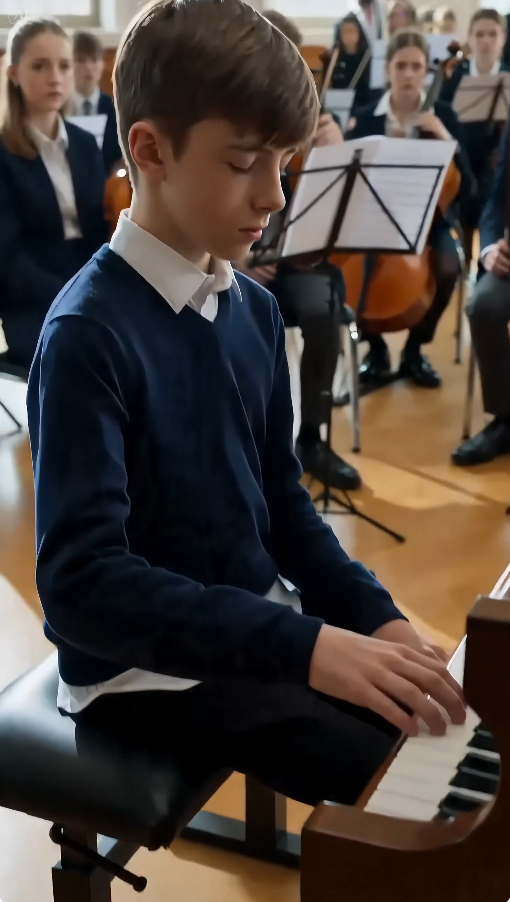
The laughter stopped when the deaf boy placed one hand on the grand piano and pointed to the exact key that had been out of tune for three months.
The rehearsal room fell silent.
The teacher froze beside the conductor’s stand.
The rich boy who had mocked him lowered his violin without realizing it.
A few students looked toward the grand piano as if it had betrayed them.
The deaf boy stood in the center of the room, clutching a folder of handwritten music against his chest.
Only minutes earlier, he had stepped into the elite orchestra room wearing an old blazer and shoes polished with more care than money.
A rich boy had laughed before the door fully closed.
“How can he play if he can’t hear?”
The boy had looked at the polished floor, then raised his eyes.
“I feel the music.”
The teacher had moved toward him with forced patience.
“This class is for advanced musicians.”
The boy walked to the piano instead of leaving.
He placed his palm against the wooden body.
Then he touched one key.
“Your piano is out of tune.”
The room laughed again.
Then he pressed the key.
A tiny vibration moved through the instrument.
He touched the side of the piano, closed his eyes, and tapped three notes on the wood.
The academy’s senior piano technician, who had just entered with a tuning kit, went completely still.
The boy was right.
Not almost right.
Exactly right.
And when the technician opened the piano lid, he found something hidden inside the frame.
A tiny carved mark beneath the strings.
The same mark used by the legendary tuner who had built that piano before disappearing years ago.
Before that day, no one at the Royal Ellington Academy knew Noah Bell’s name.
They only knew a scholarship applicant was coming.
They knew he was deaf.
They knew he came from the east district.
They knew his mother cleaned hotel rooms and his grandfather repaired old radios in a basement shop.
That was enough for some students to decide he did not belong.
The orchestra room at Royal Ellington was built like a jewel box.
Golden wall panels.
Velvet curtains.
Rows of polished chairs.
A grand piano beneath a skylight.
Portraits of famous alumni watching from the walls.
Noah stood outside the door for almost a full minute before entering.
He could not hear the orchestra tuning the way other students did.
But he felt it.
Through the floor.
Through the door handle.
Through the small tremors traveling into his wrist.
Music had always reached him in ways people did not understand.
When he was little, his father would place Noah’s hands on the side of an old upright piano and play slowly.
Low notes felt like thunder.
High notes felt like rain on glass.
Middle notes felt like voices behind a wall.
Noah lost most of his hearing after a fever when he was four.
Doctors spoke about limits.
His father spoke about doors.
His father, Daniel Bell, was not famous to the public.
But among real musicians, he had once been known as a miracle tuner.
He could restore broken instruments by touch.
He could hear flaws no machine caught.
He built custom soundboards for students who learned through vibration.
He believed music did not belong only to ears.
Then Daniel died in an accident at the academy when Noah was seven.
At least that was what Noah had been told.
After his death, Royal Ellington sent one letter of condolence and nothing else.
No award.
No memorial.
No mention in programs.
No explanation of why Daniel had been working alone in the concert hall that night.
Noah’s mother stopped speaking about the academy after that.
But Noah kept his father’s notebooks.
He studied the diagrams.
He traced the hand-drawn patterns of strings, hammers, bridges, and soundboards.
He learned how instruments breathed.
He learned that sound was movement before it was music.
That morning, he entered the orchestra room carrying one of Daniel’s folders.
Inside was a short composition called Pulse for Strings and Piano.
Noah had written it for musicians who could feel tempo through floor vibrations.
He wanted to audition with it.
He wanted the academy to hear what he could not hear.
The rich boy sitting in the first violin chair saw him first.
His name was Julian Cross.
His mother donated to the academy.
His father owned a private arts foundation.
Julian was talented, polished, and cruel in the lazy way of children who had never paid for their own mistakes.
He looked at Noah’s folder.
Then at Noah’s hearing aids.
Then at the old blazer.
“How can he play if he can’t hear?”
Several students laughed.
Noah had heard laughter before.
Not the sound of it.
The shape of it.
The open mouths.
The shoulders shaking.
The eyes turning away from the person being hurt.
He held the folder tighter.
“I feel the music.”
The orchestra teacher, Ms. Harlow, stepped forward.
She was not cruel like Julian.
That almost made it worse.
She was kind in the way adults are kind when they have already decided no.
“This class is for advanced musicians.”
Noah looked past her toward the piano.
Something in the room bothered him.
A vibration.
A wrongness.
The piano had been struck a few times during warm-up, and the resonance still sat in the floor.
One note leaned differently from the others.
Noah walked toward it.
Ms. Harlow reached out, startled.
Julian laughed again.
Noah placed his palm on the side of the piano.
The wood was warm from the room lights.
He pressed one key softly.
Then another.
Then the wrong one.
The vibration shivered unevenly against his fingers.
He lifted his head.
“Your piano is out of tune.”
The laughter grew louder.
Julian leaned back.
He said something Noah did not fully catch, but the faces around him told him enough.
Ms. Harlow looked embarrassed now.
She told him the piano had been maintained by the best technicians in the city.
Noah touched the key again.
Then he tapped the piano frame in a pattern from his father’s notebook.
Three taps.
Pause.
Two taps.
His father had called it asking the wood to answer.
The door opened behind them.
Mr. Alden Price, the academy’s senior piano technician, entered with a tuning case.
He had been called because several teachers had complained that the piano sounded dull in the lower register.
He saw Noah’s hand on the instrument and frowned.
Then he heard the key.
His expression changed.
He walked quickly to the piano.
He pressed the same note.
Then another.
Then returned to Noah’s note.
Alden looked at the boy.
“How did you know?”
Noah did not answer immediately.
He touched the piano again.
Then he opened his father’s old folder and showed a page of diagrams.
Alden saw the handwriting.
His face went pale.
Daniel Bell.
The name had been avoided at Royal Ellington for years.
Not because Daniel lacked importance.
Because his memory carried questions the academy never wanted answered.
Alden opened the piano lid.
He leaned over the frame with a small light.
Then his breath caught.
Beneath the strings, hidden near the cast-iron plate, was a tiny carved mark.
A small bell inside a circle.
Daniel Bell’s signature.
Alden whispered the name before he could stop himself.
Ms. Harlow stepped closer.
Julian stopped smiling.
Noah saw the adults exchange a look.
That look was worse than laughter.
It meant they knew something.
Noah pointed to the mark.
“My father used that.”
Alden closed the piano lid halfway and looked toward the door.
The academy director had to be called.
Within minutes, Dr. Elise Warren entered the room.
She was elegant, gray-haired, and carried the authority of someone used to applause.
When she saw Daniel’s folder in Noah’s hands, she stopped.
Noah read her face carefully.
Guilt had a vibration too.
Dr. Warren asked Noah his full name.
Noah answered.
The room tightened around the answer.
Because everyone older than thirty at Royal Ellington remembered Daniel Bell.
He had designed the resonance system beneath the orchestra floor.
He had tuned the grand piano in the main hall by hand.
He had worked with deaf and hard-of-hearing students before the academy had the courage to call inclusion a program.
He had also filed a report before his death.
A report claiming the academy had hidden donation money meant for accessible music education.
A report that disappeared after the accident.
Noah did not know that yet.
He only knew the adults suddenly looked afraid of the folder in his hands.
Dr. Warren asked to see the notebook.
Noah held it closer.
His father had taught him another rule.
When adults reach too quickly, ask why.
Alden stepped between them gently.
He asked Noah to play the piece he had brought.
Ms. Harlow looked uncertain.
Julian looked annoyed.
Dr. Warren looked trapped.
Noah opened the folder to Pulse for Strings and Piano.
The score was unusual.
It had standard notation.
But beneath the notes were vibration marks, floor pulse cues, and hand signal patterns.
It was written for an orchestra that could be felt as well as heard.
Ms. Harlow studied the first page.
Her face changed.
This was not a charity case.
This was music.
Noah sat at the piano bench.
He did not play loudly.
He placed one hand on the wood first, as if greeting an old friend.
Then he began.
The first notes were simple.
A heartbeat in the left hand.
A soft answering phrase in the strings.
Ms. Harlow began conducting slowly.
The orchestra entered awkwardly at first.
Then the floor pulse found them.
Cellos breathed.
Violins softened.
The piano answered through the repaired key.
Noah watched hands, bows, shoulders, and vibrations through the bench.
He played not by hearing the room.
He played by reading it.
By the end, no one laughed.
Julian’s violin was lowered against his knee.
Ms. Harlow wiped her eyes quickly.
Alden stood beside the piano with both hands pressed to the lid.
Dr. Warren looked at the floor.
The music had done what evidence sometimes cannot.
It made denial impossible.
After rehearsal, Alden took Noah and his mother, Maria Bell, to the old archive room.
Maria arrived breathless from work, still wearing her hotel uniform under a coat.
She froze when she saw the academy director.
Years of anger rose in her face.
Dr. Warren tried to speak.
Maria lifted one hand.
Noah had never seen his mother look so strong.
The archive drawer contained Daniel’s missing records.
Not all of them.
But enough.
Copies of his accessibility proposal.
Floor resonance designs signed with his name.
Letters asking the board to protect funding for deaf and disabled musicians.
A complaint about money being diverted to a donor lounge instead.
And one sealed envelope addressed to Noah.
Maria began to cry when she saw Daniel’s handwriting.
Noah opened the envelope with shaking hands.
Inside was a letter and one final diagram.
The letter said Daniel knew the academy might never admit what he had built.
It said he was afraid the world would tell Noah that silence meant absence.
Then came the sentence Noah would remember forever.
You do not need ears to belong to music.
You only need the courage to answer when it calls.
The diagram showed the exact hidden resonance system beneath the orchestra room.
Daniel had built it so children like Noah could feel each section through the floor.
The academy had used it for years without crediting him.
Worse, after his death, they had stopped funding the program it was built for.
Noah looked at Dr. Warren.
She did not defend herself.
The truth had finally entered the room.
The academy board met that evening.
Alden testified.
Maria testified.
Ms. Harlow testified.
The old files were copied before anyone could hide them again.
Dr. Warren admitted that Daniel’s death had allowed the board to bury uncomfortable questions.
She had not caused the accident.
But she had accepted the silence afterward because silence protected the academy’s reputation.
That confession cost her position.
By morning, she resigned.
The donor lounge built with stolen accessibility funds was closed.
The money was restored.
Daniel Bell’s name was placed back onto every design he had created.
But Noah cared less about plaques than the concert.
Ms. Harlow asked him to perform Pulse for Strings and Piano as the solo piece at the spring gala.
Julian Cross was assigned second violin.
He complained at first.
Then Ms. Harlow told him he could either learn humility or leave the orchestra.
Julian stayed.
For the first week, he avoided Noah.
For the second, he watched him.
By the third, he asked how to follow the floor pulse.
Noah showed him by placing Julian’s hand against the stage platform while the cellos played.
Julian felt the rhythm travel into his palm.
For the first time, he understood that Noah had not entered a world without sound.
He had entered a world where sound had more doors than Julian had imagined.
Julian apologized before the gala.
Noah read his lips carefully.
Then he nodded.
He did not say it was fine.
It had not been fine.
But the apology was real.
And real things can become beginnings.
On the night of the gala, the orchestra room was transformed into a concert hall.
Parents filled the seats.
Donors arrived in black suits and shining jewelry.
Maria sat in the front row, wearing the blue dress she had saved for special days.
Alden tuned the piano himself.
Then he stepped aside and touched the small bell mark beneath the lid before closing it.
Noah walked onto the stage.
Some people whispered when they saw his hearing aids.
Then he placed both hands on the piano.
The whispers died.
Ms. Harlow lifted her baton.
The orchestra began with silence.
Not empty silence.
Intentional silence.
Then Noah pressed the first note.
The floor trembled.
The cellos answered.
Violins rose.
The piano carried a heartbeat across the hall.
People did not just hear the music.
They felt it in their chairs.
In their ribs.
In the floor beneath polished shoes.
Noah played with his eyes open.
He watched the orchestra.
He watched his mother.
He watched the place that had once erased his father become filled with his father’s work.
At the final chord, Noah lifted his hands from the keys.
For a moment, the hall stayed still.
Then the applause came.
Maria stood first.
Alden followed.
Ms. Harlow lowered her baton and bowed to Noah.
Julian stood too.
This time, not because everyone else did.
Because he meant it.
After the concert, a new program was announced.
The Daniel Bell Center for Accessible Music.
It offered scholarships, vibration-based training rooms, sign language interpreters, adaptive instruments, and mentorship for students who had been told music was not made for them.
Noah became its first student ambassador.
He hated the title at first.
It sounded too formal.
But he liked showing younger children the resonance floor.
He liked watching their faces when they felt the bass line through their knees.
He liked telling them that music did not stop at the ear.
Years later, Noah became a composer and instrument designer.
He built pianos with tactile resonance panels.
He wrote concert pieces that included silent measures meant to be felt through vibration.
He returned to Royal Ellington often, but never as the boy people pitied.
He returned as the musician who had corrected the piano.
The grand piano remained in the orchestra room.
The out-of-tune key was repaired, but a small brass plate was added inside the lid.
It carried Daniel’s sentence.
You do not need ears to belong to music.
Every new student saw it before auditions.
Some understood immediately.
Others learned later.
The rich boy who once laughed became a professional violinist and donated his first major concert fee to Daniel’s center.
He never forgot the day arrogance made him deaf to something a deaf boy heard better than anyone.
Noah never forgot either.
But he remembered something more important.
He remembered the first vibration under his palm.
The wrong note.
The hidden mark.
The letter from his father.
The moment the room stopped laughing and finally listened.
They laughed when the deaf boy entered the orchestra.
Then he corrected the piano.
But the real miracle was not that he found one wrong key.
May you like



It was that he revealed an entire academy had been out of tune.
And once the truth was heard, even by those who had refused to listen, the music finally belonged to everyone.







