“They kicked the shoeshine boy into the rain… then the gang boss stepped out of the black car.”
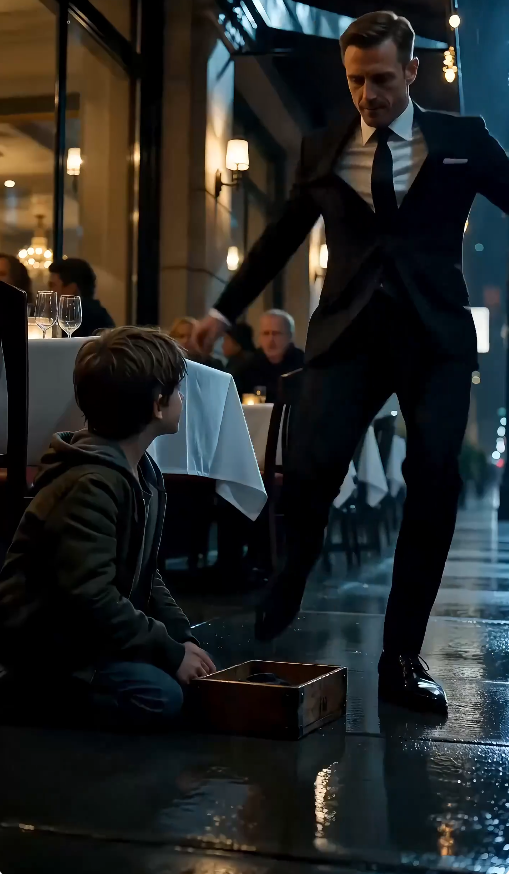
The restaurant owner fired the manager at the front door while rainwater still ran through the shoeshine boy’s broken box.
The boy stood barefoot on the wet sidewalk, clutching a soaked prescription in one hand and a pair of tiny medicine bottles in the other.
Inside the restaurant, wealthy guests stared through the glass as the most feared man in the city carried the boy’s sick little brother into the VIP room.
Only twenty minutes earlier, the manager had kicked the shoeshine box so hard that brushes, rags, coins, and polish tins scattered into the gutter.
“Get away from our guests, street rat.”
The boy had dropped to his knees in the rain, trying to save the coins before they washed away.
“Please… I only need money for my brother’s medicine.”
A black car stopped beside the curb.
A man in a dark coat stepped out, bent down, and picked up the shoeshine box with hands that had made powerful men tremble.
“How much does the medicine cost?”
The manager laughed from under the restaurant awning.
“Don’t waste your time on trash.”
Then the man saw the prescription slip fall from the boy’s pocket.
He picked it up.
His eyes stopped on the doctor’s name.
Dr. Clara Bennett.
The same doctor who had once saved his daughter’s life when no hospital dared touch her.
The man looked at the boy.
Then at the manager.
“Then tonight, this boy eats inside.”
But what the boy did not know was that the doctor’s name on that prescription was tied to the only promise the gang boss had ever been afraid to break.
Earlier that evening, Noah Alvarez sat on an overturned crate outside the golden doors of Bellavista, the most expensive restaurant on North Avenue.
He was twelve years old.
His hands were small but cracked from cold water, cheap polish, and winter wind.
His shoeshine box had been made from an old fruit crate.
One side was loose.
The handle was wrapped with tape.
Inside were two brushes, three tins of polish, a torn cloth, a folded photo of his mother, and a prescription he had checked so many times the paper had softened at the edges.
The prescription was for his little brother, Mateo.
Mateo was seven.
He had a lung infection that worsened every night.
The clinic doctor said the medicine had to be started immediately.
The pharmacy said immediate still had a price.
Noah had counted the cost in his head all day.
Seventy-eight dollars for the first medication.
Thirty-two for the inhaler refill.
Forty for the emergency clinic balance before they would release the next treatment note.
One hundred fifty dollars stood between Mateo and another night of breathing like each breath had to climb a mountain.
Noah had twenty-three dollars and sixty cents.
Most of it came from shining shoes outside train stations.
Some came from carrying groceries.
Two dollars came from a woman who cried when Noah told her he liked school but had missed three days to care for Mateo.
Noah hated telling strangers about his brother.
He hated the way pity felt like a hand pressing down on his head.
But Mateo had coughed blood that morning.
Pride could wait.
Medicine could not.
That was why Noah came to Bellavista.
The men who ate there wore leather shoes that cost more than his rent.
The women stepped from cars with heels that never touched mud.
Noah thought if he could polish ten pairs, maybe twelve, he could buy at least one bottle tonight.
He had just finished shining one businessman’s shoes when the manager noticed him.
Victor Lane had worked at Bellavista for six years.
He treated the front door like a border between human beings and problems.
Rich guests were welcomed.
Delivery workers were rushed.
Homeless people were chased away.
Children like Noah were removed before diners could feel uncomfortable.
Victor walked toward him with a tight smile that disappeared the moment he reached the sidewalk.
Noah stood quickly.
“I can move to the side, sir.”
Victor looked at the shoeshine box.
Then at Noah’s wet jacket.
Then at the guests arriving behind them.
He kicked the box.
It burst open against the curb.
Brushes rolled into the street.
Coins scattered.
Black polish spilled across the rainwater like oil.
“Get away from our guests, street rat.”
Noah dropped to his knees.
“Please… I only need money for my brother’s medicine.”
Victor stepped back so the rain would not splash his polished shoes.
He did not see a boy.
He saw an image problem.
A couple near the entrance looked away.
A waiter froze behind the glass door.
No one moved.
Noah reached for his coins.
One slipped between the drain bars.
His throat tightened.
That coin had been a bus fare.
Then the black car stopped.
It did not screech.
It did not honk.
It stopped with a calm that made the street notice.
The driver stepped out first.
Then the rear door opened.
Dante Moreau emerged into the rain.
He was fifty-one, tall, and still as a blade.
The city knew his name.
Some called him a gang boss.
Some called him a businessman.
Some called him worse things in private and respectful things in public.
Dante had grown up in alleys like the one behind Bellavista.
He had learned early that hunger had a sound.
A boy begging for medicine made that sound.
Dante looked at the broken shoeshine box.
He looked at Noah’s scraped knees.
Then he bent down and picked up the box himself.
The people under the awning stopped breathing.
“How much does the medicine cost?”
Noah looked up, startled.
He did not know who Dante was.
That made his fear honest instead of rehearsed.
“I don’t know if I can get all of it tonight.”
Victor scoffed.
“Don’t waste your time on trash.”
The word hung in the rain.
Dante’s driver looked at him once and lowered his eyes.
Everyone who knew Dante understood that some insults were dangerous.
But Dante did not move toward Victor.
He moved toward the prescription that had slipped from Noah’s pocket and landed beside a puddle.
He picked it up carefully.
Rain had blurred the edges, but the doctor’s name was clear.
Dr. Clara Bennett.
Dante went completely still.
The rain hit his face.
His eyes changed.
For one moment, North Avenue disappeared.
He saw a hospital corridor eight years earlier.
He saw his daughter Sofia on a stretcher, bleeding after a car crash caused by men trying to send him a message.
He saw doctors hesitating when they recognized his name.
He saw police outside.
He saw fear in every adult face.
Then he saw Dr. Clara Bennett step through the doors.
She did not ask who owed what.
She did not ask whether Sofia deserved saving because of her father.
She put on gloves and said that children were not responsible for the sins of men.
Sofia lived because Clara Bennett refused to let fear choose the patient.
After surgery, Dante offered her money.
Clara refused.
He offered protection.
She refused that too.
Then she told him something he never forgot.
The day a child begs you for help and you walk past, you lose whatever soul you were trying to save.
Dante had carried those words for eight years like a knife under his ribs.
Now he stood in the rain holding her prescription.
A child was begging.
And a man in a clean suit had called him trash.
Dante folded the prescription and placed it inside his coat.
Then he turned toward Victor.
“Then tonight, this boy eats inside.”
Victor laughed once, but the sound died quickly.
Dante’s driver stepped closer.
The restaurant owner, Marco Bellini, had been in the kitchen when a waiter whispered that Dante Moreau was at the door.
Marco ran out so fast he still held a towel in one hand.
He saw Dante.
He saw Noah.
He saw the broken shoeshine box.
Then he saw Victor’s face.
Marco understood enough.
Victor tried to explain.
He spoke about brand image.
He spoke about guests.
He spoke about street children bothering customers.
Marco did not let him finish.
He removed Victor’s manager badge at the entrance where he had humiliated Noah.
The rain made the badge shine before it disappeared into Marco’s hand.
Victor was told to leave immediately.
For the first time that night, Noah stopped gathering coins.
He looked at Dante as if kindness was more frightening than cruelty because it was less familiar.
Dante crouched beside him.
“Where is your brother?”
Noah swallowed.
“At home.”
“He can’t walk far.”
“He coughs if the air is cold.”
Dante looked at his driver.
The driver opened the rear door.
Noah hesitated.
Children who live with nothing learn that expensive doors can close on fingers.
Dante placed the shoeshine box gently into his hands.
“I am not taking you away from him.”
“I am taking you to him.”
Noah climbed into the car.
The leather seat was warm.
He sat on the edge, terrified of making it dirty.
Dante noticed.
He took off his coat and laid it under Noah’s soaked clothes without a word.
They drove six blocks to a narrow apartment building behind the old market.
Noah ran ahead up the stairs.
Dante followed.
The hallway smelled of damp walls and boiled cabbage.
Inside apartment 3C, Mateo lay on a thin mattress beside a space heater that barely worked.
His cheeks were flushed.
His breathing whistled.
A neighbor woman sat beside him with a wet cloth.
She stood when Dante entered, then froze when she recognized him.
Dante ignored the fear.
He moved to the child.
Mateo opened his eyes.
“Noah?”
Noah knelt beside him.
“I got help.”
Dante looked around the room.
There were schoolbooks stacked near the sink.
A photo of a woman in a bakery uniform taped to the wall.
Two bowls drying upside down.
No toys except a paper airplane made from a clinic bill.
Poverty had a way of leaving evidence everywhere.
Dante called Dr. Clara Bennett directly.
He had kept her number though he had never used it.
She answered on the third ring.
At first, her voice was guarded.
Then he said Noah’s name and read the prescription number.
Clara became sharp and immediate.
Mateo needed the medication tonight.
He also needed a hospital evaluation if his breathing worsened.
Dante asked where to take him.
Clara gave the hospital address.
Then she paused.
“Dante, listen to me.”
He did.
“You are not buying one rescue.”
“You are entering a child’s life.”
“Do not do it halfway.”
Dante looked at Noah rubbing Mateo’s cold hands between his own.
“I know.”
Within fifteen minutes, Mateo was wrapped in blankets and carried down to the car.
Noah sat beside him, holding the inhaler prescription like a passport.
Dante’s convoy moved toward St. Catherine’s Children’s Hospital.
At the pharmacy entrance, Dante paid for every medication on the list.
At the hospital desk, he paid the emergency balance, the past balance, and the next three months of care before the billing clerk finished asking for insurance.
Noah watched the black card slide across the counter.
He did not understand that kind of money.
He only understood that nobody was saying no anymore.
Dr. Bennett met them in the pediatric unit.
She was older than Dante remembered.
Her hair had more gray.
Her eyes were the same.
She examined Mateo quickly, spoke to nurses, ordered treatment, and never once looked impressed by Dante’s presence.
That comforted him.
Some people were anchors because they did not bow to storms.
Hours passed.
Noah refused to eat.
Dante had food sent from Bellavista.
Soup.
Bread.
Roast chicken.
Fruit.
Warm milk for Mateo when he was allowed.
Noah stared at the trays.
“That’s from the restaurant?”
Dante nodded.
“I thought they hated us.”
“One man did.”
“That is not the same as the whole world.”
Noah picked up the spoon slowly.
He ate like someone afraid the bowl might be taken away.
Later, when Mateo’s breathing eased, Dr. Bennett stepped into the hallway.
“He is past the worst of it.”
Noah burst into tears.
He tried to hide his face, but Dante saw.
The boy hugged his brother through the hospital blanket and cried with his whole body.
Mateo, weak and sleepy, patted Noah’s arm like he was the older one.
Dante stood near the doorway and looked away.
He had seen men die without blinking.
But two brothers surviving poverty together made something inside him ache.
When Mateo was stable enough, Dante kept his promise about dinner.
Not that night, because Mateo needed rest.
Two days later, after Dr. Bennett approved a short outing, Dante brought both boys to Bellavista.
They arrived through the front door.
Not the kitchen.
Not the side entrance.
The front door.
Marco Bellini stood outside waiting.
He welcomed Noah first.
Then Mateo.
Then he opened the door himself.
The VIP room had been prepared with warm lights, soft chairs, and a table low enough for Mateo to reach comfortably.
Noah brought his shoeshine box because he did not trust leaving it behind.
It had been repaired.
Dante’s driver had replaced the broken side with smooth wood and added a small brass latch.
Inside were new brushes, polish tins, cloths, and a folded envelope.
Noah opened it at the table.
Inside was not cash.
It was a school enrollment form, a medical care plan, and a note from Dante.
Your brother’s medicine is covered.
Your school is covered.
Your work is now your choice, not your survival.
Noah read the note three times.
Then he looked at Dante.
“Why?”
Dante glanced toward the doorway where Dr. Bennett had just arrived to check on Mateo before dinner.
“Because someone once saved my daughter.”
Noah frowned.
“The doctor?”
Dante nodded.
“And she reminded me that power is useless if it only protects itself.”
Noah looked down at the table.
“My mom used to say people with money don’t hear kids like us.”
Dante’s voice softened.
“Sometimes they hear.”
“Sometimes they pretend not to.”
“And sometimes a boy has to shout in the rain until the right person remembers who he was.”
After dinner, Marco brought dessert.
Mateo laughed for the first time in weeks when the chocolate cake arrived.
Noah watched him laugh and forgot, for one whole minute, to be afraid.
Victor Lane tried to claim he had only been enforcing restaurant standards.
The security footage ended that argument.
The clip showed him kicking the shoeshine box.
It showed Noah on his knees.
It showed guests doing nothing.
Marco issued a public apology and created a standing meal program for children from the neighborhood.
Not as a publicity stunt.
Dante made sure of that.
Every meal was logged.
Every child was treated at a table.
No one had to beg at the door.
Dante also funded a clinic account in Dr. Bennett’s name for families who could not afford urgent prescriptions.
Dr. Bennett agreed on one condition.
No branding.
No photographs.
No speeches.
Only medicine.
Dante accepted immediately.
Months passed.
Mateo grew stronger.
Noah returned to school.
He still shined shoes sometimes, but only on Saturdays because he liked earning his own money.
Bellavista allowed him to set up near the entrance on dry days, under an awning, with a small sign Marco made for him.
No one called him a street rat again.
Dante visited the restaurant once a month.
He always brought one pair of shoes for Noah to polish.
They were already clean.
Noah knew.
He polished them anyway.
It became their ritual.
One afternoon, Noah asked if Dante was really a bad man.
Dante looked at the shine forming on his shoe.
“I have been.”
Noah waited.
“Are you still?”
Dante looked through the restaurant window at Mateo eating soup with Marco near the kitchen.
“I am trying to be someone Dr. Bennett would not regret saving.”
Noah nodded as if that answer made sense.
Maybe it did.
Children understand trying better than adults do.
Years later, Noah no longer sat outside restaurants with a shoeshine box.
He became a pharmacist.
Not a famous one.
Not a rich one.
A careful one.
The kind who noticed when a mother counted coins too slowly.
The kind who called the doctor before denying medicine.
The kind who kept a private fund under the counter for children whose prescriptions came with panic in their eyes.
Mateo became a paramedic.
He said he wanted to be the person who arrived before a brother had to beg strangers in the rain.
At the opening of a new neighborhood clinic, Dr. Bennett stood beside them.
Dante came late, as always.
Older now.
Quieter.
Still feared by some.
Known by others as the man who paid bills before asking names.
Noah brought the old shoeshine box with him.
It sat in a glass case near the clinic entrance.
Inside were the original brushes, the repaired latch, and the soaked prescription that had changed everything.
Beneath it was one sentence.
No child should have to polish shoes to buy breath.
Dante read it and said nothing.
But his eyes stayed on the prescription for a long time.
He remembered Sofia in the hospital.
He remembered Clara Bennett’s words.
He remembered Noah kneeling in the rain.
He remembered Victor calling a child trash and the whole city, for one heartbeat, having to decide whether it agreed.
The boy had been kicked into the rain.
The gang boss had stepped out of the black car.
But the real rescue began when a prescription carried the name of a doctor who had once protected a child without asking who her father was.
May you like



And because of that, two brothers ate inside, medicine reached the sick, and one feared man remembered that the strongest doors are not the ones money opens.
They are the ones opened for children who have nowhere else to knock.







