“They kicked the janitor out of the symphony room… then he lifted the baton.”
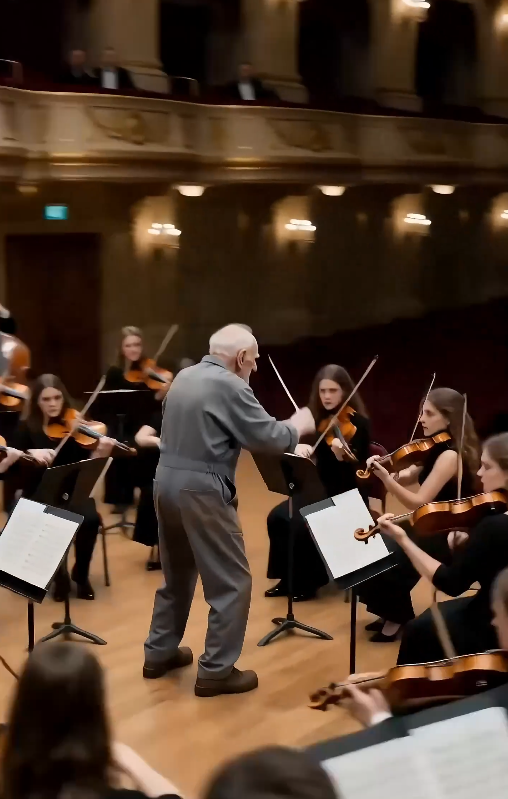
The laughter died the moment the old janitor lifted the conductor’s baton.
Every violinist in the Royal Aurelia Academy rehearsal room froze.
The manager still had one hand raised after shoving him away from the conductor’s stand.
Only seconds earlier, he had snapped at the gray-haired man in the faded cleaning uniform.
“Don’t touch the conductor’s stand.”
The old janitor had bent down, collecting a fallen page from the floor.
“I only wanted to fix the score.”
A young violinist in the front row laughed loud enough for the entire orchestra to hear.
“He can’t even read music.”
The old man looked at the torn, misplaced score in his hand.
Then he looked at the orchestra.
“Then let the music speak.”
He stepped onto the podium.
He raised the baton.
The room held its breath.
When his wrist moved, the strings entered perfectly.
The brass softened before he even signaled.
The cellos followed a tempo no one had rehearsed, yet every musician felt pulled into place by a force older than memory.
The music transformed.
Wrong notes corrected themselves.
Chaos became a storm.
A storm became grief.
Grief became beauty.
Then the academy principal rushed through the door, saw the old man conducting, and fell to his knees in front of the entire orchestra.
“Maestro.”
The manager turned white.
Because the janitor was not a janitor.
He was Elias Moreau, the academy’s legendary founder, believed dead after a concert hall accident fifteen years earlier.
But the score in his hand revealed something even darker.
The accident had never been an accident.
Earlier that morning, Elias Moreau pushed a mop bucket down the marble hallway of the Royal Aurelia Academy.
No one moved aside for him.
No one greeted him by name.
Most students knew him only as Mr. Elias, the quiet janitor who cleaned rehearsal rooms, polished brass door handles, and fixed broken music stands without being asked.
His uniform was always too loose.
His shoes were always silent.
His hair was white now, though old posters in the locked archive showed a man with black hair, fierce eyes, and a baton raised like a blade of light.
No student connected the two.
Why would they?
The great Maestro Elias Moreau had disappeared fifteen years earlier after a chandelier collapsed during a charity concert.
The newspapers wrote that he had died later from his injuries.
The academy held a memorial.
A portrait was hung in the grand hall.
A scholarship was named after him.
Then the board slowly forgot the man and kept only the prestige his name gave them.
Elias did not correct them.
After the accident, he had woken in a hospital outside the city with a damaged memory, a hand that shook, and no proof of who he was.
His documents were missing.
His assistant had vanished.
His wife had died years before.
His closest students had scattered.
For a long time, he remembered only music.
Not his name.
Not his fame.
Only the way strings should breathe before a crescendo.
Years later, fragments returned.
A hallway.
A portrait.
A rehearsal room.
A melody from his unfinished final symphony.
He returned to the academy quietly, expecting recognition.
Instead, he found a young manager at the entrance who dismissed him as a homeless old man looking for shelter.
The academy needed cleaning staff.
Elias accepted the job.
At first, he told himself it was temporary.
Then he began watching.
He saw scholarship students ignored.
He saw wealthy parents influence seating charts.
He saw teachers afraid of donors.
He saw managers use his name while betraying everything he had built.
So he stayed.
He cleaned the floors of his own academy and listened.
That morning, the youth orchestra was rehearsing for the Founder’s Memorial Gala.
The irony almost made him smile.
They were performing his final symphony.
Or rather, the damaged version the academy claimed was his.
Elias heard the error from the hallway before he entered.
The second violin line was wrong.
Not slightly wrong.
Deliberately wrong.
Someone had altered the transition into the final movement.
The music now sounded grand but hollow, as if grief had been polished into vanity.
Elias pushed open the rehearsal room door.
A page of the conductor’s score had fallen near the podium.
He bent to pick it up.
The manager, Victor Hale, spotted him immediately.
Victor ran the academy’s public events, donor seating, rehearsal access, and nearly everything that required power without talent.
He loved polished floors because they reflected money.
He hated people who reminded donors of poverty, age, or failure.
When he saw the janitor near the conductor’s stand, his face hardened.
He crossed the room and shoved Elias backward.
“Don’t touch the conductor’s stand.”
Elias held the fallen page carefully.
“I only wanted to fix the score.”
A few students laughed.
One young violinist, Julian Voss, leaned back in his chair and smirked.
“He can’t even read music.”
The laughter spread.
Not loudly.
Not bravely.
The cowardly kind of laughter that waits to see whether cruelty is allowed.
Elias looked at the students.
He saw talent.
He also saw fear.
Fear of losing seats.
Fear of donors.
Fear of being next.
Then his eyes moved to the score.
The altered passage was there.
The same wrong notes.
The same false cadence.
And beneath the ink, barely visible where time had faded the page, was his own original pencil mark.
A private correction.
A tiny symbol he had used only in manuscripts he never published.
The symbol meant wait for sorrow.
Elias remembered the night of the accident.
The chandelier above the stage.
The final rehearsal.
Victor Hale, younger then, standing near the lighting rig with unauthorized access papers.
A board member whispering about selling the academy’s land.
His own refusal to sign.
Then light.
Glass.
Pain.
Darkness.
His hand tightened around the score.
Victor reached for the page.
Elias did not give it to him.
“Then let the music speak.”
He stepped onto the podium.
The room went silent, partly from shock and partly from the strange authority in his posture.
The current conductor was late.
The students looked at one another.
Victor barked for security, but no one moved fast enough.
Elias lifted the baton from the stand.
His hand trembled once.
Then steadied.
He inhaled.
The orchestra entered.
At first, the students played because they were confused.
Then they played because they could not resist.
Elias did not conduct like a school conductor.
He conducted like a man calling memory back from the dead.
His left hand opened and the violas softened.
His eyes cut toward the horns and they corrected their volume.
He turned half an inch toward the cellos and they found a warmth they had never reached in rehearsal.
Julian Voss stopped smiling.
His bow hand shook.
He realized the old man had corrected him without looking at the sheet.
The academy principal, Madame Celeste Armand, arrived just as the final phrase began.
She had been a young pianist when Elias founded the academy.
She had believed him dead for fifteen years.
When she saw the old man on the podium, her body seemed to forget how to stand.
The baton lowered.
The final chord trembled into silence.
Celeste walked forward slowly.
Then she bowed her head.
“Maestro.”
The room gasped.
Victor staggered back.
Elias turned toward him with the score still in his hand.
Now everyone saw the old janitor differently.
The cleaning uniform did not make him smaller anymore.
It made the room ashamed.
Celeste took the page from Elias with both hands.
She saw the private correction mark.
She saw the altered ink.
She saw the signature hidden beneath the copy layer.
Her face changed.
The academy’s final symphony manuscript had been tampered with.
Elias pointed to the altered passage and then to Victor.
Victor tried to laugh.
He said the old man was confused.
He said trauma could create fantasies.
He said the academy should not embarrass itself in front of students.
But Celeste had already called the archive director.
Within an hour, the original sealed manuscripts were brought from storage.
The comparison was undeniable.
The published gala score had been altered.
The original board minutes from fifteen years earlier were pulled.
So were maintenance logs.
Access records.
Insurance claims.
Old security photographs.
Victor Hale had been a junior administrator on the night of the chandelier collapse.
He had signed off on a lighting inspection that never happened.
He had later received a promotion from the board member who wanted Elias removed.
That board member was dead now.
Victor had survived by becoming useful to richer men.
The accident had been buried as tragedy.
Elias had been buried as memory.
But music had kept the truth alive in the margins.
Victor was removed from the academy before sunset.
Not quietly.
Celeste made the announcement in the same rehearsal room where he had shoved Elias.
The students stood in silence.
Julian Voss stared at the floor.
He was the first to approach Elias after Victor left.
His apology was awkward.
Pale.
Too late.
But real enough to begin.
Elias looked at the young violinist’s expensive instrument.
Then at the boy’s frightened eyes.
He remembered arrogant students from decades before.
Most cruelty in children, he had learned, was borrowed from adults.
He did not forgive the humiliation.
But he did not destroy the boy either.
He handed Julian the corrected score and tapped the second violin line.
Julian understood.
The next rehearsal began with him playing the passage alone until it sounded honest.
The Founder’s Memorial Gala changed completely.
It was no longer a memorial.
It became a return.
The academy announced that Maestro Elias Moreau had been found alive.
The city flooded the hall with reporters, alumni, musicians, and former students who had once built their lives around his teaching.
Elias refused interviews.
He refused a grand speech.
He asked only for one thing.
The youth orchestra would perform the original final symphony exactly as he had written it.
No donor edits.
No vanity tempo.
No polished lie.
On the night of the gala, Elias entered the stage in a black suit borrowed from the academy wardrobe.
It did not fit perfectly.
No one cared.
The audience stood before he reached the podium.
Celeste wept openly in the front row.
Julian sat in the second violin section, his bow still, his face serious.
The scholarship students sat among the best players for the first time, not behind them.
Elias lifted the baton.
The hall fell silent.
The music began as a whisper.
Then it grew into the sound of years stolen and returned.
The final movement carried everything he had lost.
His name.
His academy.
His students.
His memory.
His anger.
His mercy.
And when the corrected passage arrived, the orchestra waited for sorrow exactly as the pencil mark demanded.
The pause was so deep that the audience seemed afraid to breathe.
Then the strings entered.
Not loudly.
Truth does not always need volume.
Sometimes it only needs to be played correctly.
When the symphony ended, Elias lowered his baton.
For a moment, no one applauded.
Then the hall erupted.
Students cried.
Old musicians pressed hands to their mouths.
Celeste stood and bowed to him again.
This time, the entire academy followed.
Elias looked at the young faces before him and understood why he had returned as a janitor before returning as a maestro.
He had needed to see what the academy had become when no one thought greatness was watching.
The next week, the board was investigated.
Victor Hale faced charges related to fraud, evidence tampering, and obstruction in the old accident inquiry.
The academy stripped his name from every program.
The donor committee lost control over student placement.
Scholarship auditions were moved behind screens.
No parent could buy a seat.
No manager could remove a musician from rehearsal without artistic review.
Elias also changed the cleaning staff policy.
Every staff member received full wages, healthcare, and free access to concerts.
He said anyone who keeps music halls standing deserves to hear the music too.
Months later, a new portrait was hung in the grand hall.
It showed Elias not as the young founder with fire in his eyes, but as the old man in the cleaning uniform, holding a baton in one hand and a torn score in the other.
Some board members objected.
Elias insisted.
He said the academy needed to remember the day it mistook its founder for someone disposable.
Years passed.
Julian Voss became a better violinist after he became a better listener.
He eventually taught younger students never to laugh at old hands, worn shoes, or quiet people near music stands.
Madame Celeste remained principal and guarded the academy like a promise.
Elias never fully recovered every memory, but he recovered enough.
And every year, during the Founder’s Concert, he conducted the final symphony.
Always with the same baton.
Always with the corrected score.
Always pausing at the mark that meant wait for sorrow.
Students whispered the story to new arrivals.
They told them about the janitor.
The shove.
The laughter.
The baton.
The principal’s bow.
The hidden correction.
They told it like a legend, but Elias knew it was simpler than that.
A man had been erased.
A piece of music had remembered him.
They kicked the janitor out of the symphony room.
Then he lifted the baton.
But the real triumph was not that the orchestra finally recognized him.
May you like



It was that the music did.
And from that day forward, no one at the Royal Aurelia Academy ever again laughed at a person standing near the conductor’s stand with quiet hands and something important to correct.







