“They dragged the old man away from the VIP table.”
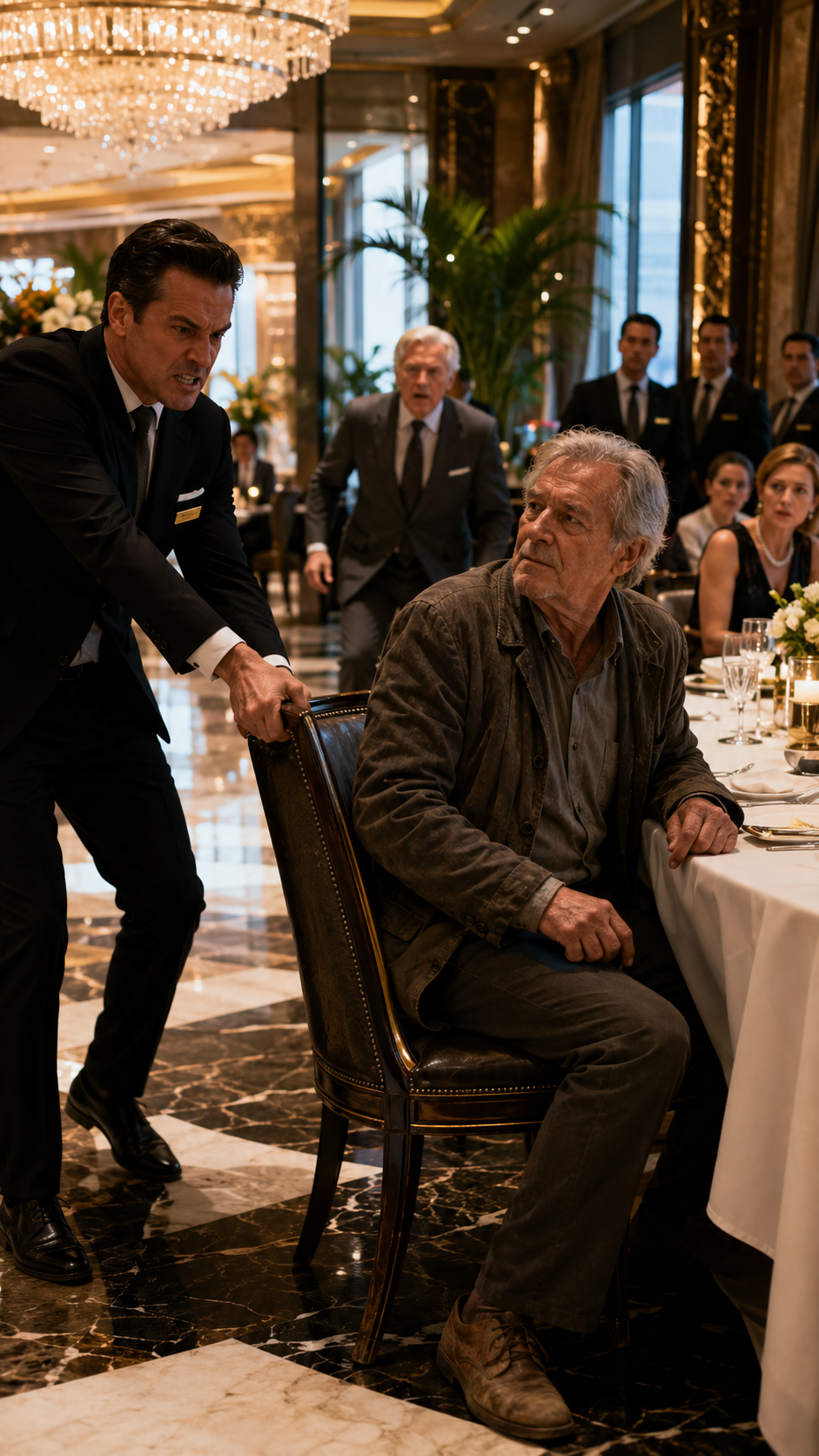
“They dragged the old man away from the VIP table.”
“This seat costs more than you make in a year.”
The restaurant manager yanked the chair backward so violently that the old man nearly fell against the table.
Crystal glasses trembled.
A silver spoon struck the marble floor.
Every conversation inside the five-star hotel restaurant stopped at once.
Seventy-year-old Arthur Cole steadied himself with one hand against the white tablecloth.
His faded jacket hung loosely from his shoulders.
His shoes were clean but badly worn.
In his left hand, he held a small brown envelope.
In his right, he carried a single white rose.
The manager, Victor Lane, looked him over with open disgust.
“This table is reserved for the most important guest of the evening.”
Arthur glanced at the polished brass plaque in front of the chair.
Reserved for Mr. Arthur Cole.
“I believe that is my name,” he said quietly.
Several wealthy diners laughed.
Victor smirked.
“Anyone can read a plaque.”
Arthur did not argue.
He only looked at the empty chair across from his own.
A second white rose had already been placed beside that plate.
Victor followed his gaze.
“You are not sitting here.”
He gripped Arthur’s arm and pulled him toward the aisle.
“This hotel serves people who understand where they belong.”
Arthur’s expression tightened, but his voice remained calm.
“And where do you believe I belong?”
Victor pointed toward the service entrance.
“Outside.”
No guest defended him.
Some avoided looking.
Others watched with the same curiosity they might show a broken glass being swept from the floor.
A woman near the window whispered that the old man was probably trying to steal food.
Arthur heard her.
He lowered his eyes and tightened his fingers around the envelope.
Forty-two years earlier, the restaurant had not possessed marble floors, chandeliers, or a VIP table.
It had been a failing roadside hotel with leaking ceilings and only twelve usable rooms.
Arthur had been twenty-eight then.
He repaired boilers during the day and worked night shifts at a factory.
His wife, Eleanor, cooked breakfast for travelers in the hotel kitchen.
The owner could not afford to pay them regularly.
Some weeks, they accepted bags of potatoes instead of wages.
When the bank announced it would seize the property, Arthur sold the small house his father had left him.
Eleanor sold her mother’s wedding necklace.
Together, they bought the hotel three days before foreclosure.
They rebuilt it one room at a time.
Arthur repaired plumbing, carried luggage, painted walls, and slept in the basement whenever guests filled every bed.
Eleanor cooked, cleaned, kept the accounts, and remembered every guest’s name.
Their first profitable year ended with a dinner at the corner table overlooking the lobby.
They could afford only one bowl of soup between them.
Eleanor placed a white rose beside Arthur’s plate and said, “One day, this will be the best table in the finest hotel in the city.”
Arthur laughed.
“Then I hope they still let us eat soup here.”
They returned to that table every anniversary for forty years.
Even after the hotel expanded.
Even after magazines praised it.
Even after politicians and celebrities began reserving rooms months in advance.
Arthur never changed the table.
He said it reminded him that success was dangerous when it erased the hunger that created it.
Ten years earlier, Arthur had appointed a young employee named David Mercer to run the growing hotel group.
David had started as a bellboy.
He was intelligent, loyal, and grateful.
When Arthur retired to care for Eleanor during her illness, David promised that the hotel would never forget who built it.
Eleanor died eleven months before the anniversary dinner.
Tonight would have been their forty-first visit to the table.
Arthur had come carrying the white rose she could no longer bring herself.
Instead, he was being dragged toward the exit.
Victor tightened his grip.
“You are embarrassing the guests.”
Arthur looked around the room.
“No.”
“I believe they are embarrassing themselves.”
Victor’s face hardened.
He signaled to two security officers near the lobby.
Before they could approach, the elevator doors opened.
David Mercer stepped out wearing a dark tailored suit.
At fifty-eight, he was known across the city as the owner of the Mercer Grand Hotel Group.
He was reviewing notes for the hotel’s anniversary speech when he noticed the disturbance.
Then he saw Arthur.
The papers slipped from his hand.
“Mr. Cole?”
Victor stopped.
David rushed across the lobby.
His face changed as he saw the hand gripping Arthur’s arm.
“Let him go.”
Victor released Arthur immediately.
“Mr. Mercer, this man entered the VIP section without authorization.”
David looked at the brass plaque.
Then at Arthur.
Then at the white rose.
His expression filled with horror.
“You pulled him from his own table?”
Victor blinked.
“His table?”
David stepped in front of Arthur and bowed deeply.
“Sir, I am so sorry.”
The restaurant fell silent.
Several guests rose slowly from their chairs.
Victor’s face drained of color.
David turned toward the room.
“This hotel exists because of him.”
A stunned murmur passed through the restaurant.
David pointed toward the black-and-white photographs lining the far wall.
One showed a young Arthur and Eleanor standing outside the original roadside hotel.
Arthur held a hammer.
Eleanor held a tray of coffee.
They were smiling despite the cracked windows behind them.
“That man built the first rooms with his own hands,” David said.
“He saved this property when no bank believed it could survive.”
“He trained every employee who helped turn it into what you see today.”
Victor stared at the photograph.
The younger face was unmistakable.
“I didn’t know,” he whispered.
Arthur looked at him.
“No.”
“You only knew my jacket was old.”
Victor lowered his eyes.
David pulled the VIP chair back into place himself.
“Please sit down, Mr. Cole.”
Arthur remained standing.
His gaze moved across the guests who had watched without speaking.
Several now looked ashamed.
One man who had laughed earlier quietly placed his napkin over his plate.
Arthur looked at Victor.
“Why did you remove me?”
Victor swallowed.
“You did not look like a VIP guest.”
Arthur nodded slowly.
“That is not an answer.”
Victor’s voice weakened.
“I thought you did not belong.”
“Because I threatened someone?”
“No.”
“Because I behaved badly?”
“No.”
“Because I was dressed poorly?”
Victor could not answer.
Arthur turned toward David.
“Do not fire him tonight.”
Victor looked up in surprise.
David’s expression remained cold.
“Sir, what he did was unacceptable.”
“It was,” Arthur agreed.
“But humiliation does not become justice simply because we return it.”
Arthur faced Victor again.
“You will work one month outside management.”
“You will serve breakfast with the waiters.”
“You will clean rooms with housekeeping.”
“You will carry luggage with the porters.”
“You will learn the names of every person whose work makes your suit possible.”
Victor’s pride collapsed.
“And if I refuse?”
Arthur’s eyes became firm.
“Then you will prove you were never qualified to manage anything except appearances.”
Victor nodded.
“I will do it.”
Arthur finally sat at the VIP table.
David took the chair beside him, but Arthur pointed to the empty place across the table.
“That seat belonged to Eleanor.”
David’s eyes filled.
“I remember.”
A server approached carrying two bowls of soup.
She placed one in front of Arthur.
Then she set the second bowl beside the white rose at the empty place.
Arthur looked at her name badge.
“Maria,” he said softly.
The young woman froze.
Few guests ever read her name.
“Yes, sir.”
“Thank you for remembering.”
Maria smiled through tears.
“It was Mrs. Cole’s favorite.”
Arthur lifted his spoon but could not eat.
The restaurant had become painfully quiet.
David asked whether he wanted the room cleared.
Arthur shook his head.
“No.”
“Let them stay.”
“Everyone should see what memory costs when it is neglected.”
The anniversary program began twenty minutes later.
David invited Arthur to the small stage near the grand piano.
The guests stood as he approached.
Arthur did not enjoy applause.
He waited until it stopped.
Then he placed the brown envelope on the podium.
“I came tonight because Eleanor and I made a promise at that table.”
“We promised success would never teach us to look down on the people we once were.”
He glanced toward Victor.
“Tonight, I learned the hotel has forgotten.”
David lowered his head.
Arthur continued.
“But one man’s cruelty is rarely born alone.”
“It grows when others laugh.”
“It grows when witnesses remain silent.”
“It grows when a room decides dignity belongs only to the powerful.”
Several guests shifted uncomfortably.
Arthur lifted the envelope.
“This contains documents I signed before coming here.”
David looked at him.
“What documents?”
Arthur did not answer immediately.
He opened the envelope and removed a legal folder.
For years, newspapers had described David Mercer as the owner of the hotel group.
That was not entirely true.
David owned twenty percent.
Arthur still controlled the remaining shares through a private trust.
No one outside the company’s legal office knew.
Arthur had planned to transfer those shares to David that evening.
It was meant to be his final gift.
David stared at the folder.
“You were giving me the company?”
“I was.”
The word struck harder than accusation.
David’s face collapsed.
“I failed you.”
Arthur looked at him sadly.
“You trusted systems more than people.”
“That failure belongs to both of us.”
David shook his head.
“I should have protected what you built.”
“You still can.”
Arthur turned to the guests.
“The ownership transfer will proceed.”
David looked stunned.
“But the shares will not go to one man.”
Arthur removed a second document from the folder.
“Beginning tomorrow, this hotel group will belong partly to its employees.”
A gasp passed through the room.
“Housekeepers, cooks, porters, receptionists, maintenance workers, and servers will receive voting shares through an employee trust.”
“Executive bonuses will depend on staff wages, workplace complaints, and guest treatment.”
“Any employee may challenge a manager’s conduct without risking dismissal.”
David’s eyes filled with tears.
“Eleanor wanted this?”
Arthur smiled faintly.
“She wrote the first version fifteen years ago.”
“She said no hotel should become rich by making its workers invisible.”
Victor stood near the wall, listening with his head lowered.
Arthur closed the folder.
“I had forgotten the plan.”
“Tonight reminded me.”
The guests applauded again.
Arthur raised one hand.
“This is not a celebration.”
“It is a correction.”
The applause stopped.
One month later, Victor completed every task Arthur had assigned.
He cleaned bathrooms.
He changed sheets.
He carried luggage through rain.
He ate lunch in the basement cafeteria with employees whose names he had never learned.
On his third week, a dishwasher named Luis fainted from exhaustion.
Victor discovered Luis had been working two jobs because his hotel wage could not cover his daughter’s medicine.
For the first time, Victor understood that the people he had dismissed were carrying lives heavier than any tray.
When his month ended, he asked Arthur for permission to return as manager.
Arthur gave him one condition.
“You may manage the restaurant again only if every employee who worked beside you agrees.”
The staff voted.
The result was eleven in favor and nine against.
Victor returned, but the narrow margin stayed with him.
He changed slowly.
Not because he feared losing his job.
Because nineteen people had looked at his name on a ballot and decided whether he deserved power.
He never forgot that.
David also changed.
He moved his office from the top floor to a smaller room beside staff operations.
He ate with employees twice a week.
He created an emergency fund in Eleanor’s name for workers facing medical debt.
The hotel became more successful, but Arthur rarely discussed profits.
He cared more about the staff turnover falling.
He cared that complaints were answered.
He cared that Maria became restaurant supervisor after years of being overlooked.
Every year, Arthur returned to the VIP table with two white roses.
One for Eleanor.
One for the person he had been before the world called him important.
Three years after the humiliation, Arthur’s health began failing.
He invited David, Victor, Maria, and several longtime workers to the anniversary dinner.
The second bowl of soup was placed across from him as always.
After the meal, Arthur reached beneath his chair and removed a small wooden box.
Inside was the brass plaque that once marked the table.
Reserved for Mr. Arthur Cole.
David smiled sadly.
“You’re taking it home?”
Arthur shook his head.
“I want it replaced.”
“With what?”
Arthur handed Maria a folded card.
She read it and began crying.
The new plaque was installed the following morning.
It did not contain Arthur’s name.
It read:
Reserved for anyone who has been made to feel they do not belong.
The table was no longer limited to celebrities or executives.
Each week, hotel staff chose a guest who had shown courage, kindness, or dignity without expecting recognition.
A homeless veteran ate there after returning a wallet full of cash.
A single mother sat there after helping an elderly stranger through a snowstorm.
A dishwasher celebrated his daughter’s graduation there.
Arthur watched quietly as the most exclusive seat in the hotel became the one place where wealth could not buy admission.
He died peacefully the following winter.
At his memorial, hundreds of employees filled the ballroom.
Victor placed Arthur’s old jacket over the VIP chair.
Maria set a bowl of soup beside it.
David delivered no speech about revenue, awards, or luxury.
He spoke only about the night they nearly threw their founder into the street.
After the memorial, David opened the final envelope Arthur had left with the company attorney.
Inside was Eleanor’s original handwritten version of the employee trust.
Beneath her signature was a message Arthur had never shown anyone.
If they ever forget who built this place, do not close the doors.
Open them wider.
David turned the page and found one final legal instruction.
Arthur had transferred the last of his personal fortune into a fund that would buy temporary rooms for families facing eviction.
No press release was permitted.
No donor plaque could carry his name.
The guests who stayed through that program would enter through the main doors and eat breakfast in the same dining room as everyone else.
Years later, visitors still asked why an old, faded jacket hung beside the finest table in the hotel.
The staff always answered the same way.
“It belonged to the richest man who ever walked through these doors.”
Most visitors assumed they meant money.
Only those who stayed long enough to hear the full story understood the truth.
May you like



Arthur’s greatest fortune was not the hotel he built.
It was the door he refused to close, even on the people who had once tried to throw him out of it.







