“They chased the hungry boy out… then the chef saw what he was holding.”
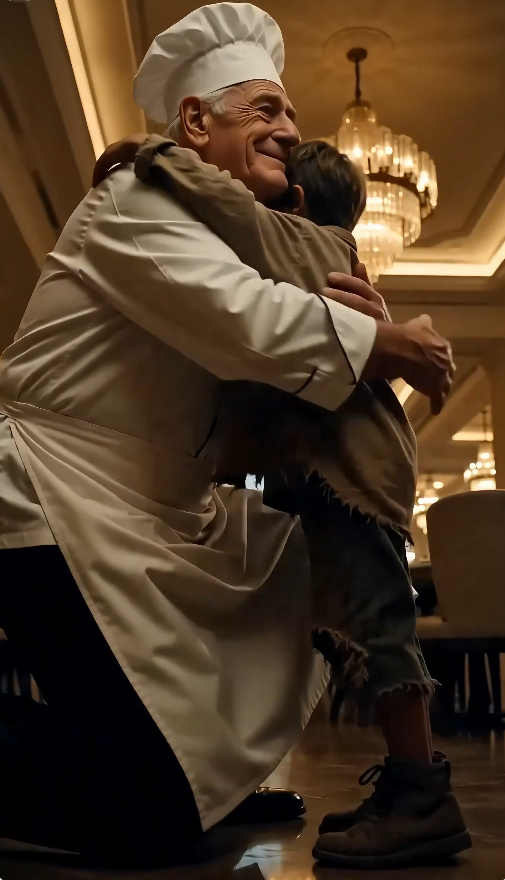
“No money, no food.”
“Get out.”
The manager’s hand clamped around the boy’s thin arm and dragged him through the polished restaurant doors.
The lunch crowd inside the Silver Garden barely stopped eating.
Forks continued to cut into roasted lamb.
Wine glasses lifted beneath golden chandeliers.
Soft piano music floated over tables covered in white linen.
The boy stumbled onto the sidewalk and nearly fell.
He was ten years old, small for his age, with torn sneakers, a faded hoodie, and cheeks hollow from too many missed meals.
His name was Milo.
He clutched a paper bag against his chest, but it was empty.
The manager, Victor Sloan, stood in the doorway with a face full of disgust.
The smell of butter, garlic, and fresh bread poured out behind him like a cruel invitation.
Milo wiped his eyes with the back of his sleeve.
“I just wanted the leftovers for my little sister.”
Victor looked at the people passing on the sidewalk, embarrassed only because the boy had made the scene visible.
He stepped forward and pointed down the street.
Milo turned and ran before the man could grab him again.
He did not run far.
His stomach hurt too badly for that.
Halfway past the restaurant window, his foot caught on a loose stone, and he fell hard onto one knee.
The old photograph slipped from inside his hoodie and fluttered onto the wet pavement.
It landed faceup beside the curb.
Inside the restaurant kitchen, Chef Gabriel Moreau had seen everything through the narrow service window.
He was sixty-four, broad-shouldered, silver-haired, and famous for refusing interviews.
People came from other cities to taste his food.
Critics called him a genius.
Customers called him a legend.
But the staff knew him as a quiet man who stayed after closing to feed stray cats behind the alley and who never allowed bread to be thrown away.
He had been plating soup when Victor dragged the boy outside.
The bowl remained untouched in his hands.
When the photo fell, Gabriel saw it through the glass.
Something about it stopped him.
Not the paper.
Not the boy.
The woman in the picture.
Gabriel set the soup down and walked out of the kitchen without removing his apron.
Victor turned as he entered the dining room.
“Chef, I handled it.”
Gabriel did not look at him.
He pushed through the front doors and stepped into the cold air.
Milo was on his knees, reaching for the photograph with shaking hands.
Gabriel crouched before he could hide it.
“Where did you get that picture?”
Milo froze.
His eyes were red and frightened.
He pulled the photograph close to his chest as if it were food someone might steal.
“It’s my mother’s… before she died.”
Gabriel’s face changed.
The city sounds around them became distant.
He held out one trembling hand.
“May I see it?”
Milo hesitated.
People had taken many things from him.
Food.
Warmth.
Trust.
But the old man’s voice did not sound like the manager’s.
It sounded like someone asking permission from a wound.
Milo handed him the photograph.
Gabriel looked at it once.
Then again.
His knees weakened.
The woman in the photo was young, smiling, and standing beside a street cart covered with flowers.
Her hair was dark.
Her eyes were bright.
Around her neck was a small silver spoon pendant.
Gabriel knew that pendant.
He had carved it from an old serving spoon on his daughter’s sixteenth birthday.
Her name had been Elise.
Twenty-two years ago, Elise Moreau walked out of his life after a terrible argument in this very restaurant.
She had wanted to marry a delivery driver Gabriel believed would ruin her future.
Gabriel had shouted.
Elise had cried.
He had said words fathers should never say if they want the door to remain open.
If you leave with him, do not come back.
She left.
For years, Gabriel waited for anger to soften enough for pride to move.
Then the letters stopped coming.
The phone number no longer worked.
Her husband vanished from every address Gabriel found.
Eventually, someone told him Elise had died in another state.
No grave.
No goodbye.
Only a rumor and a silence that grew heavier every year.
Gabriel stared at the photograph until the woman blurred.
“Elise,” he whispered.
Milo’s eyes widened.
“You knew my mom?”
Gabriel lowered the photograph.
His voice barely worked.
“She was my daughter.”
Milo stared at him.
The sidewalk, the restaurant, the manager in the doorway, and the watching customers all disappeared from the boy’s face.
All that remained was hunger meeting history.
“My mom said her father was dead.”
Gabriel flinched.
The words struck him exactly where he deserved.
“To her, maybe I was.”
Milo looked down.
“She never talked about family.”
“She just kept this picture.”
“And a little box.”
Gabriel’s breath caught.
“What box?”
Milo stepped back slightly.
“It’s with my sister.”
Gabriel stood too fast and almost lost balance.
“Where is she?”
Milo hugged himself.
“In the old laundry building near the train tracks.”
Victor had followed them out now, annoyed and pale.
Gabriel turned on him.
“Bring my coat.”
Victor blinked.
“Chef, we have a full lunch service.”
Gabriel’s eyes hardened.
“Then feed them bread and shame until I return.”
Victor said nothing.
A young server ran out with Gabriel’s coat instead.
Gabriel wrapped it around Milo’s shoulders without asking.
The coat swallowed the boy.
Milo looked up at him, uncertain what kindness cost.
Gabriel looked back toward the restaurant.
Every customer near the window was watching now.
He did not care.
He took Milo’s hand.
“Take me to your sister.”
They walked quickly through three blocks of cold wind and traffic.
Milo’s hand was small and icy in Gabriel’s palm.
The boy kept glancing at him as if afraid the chef might disappear before they reached the truth.
The laundry building stood behind the train tracks, half abandoned, its windows boarded on one side and cracked on the other.
Inside, the air smelled of dust, soap, and old rain.
Milo led Gabriel behind a row of broken machines.
A little girl lay curled on a pile of blankets.
She was six years old.
Her name was Ruby.
Her face was pale, and she was trying to sleep through hunger.
When Milo approached, she opened her eyes.
“Did you get food?”
Milo stopped.
The question crushed him.
Gabriel knelt.
Ruby looked at the tall chef in the white apron and shrank back.
Milo quickly said, “He knew Mom.”
Ruby blinked.
Gabriel removed a clean napkin from his coat pocket and placed it on the floor like a tiny tablecloth.
From another pocket, he took two wrapped rolls he always carried from the kitchen for the alley cats.
He gave one to Ruby and one to Milo.
They stared at the bread.
“Eat slowly,” Gabriel said.
Ruby took the smallest bite possible.
Milo tried to do the same, but hunger betrayed him.
Gabriel looked away for a moment because watching children ration bread hurt more than any bad review he had ever received.
After they ate, Milo crawled behind a rusted machine and pulled out a dented tin box.
He held it to Gabriel.
“This was Mom’s.”
Gabriel took it carefully.
Inside were three things.
The photograph.
A spoon pendant wrapped in cloth.
And a folded letter that had been opened and closed so many times the paper had nearly split at the creases.
Gabriel recognized Elise’s handwriting before he read a word.
His hands shook.
Milo watched him closely.
“Can you read it?”
Gabriel nodded.
But he did not open it immediately.
He was afraid of what twenty-two years might say.
Finally, he unfolded the letter.
Papa,
I told Milo you were dead because I did not know how to explain that love can still hurt after it leaves.
Gabriel covered his mouth with one hand.
The children stared at him.
He kept reading.
I tried to come home twice.
The first time, I stood across the street from the restaurant and saw your name in gold letters.
I was proud and ashamed at the same time.
The second time, I had Milo in my arms, and Victor told me you refused to see me.
Gabriel stopped breathing.
Victor.
The name turned the letter into a knife.
He read the line again.
Victor told me you refused to see me.
His vision darkened.
He had never refused.
No one had ever told him Elise came.
He forced himself to continue.
If my children ever find you, do not let pride answer the door first.
Feed them before you ask for forgiveness.
That was my last request as your daughter.
Elise.
The letter slipped slightly in his hand.
Ruby looked scared.
Milo whispered, “Are you mad?”
Gabriel folded the letter with heartbreaking care.
“No.”
His voice broke.
“I am late.”
Milo did not understand.
Gabriel looked at both children.
“I am your grandfather.”
Ruby stared at him with bread crumbs on her sleeve.
Milo’s lips parted.
“You’re Mom’s father?”
Gabriel nodded.
Milo looked toward the door of the abandoned laundry.
His face had learned caution too early.
“Do we have to go back outside?”
Gabriel’s answer came immediately.
“No.”
He took off his coat and wrapped it around both children.
“You are coming home.”
Milo held the tin box tight.
“Home where?”
Gabriel looked toward the restaurant district, where chandeliers glowed and people paid hundreds of dollars to taste sauces named after memories.
“With me.”
Ruby’s eyes filled.
“Will there be food?”
Gabriel knelt lower until he was at her level.
“You won’t be hungry anymore.”
The words were simple.
They were also a promise, an apology, and a vow to Elise’s ghost.
Gabriel called his driver, then called a doctor he trusted, then called the restaurant.
Victor answered.
Gabriel did not shout.
That would have been too generous.
He only said, “Do not leave.”
By the time Gabriel returned to Silver Garden with Milo and Ruby, the lunch crowd had thinned, but the staff remained tense.
Victor stood near the host podium, pretending calm.
Gabriel walked in holding Ruby’s hand while Milo carried the tin box.
The restaurant fell silent.
Not polite silence.
Guilty silence.
The same customers who had watched the boy dragged out now watched him return beside the man whose name was printed on the menu.
Gabriel led the children to the best table in the restaurant.
He pulled out chairs himself.
Ruby sat carefully, as if someone might tell her the chair was too expensive for her bones.
Milo did not sit until Gabriel nodded.
Then Gabriel went to the kitchen.
The entire staff moved aside.
He cooked without speaking.
Tomato soup with cream.
Soft eggs.
Warm bread.
Chicken with rice.
Apple slices with honey.
Food not for critics, not for awards, not for beauty.
Food for children whose bodies needed to believe safety was real.
He carried the plates out himself.
Ruby cried when the soup arrived.
Milo tried not to.
Gabriel sat with them while they ate.
Only after their bowls were empty did he stand and face Victor.
The manager’s face had lost all color.
Gabriel held up Elise’s letter.
“She came here with my grandson.”
Victor swallowed.
“I don’t know what you mean.”
Gabriel stepped closer.
“You told her I refused to see her.”
Victor’s eyes flicked toward the staff.
That was enough.
A young hostess covered her mouth.
An older waiter looked down.
Gabriel understood then that Victor had been guarding the restaurant like a kingdom.
For years, he had protected the image of Silver Garden by turning away anyone who looked poor, desperate, or inconvenient.
Perhaps Elise had arrived in a worn coat.
Perhaps she had carried a baby and asked for her father.
Perhaps Victor saw only scandal.
So he sent her away and buried the message because grief was easier to manage than embarrassment.
Gabriel’s voice became quiet.
“You stole my last chance to hold my daughter.”
Victor tried to speak.
Gabriel raised one hand.
“No.”
The word stopped him.
Gabriel turned to the staff.
“Every leftover meal from this restaurant will be packed nightly and delivered to the shelter kitchen.”
He looked at Victor again.
“And you will never stand at my door again.”
Victor removed his name badge with shaking fingers.
No one defended him.
No one applauded either.
Some moments are too sad for applause.
That night, Milo and Ruby slept in Gabriel’s guest room beneath clean blankets.
Ruby fell asleep with a roll of bread still wrapped in a napkin on the pillow beside her.
Milo stayed awake longer.
Gabriel sat in a chair near the door, because the boy had asked whether he could.
After midnight, Milo whispered, “Did Mom love you?”
Gabriel closed his eyes.
“I think she tried.”
“Did you love her?”
“Yes.”
“Then why didn’t you find us?”
Gabriel deserved the question.
He let it hurt before answering.
“Because I thought sorrow was the same as punishment.”
Milo was quiet.
Gabriel continued.
“I was wrong.”
The next morning, doctors examined both children.
They were underweight, exhausted, and frightened, but alive.
Legal papers took weeks.
DNA tests confirmed what the photo, the pendant, and Gabriel’s heart already knew.
Milo and Ruby were Elise Moreau’s children.
Gabriel became their guardian.
He did not make them call him Grandpa.
Ruby did after three days.
Milo took four months.
Gabriel waited.
The restaurant changed.
The gold-lettered menu lost some of its arrogance.
The front door policy changed first.
No child was to be turned away hungry.
No person asking for leftovers was to be humiliated.
No manager could refuse food that would otherwise be thrown away.
Silver Garden became famous again, but not for the reason critics expected.
Every night, after closing, the back door opened to volunteers who carried packed meals across the city.
Milo helped label the bags.
Ruby drew small hearts on the boxes.
Gabriel kept Elise’s photograph above the kitchen pass where every plate left the kitchen.
People asked about the woman in the picture.
Gabriel always said, “She taught me what hunger costs.”
Years later, Milo found one more thing inside the tin box.
The lining had come loose at the bottom.
Beneath it was a small folded receipt from Silver Garden dated seven years earlier.
On the back, Elise had written only one sentence.
I was here, Papa, but the door had learned not to recognize me.
Milo brought it to Gabriel without speaking.
The old chef read it at the kitchen table and wept harder than he had wept the day he found the photograph.
That receipt became the final piece of the story.
Not the photo.
Not the pendant.
Not even the letter.
The receipt proved Elise had stood inside the restaurant once with her son in her arms and enough hope to ask for her father.
She had not disappeared.
She had been turned away.
Gabriel framed the receipt beside the photograph.
Under it, he placed a new rule for every employee to read before service.
A restaurant is not judged by who can pay to enter.
It is judged by who leaves less hungry than they came.
Milo grew taller.
Ruby grew louder.
Gabriel grew softer.
On winter nights, when the restaurant lights glowed against the street, the children sometimes sat at the best table by the window and did homework while Gabriel cooked.
People passing outside saw them laughing over bowls of soup.
They never knew that one dropped photograph had opened a door grief had kept locked for twenty-two years.
The boy had come asking for leftovers.
The chef found a grandson.
May you like



And in the end, the photograph did not just reveal who Milo’s mother had been.
It revealed the kind of man Gabriel still had time to become.







