“They accused the poor boy of stealing at the birthday party… then the gift tag revealed everything.”
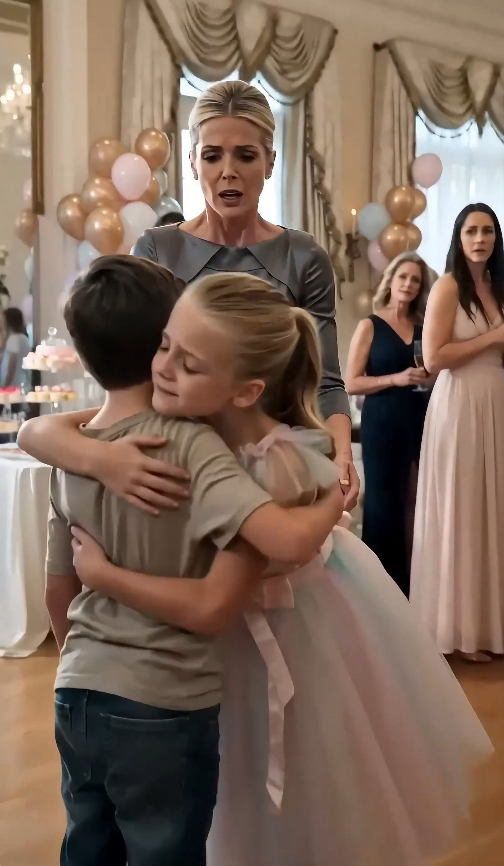
The room went silent when the rich mother ripped the gift from the poor boy’s hands.
The birthday table was covered in pink balloons, gold ribbons, and a cake taller than the boy’s chest.
Children in expensive shoes stood around the mansion ballroom holding wrapped presents with satin bows.
Noah Miller stood near the end of the line with a small blue box wrapped in plain paper.
His jacket was too thin.
His sneakers were worn at the toes.
His hands were clean, but they shook as he tried to hold the gift carefully.
Veronica Bennett, the birthday girl’s mother, looked him up and down with disgust.
Then she snatched the box from him in front of everyone.
“You stole this gift, didn’t you?”
Noah’s face went red.
“No, ma’am. I brought it for her.”
The birthday girl, Ava Bennett, ran forward in her glittering dress.
“He’s my friend!”
Veronica held the gift higher, away from both children.
“Children like him don’t bring gifts.”
The words hit Noah harder than a slap.
He lowered his eyes.
Ava reached for the box again.
The wrapping tore.
A small gift tag slipped out and fell onto the marble floor.
Noah tried to pick it up, but Veronica grabbed it first.
She read the crooked handwriting.
Then her face changed.
The tag said Noah had sold his old bicycle to buy the music box because Ava had shared her lunch with him every day when he had none.
Noah’s voice was barely above a whisper.
“She was kind when nobody else was.”
Ava began crying.
Her father, Charles Bennett, stepped forward and read the tag over Veronica’s shoulder.
For the first time all afternoon, the adults in the room had nothing to say.
Noah Miller had not planned to attend the party.
He had received the invitation three weeks earlier at school.
It was printed on thick pink paper with Ava Bennett’s name in gold letters.
Every child in Mrs. Carter’s fourth-grade class received one.
Even Noah.
At first, he thought it was a mistake.
He lived with his grandmother in a small apartment above a laundromat.
His father was gone.
His mother worked nights cleaning offices and slept during the day with swollen feet and tired eyes.
Noah owned two school shirts, one hoodie, and a bicycle that squeaked whenever he turned left.
Birthday parties at mansions were not part of his world.
But Ava had placed the invitation on his desk herself.
She told him she wanted him there.
Noah had stared at the paper for a long time after school.
He knew children like him were often invited because teachers expected everyone to be included.
But Ava did not act like that.
Ava sat beside him at lunch even when the other girls whispered.
She shared apple slices when he said he was not hungry.
She pushed half her sandwich toward him without making it feel like charity.
She laughed at his drawings.
She asked about his grandmother.
When another boy mocked Noah’s old backpack, Ava told him old things lasted because someone cared enough to keep using them.
Noah remembered that sentence.
At home, he placed the invitation on the kitchen table.
His grandmother, Ruth, read it under the yellow light.
She smiled, then looked at the rent envelope near the sugar jar.
Noah understood before she spoke.
They did not have money for a gift.
Ruth told him a handmade card would be enough.
Noah nodded because he did not want her to feel bad.
But that night, he lay awake thinking about Ava’s lunch tray.
He remembered the first day she gave him half her sandwich.
He had not eaten breakfast.
He had told everyone he forgot his lunch.
Ava had not asked questions.
She had only split what she had and kept talking about math homework like nothing unusual had happened.
That kindness saved him from shame.
Noah wanted to give her something real.
Something that said thank you without making her feel sorry for him.
The next day, he passed a thrift shop on the way home.
In the window was a small wooden music box.
It had a painted ballerina inside and a tiny mirror shaped like a heart.
The price tag said twenty-eight dollars.
To most families at Ava’s party, twenty-eight dollars was nothing.
To Noah, it was impossible.
He stood outside the shop until the owner noticed him.
The owner, Mr. Alvarez, opened the door and asked if he was all right.
Noah pointed at the music box.
He asked if it worked.
Mr. Alvarez wound the key.
Soft music filled the shop.
Noah thought of Ava humming during art class.
He thought she would love it.
He asked if Mr. Alvarez could hold it for him.
The man studied his face and agreed.
Noah had one thing worth selling.
His bicycle.
It was old.
The paint was scratched.
The bell did not ring anymore.
But it got him to school when he missed the bus.
It got him to the grocery store when his grandmother needed milk.
It was the one thing that made him feel free.
He sold it to a repair shop for twenty-two dollars.
Then he counted coins from a jar under his bed.
He found four dollars and eighty cents.
His grandmother gave him the last dollar from her purse after he finally told her what he was doing.
She cried when she realized he was selling the bicycle for a girl who shared lunch.
Noah told her Ava was the first person at school who never made him feel poor.
Ruth kissed his forehead and helped him wrap the music box in blue paper from an old grocery bag.
Noah wrote the tag himself.
Dear Ava.
I sold my bike to buy this because you shared lunch with me when I had nothing.
You were kind when nobody else was.
Your friend, Noah.
On the day of the party, Noah walked to the Bennett mansion.
It took almost an hour.
He wore his best shirt beneath the thin jacket.
He carried the gift with both hands to keep the paper from tearing.
Cars passed him on the long road leading to the estate.
Parents in black SUVs drove by with children in party dresses.
Some stared.
Noah kept walking.
The Bennett house looked bigger than his school.
White columns.
A fountain.
A balloon arch at the door.
Ava’s father, Charles, stood near the entrance greeting guests with a warm smile.
He noticed Noah and bent down slightly.
He told him he was glad he came.
Noah relaxed.
Then Veronica Bennett appeared behind him.
Ava’s mother looked perfect.
Perfect hair.
Perfect dress.
Perfect smile.
But the smile faded when she saw Noah.
She glanced at his shoes.
Then at his plain gift.
Then at the staff member holding a tray of lemonade.
She asked who had let him in.
Charles said he was Ava’s classmate.
Veronica said nothing, but her eyes made Noah want to disappear.
Inside, the party felt like another world.
There was a magician.
A chocolate fountain.
A photo booth.
A table piled with gifts taller than Noah.
Children ran past him in clothes that probably cost more than his family’s rent.
Noah stood near the wall, holding the music box.
Ava spotted him from the staircase.
Her whole face lit up.
She ran down and hugged him in front of everyone.
That hug almost made the walk worth it.
She introduced him to her father again, then tried to pull him toward the cake table.
But Veronica stepped in.
She told Ava to greet other guests first.
She told Noah to place his gift with the others.
Noah walked to the gift table carefully.
That was when Veronica saw the small blue box.
Perhaps it was the plain wrapping.
Perhaps it was his old shoes.
Perhaps cruelty only needs a reason it already wanted.
She grabbed the gift from his hands.
“You stole this gift, didn’t you?”
The accusation froze the ballroom.
Noah shook his head quickly.
“No, ma’am. I brought it for her.”
A few children whispered.
One boy laughed under his breath.
Noah felt his ears burn.
Ava ran back.
“He’s my friend!”
Veronica did not soften.
She lifted the box higher.
“Children like him don’t bring gifts.”
Noah looked at Ava then.
Not at Veronica.
Not at the guests.
Only at Ava.
He wanted to say he was sorry for ruining her party.
He wanted to say he should not have come.
He wanted to say the music box was not stolen, but his throat closed.
Ava reached up and pulled at the gift.
The paper tore.
The tag fell.
It landed between Veronica’s heels.
She picked it up with the expression of someone expecting proof of guilt.
Instead, she found proof of love.
The crooked handwriting was simple.
Every line made the room smaller.
Every word made the adults quieter.
Charles Bennett stepped closer and read it too.
His jaw tightened.
He looked at Noah’s shoes, then at the gift, then at his wife.
Noah whispered the only truth he knew how to say.
“She was kind when nobody else was.”
Ava took the box from her mother’s loosened hand.
She unwrapped it herself.
When the music box appeared, she gasped.
Not because it was expensive.
Because it was thoughtful.
She opened the lid.
The small ballerina turned slowly while the soft tune played.
Ava began crying.
Then she hugged Noah in front of every guest.
This time, he cried too.
Children do not always understand class.
But they understand when someone is hurt unfairly.
Several classmates looked ashamed.
The boy who had laughed stared at the floor.
Charles placed one hand on Noah’s shoulder and asked him how he got to the party.
Noah admitted he walked.
Charles asked where his bicycle was.
Noah looked at the music box.
He did not answer.
He did not need to.
Veronica’s face had changed from anger to humiliation.
She opened her mouth, but no apology came at first.
People who are used to judging others often do not know how to stand inside their own shame.
Ava turned to her mother with tears on her cheeks.
She said Noah had never stolen from anyone.
She said he gave more than anyone at the party because he gave something he needed.
That sentence broke the silence.
Charles asked Veronica to apologize.
Not later.
Not privately.
There.
In front of the child she had accused.
Veronica knelt awkwardly in her expensive dress.
For the first time, she looked at Noah instead of his clothes.
She apologized.
Her voice shook.
Noah nodded, but he did not say it was okay.
Because it was not okay yet.
Some wounds should not be rushed into forgiveness just because adults feel embarrassed.
Ava kept holding his hand.
The party changed after that.
The magician’s music felt too loud.
The gold balloons seemed too shiny.
Charles looked around his own ballroom as if seeing it through Noah’s eyes.
He saw too much food.
Too many gifts.
Too many adults who had stayed silent until the tag made silence uncomfortable.
He asked the caterers to pack extra meals.
He asked the staff to invite families from the community center after the party.
Veronica did not object.
Maybe because she had no strength left to perform superiority.
Maybe because shame had finally taught her something.
When the cake was cut, Ava asked Noah to stand beside her.
He tried to step back.
She pulled him forward.
She said friends belonged at the table.
Those words made Ruth’s old sentence echo in Noah’s mind.
Kindness is not small when someone is hungry for it.
At the end of the party, Charles disappeared for twenty minutes.
When he returned, he asked Noah to come outside.
Ava came too.
On the driveway stood a brand-new blue bicycle.
It had a working bell.
A sturdy basket.
Reflectors on both wheels.
Noah stared at it without moving.
Charles told him it was not a reward for being poor.
It was a thank-you for reminding everyone in that house what a gift really means.
Noah touched the handlebar.
His fingers trembled.
He asked if he could ride it home.
Charles said he would drive him and the bicycle home because it was already dark.
Before they left, Ava tied a pink ribbon around the bicycle bell.
She said so he would remember her birthday.
Noah smiled for the first time since the accusation.
The next Monday at school, everything was different.
Children who had ignored Noah asked about the bike.
Some apologized.
Some only acted nicer because they had seen adults approve of him.
Noah understood the difference.
Ava still sat beside him at lunch.
But this time, Noah brought two peanut butter sandwiches wrapped in paper.
He gave one to Ava.
She laughed and said he did not have to.
Noah said he knew.
That was why he wanted to.
Weeks passed.
The story of the birthday party spread through the school.
Mrs. Carter used it gently during a lesson about kindness, though she never named Noah without permission.
Ava asked her parents to start a lunch fund for students who came to school without food.
Charles agreed immediately.
Veronica struggled at first.
She did not like public reminders of her mistake.
But one afternoon, she visited the school cafeteria and saw a little girl hide an empty tray under the table.
Noah saw her see it.
That was the day Veronica changed in a way that mattered.
Not all at once.
Not perfectly.
But visibly.
She began volunteering quietly.
She stopped wearing diamonds to school events.
She learned the names of cafeteria workers.
She apologized to Ruth in person.
Ruth listened with folded hands.
She accepted the apology, but she also told Veronica that dignity should not depend on being someone’s guest.
Veronica cried in the hallway afterward.
Noah did not know what to do with that.
Adults crying because they are ashamed can make children feel responsible for comforting them.
Ruth told him he did not have to carry that.
So he did not.
Months later, Charles invited Noah and Ruth to the Bennett house again.
This time, not for a party.
For dinner.
Noah hesitated outside the front door.
The mansion still reminded him of the accusation.
Ava opened the door herself.
She was wearing jeans and an old sweatshirt.
She had set the table in the kitchen, not the ballroom.
The music box sat on a shelf near the window.
It was not hidden among expensive toys.
It was displayed where everyone could see it.
The blue tag was framed beside it.
Noah stopped when he saw the frame.
Ava explained that it reminded her family what kindness costs and what cruelty reveals.
Noah did not know what to say.
So he wound the music box.
The same soft tune filled the kitchen.
This time, it did not sound like shame.
It sounded like friendship.
Years passed.
Noah and Ava remained close through middle school, then high school.
Their lives did not become magically equal.
Ava still had advantages Noah did not.
Noah still worked after school to help his family.
But Ava never treated helping as ownership.
Noah never treated pride as refusing all kindness.
They learned balance.
The lunch fund became a foundation.
The bicycle story became its beginning.
By senior year, the program had paid for thousands of meals, school supplies, field trip fees, and emergency transportation for students who would otherwise stay home.
Noah helped run it.
Ava helped fundraise.
Veronica served meals once a week.
Charles repaired donated bicycles in the community center garage.
On graduation day, Noah gave a speech.
He did not mention the accusation directly.
He spoke about hunger.
The kind in the stomach.
The kind in the heart.
The kind children feel when a room tells them they do not belong.
He said one shared lunch can become a life raft.
He said one cruel sentence can bruise for years.
He said one apology matters only when it becomes a different way of living.
Ava cried in the front row.
Veronica did too.
Ruth smiled like she had known the boy would become this all along.
After the ceremony, Noah rode the same blue bicycle home one last time before leaving for college.
It was too small for him now.
His knees rose too high.
The bell still worked.
The pink ribbon had faded almost white.
He stopped outside the thrift shop where he had first seen the music box.
Mr. Alvarez was older now.
He still remembered the boy who sold his bicycle for a birthday gift.
Noah thanked him for holding the box.
Mr. Alvarez said he had known even then that the gift was going somewhere important.
Years later, Ava became a pediatric nutritionist.
Noah became a teacher.
Together, they helped expand the lunch foundation into schools across the state.
They named it The Gift Tag Project.
Every child who received help got a blank card with one sentence printed at the top.
Kindness belongs at every table.
At one annual fundraiser, the original music box was placed beneath glass beside the faded blue gift tag.
Veronica stood near it for a long time.
She was older now.
Softer.
She told Noah she still heard her own words from that day and wished she could erase them.
Noah looked at the tag.
Then at Ava greeting children near the food tables.
He told Veronica that some things cannot be erased, but they can be answered.
The foundation was an answer.
The meals were an answer.
The children laughing with full trays were an answer.
Veronica nodded through tears.
This time, Noah did not feel pressured to forgive for her comfort.
He had already forgiven in the only way that mattered to him.
He had refused to become cruel.
On Ava’s twenty-fifth birthday, she held a small party at the community center instead of the mansion.
There was no gold cake.
No photographers.
No gift table guarded by adults.
Children from the lunch program decorated the room with paper stars.
Noah brought one small box wrapped in blue paper.
Ava laughed when she saw it.
Inside was a tiny bicycle charm for her keychain.
The tag read that she had once shared lunch with him when nobody else did, and he had been trying to give that kindness back ever since.
Ava hugged him in front of everyone.
Just like she had when they were nine.
This time, no one accused him of anything.
They accused the poor boy of stealing at the birthday party, then the gift tag revealed everything.
May you like



But the real ending was not the apology, the new bicycle, or the rich mother standing ashamed before her guests.
The real ending was that a hungry boy’s gratitude became a movement, a little girl’s kindness became a foundation, and a plain blue gift tag proved that the most valuable gifts are often bought with sacrifice no one sees.







