“The little boy hid under the table and called his gangster father… while the kidnappers searched the room.”
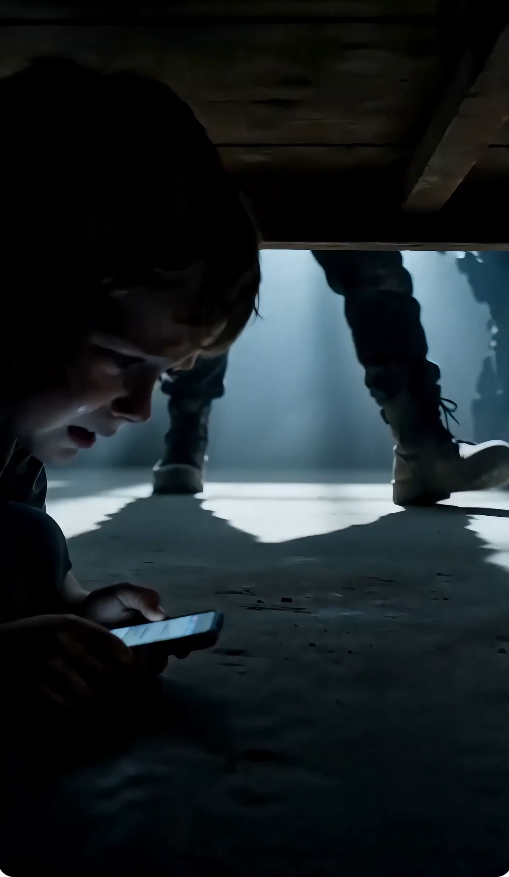
The warehouse room froze when the gang boss stepped out of the darkness before the kidnappers could reach the table.
His little boy was still hidden beneath it, curled into a trembling ball with both hands wrapped around a phone.
Dust covered the floor.
A single hanging bulb swung above the room.
The kidnappers had been searching for him for nearly ten minutes, kicking crates aside, opening cabinets, and dragging curtains from the windows.
One of them stopped near the table.
His boots were inches from the boy’s face.
He bent down slowly, fingers reaching toward the edge of the cloth.
“Come out, kid. There’s nowhere to hide.”
The boy pressed the phone to his mouth, tears sliding down his cheeks.
“Dad… I’m under the table. Please hurry.”
On the other end of the line, his father’s voice came back cold, calm, and terrifyingly close.
“Stay still, son. I’m already inside.”
The boy stopped breathing.
Behind the kidnappers, the metal service door opened without a sound.
A man dressed like a warehouse worker stepped out of the shadows, removed an earpiece, and lowered his head toward the man entering behind him.
“Boss, the room is surrounded.”
The kidnappers turned at the same time.
Their faces changed.
The man they had been trying to blackmail was already in the room.
Not outside.
Not on the phone.
Not coming later.
Already there.
And when one kidnapper’s hand moved toward the table, the father raised his gun without raising his voice.
“Touch my son, and none of you leave alive.”
Eight hours earlier, seven-year-old Luca Bellini had been taken outside his private school.
He was not supposed to leave alone.
His driver was always parked at the same corner.
His bodyguard always stood across the street pretending to read news on his phone.
His father, Matteo Bellini, trusted almost no one.
The city called Matteo a gangster.
Some called him a criminal king.
Some called him the man who owned half the docks and frightened the other half into obedience.
But inside his home, Luca knew him only as the father who checked the windows at night, tied his shoelaces badly, and never missed Sunday breakfast.
That afternoon, the driver was delayed by a staged accident two blocks away.
The bodyguard was lured to the rear entrance by a false emergency.
For ninety seconds, Luca stood alone near the school gate.
That was all the kidnappers needed.
A white van stopped.
A coat was thrown over Luca’s head.
A hand covered his mouth.
The city kept moving around him, unaware that Matteo Bellini’s only son had vanished in broad daylight.
By the time Matteo received the first message, his house had already gone silent.
No shouting.
No panic.
No wasted movement.
His men watched the security footage frame by frame.
They traced the van.
They checked traffic cameras.
They searched old enemies first.
Then new ones.
Matteo stood in his study with Luca’s school tie in his hand.
It had been found near the curb.
The knot was still half done, the way Luca always left it.
To everyone else in the room, Matteo looked calm.
To the men who knew him well, that calm was more dangerous than rage.
The kidnappers sent proof of life near sunset.
A photograph of Luca sitting on a concrete floor.
His face was dirty.
His eyes were red.
His hands were tied loosely, probably because they thought a child could not fight.
Matteo noticed the floor first.
Gray concrete with green paint flakes.
Then the wall.
Old brick.
Water damage.
A rusted yellow safety rail in the background.
He knew warehouses the way other fathers knew playgrounds.
This was near the abandoned riverfront storage district.
The kidnappers sent a demand.
Money.
Safe passage.
No police.
Matteo did not answer immediately.
He looked at the photo again.
Not at the ropes.
Not at the fear.
At the boy’s left shoe.
Luca had kicked a small screw loose from the floor and hidden it beneath the sole.
Matteo saw the bulge.
Even terrified, his son was thinking.
That saved him from falling apart.
Within twenty minutes, Matteo’s people found the warehouse.
Within thirty, they found the outer guards.
Within forty, they entered through the drainage tunnel beneath the loading dock.
Not with sirens.
Not with noise.
They entered like shadows returning to a room that had always belonged to them.
One of Matteo’s oldest bodyguards, Enzo, changed into a warehouse maintenance uniform.
Two others cut power to the east wing.
Another team blocked the rear exit from outside.
A trusted doctor waited in a black van.
A lawyer waited beside him.
Matteo did not call the police at first because he knew one thing.
Someone had given the kidnappers Luca’s route.
Someone close enough to know the school schedule.
Someone close enough to know Matteo’s security habits.
Police would come later.
After Luca was safe.
First came the boy.
Inside the warehouse, Luca had been moved to a room with a long table, broken chairs, and plastic sheets over stacked boxes.
The kidnappers argued silently at times, using gestures and tense expressions because they feared the phone might still be recording.
Luca watched everything.
His father had taught him rules for fear.
Do not run if there is nowhere to run.
Do not scream if silence can keep you hidden.
Find exits.
Find shadows.
Find something adults forget to check.
When the kidnappers left him alone for less than a minute, Luca used the screw in his shoe to loosen the rope around his wrists.
His fingers hurt.
His skin burned.
But the rope gave way.
He slipped under the table just as footsteps returned.
His phone was still in his jacket lining.
Matteo had sewn a hidden emergency phone there after a threat the previous year.
Luca used it once during a game and got in trouble for calling during dinner.
Now his tiny fingers found the button in the dark.
The line connected.
Matteo answered without greeting, because he had been waiting with the phone in his hand.
Luca could barely whisper.
The kidnappers moved through the room above him.
Boots scraped.
A chair fell.
A hand swept across the tabletop.
One kidnapper stopped near the hanging cloth.
“Come out, kid. There’s nowhere to hide.”
Luca closed his eyes.
“Dad… I’m under the table. Please hurry.”
Matteo was already inside the warehouse, standing in the black corridor outside the room.
He heard the fear in his son’s voice.
Every instinct in him wanted to break the door down.
Every lesson he had learned from a lifetime of violence told him one wrong second could make a child pay.
So he stayed cold.
He stayed precise.
“Stay still, son. I’m already inside.”
Luca obeyed.
He did not move when the cloth brushed his hair.
He did not cough when dust entered his nose.
He did not cry louder when the kidnapper’s hand came close enough to touch his sleeve.
The metal service door opened behind the kidnappers.
Enzo stepped out first, disguised as a warehouse worker.
Then Matteo entered the room.
His face carried no expression.
That was what made him terrifying.
A furious man could make mistakes.
A silent father did not.
Enzo lowered his head.
“Boss, the room is surrounded.”
The kidnappers turned.
One reached toward his waistband.
Before his fingers closed around the weapon, red dots appeared across his chest from unseen men in the rafters and behind the broken windows.
Another kidnapper looked toward the rear exit.
A shadow moved there too.
The leader’s eyes flicked toward the table.
That was his mistake.
Matteo saw it.
He raised his gun.
“Touch my son, and none of you leave alive.”
No one moved.
One weapon hit the floor.
Then another.
The kidnappers lowered their hands slowly.
Matteo’s men surged in and forced them down with clean, controlled force.
No chaos.
No wild shooting.
No chance for the boy under the table to be caught in the middle.
Only when every kidnapper was restrained did Matteo lower his weapon.
Then he dropped to one knee beside the table.
He lifted the cloth.
Luca was curled beneath it, face streaked with tears and dust, phone still pressed in both hands.
For one heartbeat, the gang boss disappeared.
Only the father remained.
Luca crawled out and threw himself into Matteo’s arms.
Matteo held him so tightly the child’s feet lifted from the floor.
His eyes closed.
His hand covered the back of Luca’s head.
Around them, his men looked away.
Some things were too private even in a room full of violence.
The doctor entered next.
He checked Luca’s breathing, wrists, pupils, and pulse.
Luca refused to let go of his father’s coat.
So Matteo carried him to the black van himself.
Outside, the warehouse district was filled with silent figures.
Every exit had been blocked.
Every kidnapper had been taken alive.
Every phone and weapon had been sealed in evidence bags.
Only then did the police arrive.
Not the entire force.
Only the officers Matteo trusted because Enzo had already identified the leak.
The leak was not a policeman.
It was worse.
It was Matteo’s own logistics manager, Carlo Vieri.
Carlo had known Luca’s school route.
He had known the driver’s schedule.
He had sold the information to one of Matteo’s rivals, thinking the ransom would weaken Matteo and force a leadership fracture.
He had not expected Matteo to trace the warehouse so quickly.
He had not expected Luca to escape his ropes.
He had not expected the boy to call from beneath the table.
Carlo was arrested before midnight while trying to leave the city through the private marina.
Matteo did not go to him.
He did not need to.
The law could have him.
Matteo had already recovered what mattered.
At the hospital, Luca sat on the examination bed wrapped in a blanket far too large for him.
Matteo stood beside him, one hand resting on his shoulder.
The doctor found bruises, rope burns, dehydration, and shock.
Nothing broken.
Nothing that time and care could not heal.
Matteo listened without blinking.
When the doctor left, Luca stared at his shoes.
His voice wanted to ask questions, but the room stayed quiet.
The locked dialogue of terror was over.
There were no more words needed for a while.
Matteo sat beside him.
He untied the boy’s ruined shoelaces and removed the small screw from the sole.
He held it in his palm.
That tiny piece of metal had helped save his son’s life.
He placed it in his pocket as carefully as another man might carry a medal.
For three nights, Luca slept in Matteo’s room with the lights on.
For three nights, Matteo sat awake in a chair, watching the door.
On the fourth morning, Luca woke and found his father asleep for the first time, still sitting upright, one hand near the bed.
Luca reached out and touched his fingers.
Matteo opened his eyes instantly.
The boy did not speak.
He simply moved closer.
Matteo understood.
The weeks that followed changed the Bellini house.
Security changed first.
New routes.
New teams.
New rules.
But Matteo changed more quietly.
He stopped taking late-night meetings in the dining room.
He stopped letting men with blood on their hands pass through halls where his son played.
He moved business away from the house.
He built a private school safety foundation under Luca’s mother’s name, funding secure transportation, emergency phones, and protection training for children at risk.
He did not put the Bellini name on it.
He knew his name frightened people.
The help did not need to.
The kidnappers went to trial.
Every one of them was convicted.
Carlo Vieri received the longest sentence because betrayal cuts deeper when it reaches for a child.
Luca never entered the courtroom.
Matteo made sure he did not have to carry adult fear again.
Months later, the warehouse was demolished.
Matteo bought the land legally through a public trust and turned it into a youth boxing and safety center.
Not to teach children violence.
To teach them confidence, escape, discipline, and how to survive long enough for help to arrive.
Near the entrance, behind glass, sat the old table from the warehouse room.
The cloth had been cleaned.
The wood had been repaired.
Beside it was a small emergency phone and a plaque with no names.
It said that courage can be very small and still be enough.
Luca saw it only once.
He stood in front of the table for a long time.
Then he took his father’s hand.
Matteo did not ask whether he was okay.
Some questions force children to perform recovery before they are ready.
Instead, he stayed beside him until Luca was ready to leave.
Years passed.
Luca grew taller.
He learned to read rooms the way his father did, but he also learned something Matteo had taken longer to understand.
Power was not only the ability to punish danger.
Power was the ability to reach someone before danger arrived.
As a teenager, Luca volunteered at the safety center.
He taught younger children how to use emergency phones.
He showed them how to find exits.
He told them hiding was not cowardice when it kept them alive.
He never described the warehouse in detail.
He did not need to.
The children listened because they sensed he knew.
Matteo watched from the doorway sometimes.
Older now.
Quieter.
Still feared in corners of the city.
But to the children at the center, he was the man who paid for lights, locks, rides, counselors, and warm meals.
One evening, Luca found his father holding the small screw from the shoe.
Matteo had kept it all those years.
It sat inside a velvet box in his desk.
Not a diamond.
Not a gold watch.
A screw.
Luca looked at it and finally understood.
His father had trophies from enemies.
Awards from businessmen.
Gifts from men who wanted favor.
But the only object he touched like a prayer was the one his son had used to survive.
The little boy had hidden under the table and called his gangster father while the kidnappers searched the room.
The world would remember the black cars, the surrounded warehouse, and the terrifying final warning.
But Matteo remembered something else.
A child staying still in the dark.
A whisper through a hidden phone.
A father already inside the room before fear could finish its work.
May you like



And from that night on, no child under Matteo Bellini’s protection ever had to wonder whether help was coming.
It was already there.







