“The kidnapped boy whispered to a street camera… and the city AI found his father.”
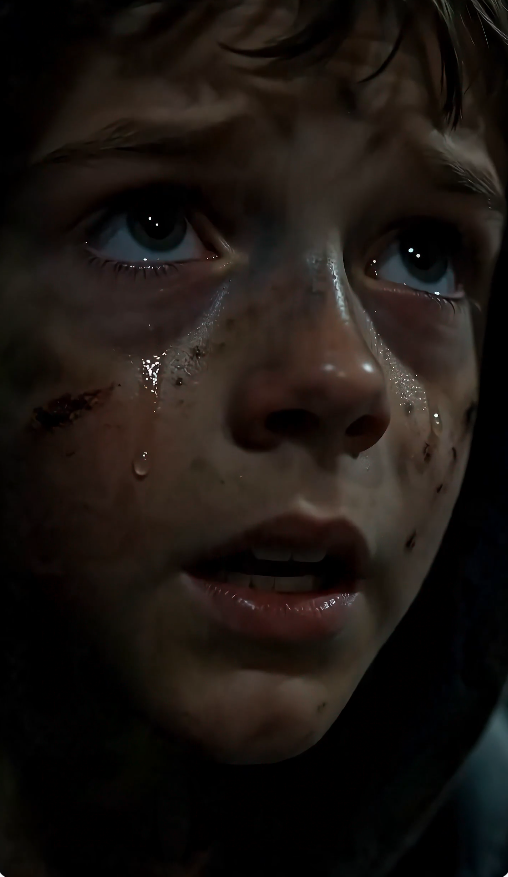
The boy held his breath behind a row of overflowing trash bins in a narrow alley behind a closed pharmacy.
Rainwater ran along the cracked pavement.
A broken neon sign flickered red against the brick wall.
The city camera above the streetlamp turned slowly, its black glass eye scanning the dark.
Eight-year-old Noah Mercer pressed both hands over his mouth to keep himself from sobbing.
His jacket was torn at the sleeve.
One shoe was missing.
A strip of gray tape still clung to his wrist where he had chewed himself free inside the kidnapper’s van.
At the mouth of the alley, heavy footsteps stopped.
The man who had taken him moved into the dim light.
Kidnapper: “Stop hiding. Your father can’t find you.”
Noah squeezed his eyes shut.
His father had always told him that fear lied loudest when help was close.
But the alley was empty.
The shops were locked.
Cars passed at the far end of the street without slowing.
Noah looked up through the rain.
The street camera was still there.
His father had shown him those cameras once.
Not as toys.
Not as spies.
As part of the city emergency system he had helped design after Noah’s mother died.
Noah crawled forward until the camera could see his face.
His voice came out as a broken whisper.
Boy: “Camera… please call my dad.”
Inside the city operations center, the emergency AI processed the sound, the face, the missing child alert, and the fear in the boy’s voice.
Across thousands of data points, one match rose above all others.
AI System: “Emergency identity match found.”
Three blocks away, Ryan Mercer’s phone vibrated in his hand before the police dispatcher could finish speaking.
He had been running through the rain for nearly an hour, refusing to wait inside the station while his son was somewhere in the city.
The map on his screen locked onto a small alley behind East 47th Street.
Ryan stopped breathing for one second.
Then he started running harder.
Father: “I’m already on that street.”
Police units turned the corner seconds later.
The kidnapper heard the sirens and spun toward the alley entrance.
Noah ran before the man could reach him.
Blue lights hit the wet pavement.
Armed officers flooded the sidewalk.
Ryan broke through the line and dropped to his knees as Noah crashed into his arms.
The officer beside them lowered his radio.
Police Officer: “The boy is safe.”
Ryan Mercer had not built the SafeLight system to become famous.
He built it because he had once been too late.
Five years earlier, his wife, Julia, had died in a hit-and-run on a rainy night near the same district where Noah would later disappear.
There had been cameras on the street.
There had been witnesses.
There had been data everywhere.
But every system belonged to a different department.
Traffic footage sat in one database.
Emergency calls sat in another.
License plate scans were delayed by paperwork.
A store camera held the image of the car that struck Julia, but no one found it until four days after her funeral.
Ryan was an artificial intelligence engineer for the city at the time.
Before Julia died, he had believed systems failed because technology was not advanced enough.
After Julia died, he understood something worse.
Systems failed because people built them without imagining their own loved ones inside the delay.
He could not bring Julia back.
So he built SafeLight.
SafeLight connected emergency reports, public cameras, traffic sensors, missing person alerts, ambulance routes, and police dispatch locations.
It was not designed to watch ordinary people for curiosity.
It was designed to respond when danger had already been reported.
Missing child.
Medical collapse.
Violent assault.
Fire evacuation.
Hit-and-run.
Every activation required an emergency trigger and a record.
Every search had to be logged.
Every result had to be reviewed.
Ryan fought for those protections because he knew fear could make cities careless with power.
He wanted speed without cruelty.
He wanted safety without turning every citizen into a suspect.
For two years, SafeLight saved lives quietly.
A stroke victim found on a bench.
An elderly woman with dementia located near the river.
A stolen ambulance tracked through winter traffic.
A missing toddler found inside a parked car before the temperature dropped.
Ryan never gave interviews about those rescues.
He went home to Noah and made pancakes shaped like stars.
Noah grew up thinking his father’s work was magic.
Ryan always corrected him.
He said it was not magic.
It was people deciding that time mattered.
Then city politics changed.
A private security contractor wanted control of SafeLight’s maintenance data.
Ryan objected.
The contractor wanted broader access.
Ryan refused.
He testified before a council oversight panel that emergency tools should never become profit engines.
The testimony made enemies.
One of those enemies was a man named Victor Lang, a former security consultant whose company lost a multimillion-dollar contract after Ryan’s testimony exposed inflated billing and unauthorized data requests.
Victor was not the man in the alley.
He was too careful for that.
But the kidnapper had once worked for him as a driver.
The plan was not only to take Noah.
The plan was to force Ryan to hand over emergency override credentials.
If Ryan refused, the boy would be moved out of the city before sunrise.
Noah was taken from the school parking lot during a chaotic dismissal after a false fire alarm.
The kidnapper wore a maintenance jacket.
He knew the blind spots.
He knew the camera rotation pattern before SafeLight’s emergency mode activated.
He knew that once a missing child alert was filed, the system would begin scanning possible routes.
So he kept Noah inside an old delivery van lined with signal-blocking mesh.
He planned to reach the river warehouse district.
But panic makes criminals sloppy.
Noah had listened to his father for years.
He knew small things.
He knew emergency exits.
He knew how to stay low.
He knew that plastic zip ties could loosen if twisted against pressure.
He knew that cameras near streetlamps could see better when a person stepped into the yellow pool of light.
When the van stopped at a red light near East 47th Street, Noah kicked the rear latch with both feet.
It did not open fully.
But it opened enough.
He slipped through the gap, hit the wet road, rolled under a parked truck, and ran into the alley.
The kidnapper followed.
That was where the story nearly ended.
One dark alley.
One terrified child.
One man repeating the lie every victim hears.
No one is coming.
But Ryan had built SafeLight with one hidden feature that few people knew about.
It was called Guardian Echo.
The feature allowed registered emergency profiles for children at high risk, such as children in custody cases, trafficking cases, or active missing alerts, to trigger a direct guardian notification if a verified identity match occurred.
Ryan had never registered Noah for special protection.
He believed no father should use public tools to give his own child privilege.
But after Noah was reported missing, the police entered his profile into the emergency system like any other kidnapped child.
SafeLight did not know Noah was the founder’s son.
It only knew a child was missing and a frightened face in the rain matched the alert.
That was why the moment worked.
Not because Ryan had power.
Because the system did what it was built to do for any child.
When Noah whispered to the camera, SafeLight detected his face, his voice stress pattern, the open missing child report, and the last known route of the suspect van.
The AI generated a high-confidence emergency identity match.
The city operations center received the alert.
Ryan received the guardian ping.
Police units received the location.
The closest patrol car was four blocks away.
Ryan was closer.
He had not been waiting at headquarters.
He had left the police station after signing the emergency access forms because he could not sit beneath fluorescent lights while Noah’s backpack lay on an evidence table.
He ran the streets Noah might have passed.
He checked bus shelters.
He checked parking lots.
He checked alleys.
Every father in that situation becomes part detective, part animal, part prayer.
When his phone vibrated, the map did not feel like technology.
It felt like breath returning to a body.
He ran toward East 47th Street so fast that later he would not remember crossing the road.
The kidnapper saw him before the police arrived.
For one second, the man looked shocked.
He had believed Ryan would be trapped behind procedure.
He had forgotten that fathers do not move at the speed of paperwork.
Noah bolted when he saw the blue lights.
Ryan reached him halfway between the bins and the sidewalk.
He wrapped both arms around his son and turned his body like a shield.
The kidnapper tried to run.
He did not get ten steps.
Two officers took him down near the pharmacy gate.
One recovered a burner phone.
Another recovered a folded paper with Ryan’s home address, Noah’s school schedule, and the name of Victor Lang’s old security company.
That paper widened the case beyond kidnapping.
By dawn, federal investigators were involved.
By noon, Victor Lang was arrested at a private airfield outside the city.
His attorneys claimed misunderstanding.
The van, phone records, payment transfers, and stolen route files told a different story.
Ryan did not care about the press conference.
He stayed at the hospital with Noah.
Noah had bruises on his wrist, a scraped knee, and nightmares that made his small body shake each time footsteps sounded in the hallway.
Ryan sat beside the bed all night.
He watched Noah sleep with one hand gripping the sleeve of his father’s jacket.
At sunrise, Noah woke and looked toward the window.
A city camera stood on the corner outside the hospital.
It rotated slowly above the street.
Noah did not flinch.
He only held his father’s hand tighter.
The mayor came that afternoon.
So did the police commissioner.
So did reporters.
Ryan refused cameras near Noah.
He gave one statement from the hospital steps without naming his son’s details.
He said SafeLight did not save Noah because his father built it.
It saved Noah because the city agreed that a child’s cry should reach help faster than a criminal could disappear.
That sentence traveled everywhere.
But the public celebration hid a harder debate.
Some council members wanted SafeLight expanded without limits.
Others wanted it shut down out of fear.
Ryan stood in the middle of that storm with the only authority that mattered.
He had built the system.
His son had been saved by it.
And he still refused to let fear remove safeguards.
At the public hearing one month later, Ryan walked in with Noah’s small hand in his.
Noah did not testify.
He did not need to.
His presence was enough.
Ryan asked the city to keep SafeLight active for verified emergencies only.
He asked for stronger audits, faster missing child activation, independent oversight, and public reporting.
He asked that every neighborhood receive working cameras and emergency response access, not only wealthy districts with political influence.
He said a system that could find his son in minutes should never take hours to serve a poorer child.
That became the turning point.
The council voted unanimously to protect and reform SafeLight.
The new law was named the Mercer Emergency Response Act, though Ryan asked them not to use his name.
They used Julia’s instead for the child rescue wing.
The Julia Mercer Guardian Fund paid to repair broken emergency cameras near schools, shelters, bus stops, clinics, and public housing.
Noah chose the first camera location himself.
It was the streetlamp above the alley.
A small plaque was placed below it.
Not with his name.
Not with Ryan’s.
Only one line.
For every child who needs someone to hear.
The case against Victor Lang exposed a network of contractors who had tried to pressure cities into privatizing emergency data systems.
Several officials resigned.
Two contracts were canceled.
The city operations team was rebuilt with more public accountability.
The camera that heard Noah became evidence in court.
The recording of his whisper was never released.
Ryan insisted on that.
A child’s terror was not content.
It was testimony.
The kidnapper pleaded guilty.
Victor Lang was convicted after a long trial.
But Ryan did not feel victory when the sentence was read.
He felt relief mixed with the knowledge that safety is never final.
Noah returned to school slowly.
At first, Ryan walked him to the classroom door every morning.
Noah carried a small blue whistle in his pocket.
He also carried a drawing of the street camera.
His teacher said he drew it again and again, but not as a monster.
As a tall black bird with a bright yellow eye watching over lost children.
Therapists helped him speak about the alley.
Some days he could.
Some days he could not.
Ryan learned not to rush healing.
Technology could locate a child in seconds.
Love had to sit beside the bed for months.
A year later, the city held a quiet ceremony at the operations center.
No reporters were allowed inside.
Only dispatchers, officers, emergency workers, engineers, and families who had been helped by SafeLight attended.
Noah stood beside Ryan and pressed the ceremonial button that activated the updated Guardian Echo system citywide.
The screen filled with small green lights across the map.
Each light represented an emergency point now connected, audited, and ready.
Ryan looked at the lights and thought of Julia.
He remembered the night she died and the systems that had failed to speak to one another.
He remembered the apology letters that had arrived after it was too late.
He remembered building code through grief while Noah slept in the next room.
Then he looked at his son, alive under the soft glow of the screens.
For the first time, he let himself cry in public.
Nobody clapped.
They understood the moment did not need applause.
Years passed.
SafeLight became a model for other cities.
Ryan traveled to help design ethical emergency response systems.
He always brought the same warning.
A city should not watch people to control them.
A city should be able to hear when someone is in danger.
That distinction became the heart of his work.
Noah grew older.
He became quieter than other boys his age, but not broken.
He played soccer.
He loved astronomy.
He hated gray vans for a while, then less.
On his twelfth birthday, he asked Ryan if they could visit the alley.
Ryan almost said no.
Then he remembered that fear owns the places we never return to.
They went at sunset.
The alley had changed.
The trash bins were gone.
A mural covered the brick wall.
Children had painted stars, birds, streetlights, and open hands.
The camera above the lamp still turned slowly.
Noah stood beneath it for a long time.
Then he looked up and waved.
The camera did not wave back.
It was only a machine.
But somewhere in the operations center, the system logged a normal motion, no emergency, no alert, no action.
That was exactly how it should be.
Machines should sleep when people are safe.
Ryan placed a hand on Noah’s shoulder.
Noah did not tremble.
That was enough.
On the fifth anniversary of the rescue, the city opened the Julia Mercer Center for Missing and Exploited Children.
It provided counseling, legal support, emergency technology, and family reunification services.
The lobby display showed a streetlamp, not a camera.
Ryan wanted the symbol to be light, not surveillance.
At the center of the room was a sculpture made from old broken camera housings, melted and reshaped into a child’s open hand.
The artist titled it Heard.
Noah attended the opening as a teenager.
He avoided reporters.
He stood with other children who had been found through emergency alerts, neighbors, police work, and ordinary people paying attention.
Ryan looked at them and understood that SafeLight had never been about one rescue.
It was about building a city where a child could whisper and not be swallowed by the dark.
When Ryan eventually retired from city work, Noah was the one who gave the final speech.
He did not describe the kidnapping in detail.
He did not perform trauma for strangers.
He spoke about the moment after.
The hospital room.
The night terrors.
The mural.
The law.
The way his father kept showing up even after the AI had done its part.
He said the camera found him, but his father brought him home.
Ryan lowered his head.
That was the truest sentence of his life.
The original street camera was later removed and placed inside the Julia Mercer Center.
Not as a trophy.
As a reminder.
Beside it was a small plaque explaining that one emergency match led to reforms that helped thousands of children and families.
The plaque did not include the audio of Noah’s whisper.
It only included the words approved by Noah when he was old enough to decide.
A child asked for help.
The city answered.
Many years later, Noah became an emergency systems lawyer.
He did not build AI like his father.
He wrote the rules that kept it honest.
Every time a city wanted faster tools without safeguards, Noah told them speed without rights could become another kind of danger.
Every time a city wanted to delay emergency systems because accountability seemed difficult, he told them delay could become a grave.
He carried both truths because he had lived between them.
He kept a photograph on his desk.
Not of the alley.
Not of the kidnapper.
Not of the police lights.
It was a picture of Ryan kneeling in the rain with his arms around him beneath the yellow glow of the streetlamp.
The kidnapped boy whispered to a street camera, and the city AI found his father.
May you like



But the real ending was not the arrest, the emergency match, or the sirens arriving just in time.
The real ending was that one frightened whisper forced a city to build technology with both speed and conscience, and every child who came after Noah Mercer inherited a streetlight that knew how to listen when the dark got too close.







