“The father slapped the groom… after hearing what he planned to sell.”
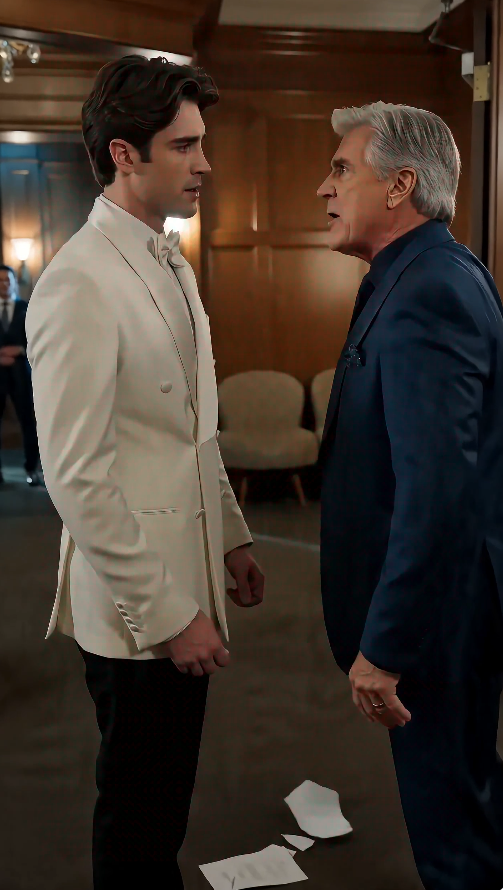
The slap landed in the bridal waiting room five minutes before the ceremony.
The groom staggered backward with his phone still in his hand.
A folded contract slid from the table and scattered across the carpet beside the bride’s bouquet.
The father-in-law stood in the doorway, pale with rage, his tuxedo jacket still open as if he had run there without stopping.
His daughter’s company name was printed across the top of every page.
Hale Biotech.
The company her mother had died building.
The company she had protected since she was twenty-three.
The company the groom had just promised to hand over to investors after becoming her husband.
The father-in-law’s voice cut through the room like broken glass.
“You married my daughter to steal her company?”
The groom’s face changed.
Not with guilt first.
With calculation.
He looked at the phone.
Then the contract.
Then the door behind the father, where the bride had appeared in her wedding dress, eyes red, one hand gripping the lace at her chest.
He did not deny it.
He only lifted his chin.
“Business is business.”
The bride stared at him as if the man in front of her had died and left a stranger wearing his face.
“So I was never your wife, just access?”
At the far end of the room, behind the curtain near the champagne table, an investor stepped out slowly.
He no longer bothered hiding.
His briefcase was open.
Inside were shareholder transfer forms, board-control agreements, and a document scheduled to activate at midnight after the wedding.
“He promised us control after the wedding.”
The bride’s father picked up the master agreement.
His hands shook once.
Then he tore it cleanly down the center.
“The deal is dead, and so is this marriage.”
Three hours earlier, Grace Hale had stood alone in the hotel bridal suite, looking at the small silver pin attached inside her wedding dress.
It was not decorative.
It belonged to her mother.
Eleanor Hale had worn that pin on the day she opened Hale Biotech in a rented laboratory behind a dental clinic.
Back then, the company was not worth billions.
It was worth debt, stubbornness, and the last savings of a woman who believed children with rare illnesses deserved medicine that large corporations ignored.
Grace grew up under lab lights.
She did homework beside centrifuges.
She ate takeout on cardboard boxes while her mother read research reports.
Her father, Robert Hale, handled early finances, drove supply vans, repaired broken office chairs, and stood beside Eleanor every time a banker laughed at her.
When Eleanor became sick, she made Grace promise two things.
The first was to keep the company ethical.
The second was to never let anyone love her only for what her name could unlock.
Grace had thought she understood that warning.
Then she met Ethan Cole.
Ethan was charming in the ordinary, dangerous way.
He remembered small details.
He brought coffee before meetings.
He listened when Grace spoke about her mother’s work.
He never seemed intimidated by her position as CEO.
That made him feel safe.
Hale Biotech had grown into one of the most important medical research companies in America.
Its newest therapy was months away from approval.
Its patents were worth more than most people could imagine.
Its independence was the one thing Grace guarded fiercely.
For years, aggressive investment groups had tried to buy their way into control.
Grace refused them all.
She believed her mother’s company should answer first to patients, not shareholders who saw sick children as market segments.
Ethan praised that conviction.
He said he admired women who protected legacies.
He said the right husband would stand beside her, not in front of her.
Grace believed him.
Her father did not.
Robert Hale was not rude to Ethan.
He was too disciplined for that.
But he watched.
He watched Ethan ask questions about board voting rights with too much casual curiosity.
He watched Ethan remember investor names faster than family names.
He watched Ethan compliment Grace’s power, but rarely her exhaustion.
When Robert shared his concerns, Grace thought grief had made him suspicious.
Her mother had been gone for five years, and Robert still spoke to her photograph before major decisions.
Grace loved him for that.
She also thought he was afraid of losing his daughter.
The wedding was scheduled at the Whitcomb Grand Hotel, a place chosen by Ethan’s social circle because it looked impressive in photographs.
Grace would have preferred the small garden behind Hale Biotech headquarters, where her mother once planted rosemary outside the laboratory doors.
Ethan said they deserved something grand.
Grace agreed because love sometimes disguises compromise as generosity.
On the morning of the wedding, Robert arrived early.
He carried a leather folder containing a letter Eleanor had written for Grace before her death.
He had planned to give it to her before walking her down the aisle.
But when he reached the hallway outside the groom’s waiting room, he heard Ethan’s voice through the half-open door.
At first, Robert meant to walk past.
Then he heard Hale Biotech.
He stopped.
The room was nearly empty.
Ethan stood beside the table with his phone on speaker, speaking to someone about timing.
The contract was spread out before him.
Robert saw familiar legal language even from the doorway.
Voting proxy.
Spousal access rights.
Board restructuring.
Emergency consent.
His heart began pounding.
He stepped closer without making a sound.
Ethan was explaining that the wedding solved the problem of access.
After the ceremony, Grace would be easier to pressure.
After the honeymoon, the signatures could be framed as marital planning.
After public celebration, any resistance would look unstable.
Robert did not hear a lover.
He heard a thief measuring the locks on his daughter’s life.
Then the investor’s voice came through the phone, approving the final step.
Robert opened the door.
Ethan turned too late.
The slap came from a place deeper than anger.
It came from every hour Eleanor had spent in laboratories while other parents slept.
It came from every sick child who had depended on Hale Biotech staying independent.
It came from a father hearing his daughter reduced to a corporate doorway.
The contract pages scattered.
The phone remained connected.
Ethan’s mask broke for one second.
That was enough.
Robert’s question filled the room.
“You married my daughter to steal her company?”
Grace heard it from the hallway.
She had been walking toward the room because a strange message had appeared on her phone from the company’s general counsel.
It warned her not to sign anything Ethan presented after the wedding.
The message included one screenshot.
A clause from a document she had never seen.
Her name.
Her voting rights.
Her future spouse.
The shock had already sent her running.
Now she stood in the doorway in her wedding dress, watching her father face the man she had planned to marry.
Ethan could still have begged.
He could still have lied.
He could still have collapsed into shame.
Instead, he reached for the dignity of cruelty.
“Business is business.”
Grace felt the sentence enter her body like cold water.
The bridesmaids behind her had fallen silent.
A makeup artist near the mirror was crying without moving.
Someone in the corridor had stopped the music rehearsal.
The room seemed suspended between a wedding and a crime scene.
Grace looked at the contract.
Then at Ethan.
Then at the open phone on the table.
She understood the scale of it before she understood the details.
He had not wanted her life.
He had wanted the door her life opened.
“So I was never your wife, just access?”
The question did not sound like shouting.
It sounded worse.
It sounded like a woman hearing the last honest answer she needed.
Ethan said nothing more.
He had already used the only line he would ever get to say in the story of their ending.
Then the curtain moved.
Victor Sloan stepped out from the far side of the room.
Grace knew him immediately.
He was the managing partner of Northbridge Capital, the investment group Hale Biotech had rejected twice.
He had once told Grace in a boardroom that idealism was charming until it interfered with scale.
He had sent flowers after Eleanor’s memorial despite never meeting her.
Grace had thrown them away.
Now Victor stood in the groom’s waiting room with polished shoes and an open briefcase.
His presence explained every missing piece.
The dinner invitations.
The sudden interest in company governance.
The prenuptial revisions Ethan had insisted were standard.
The honeymoon delay.
The pressure to let Ethan review personal trust documents.
Victor spoke without apology.
“He promised us control after the wedding.”
Grace’s father did not look surprised anymore.
He looked devastated.
Not because the betrayal existed.
Because his daughter had to see it wearing a wedding suit.
The contract on the table was called a Strategic Family Alignment Agreement.
Its language was elegant enough to hide violence.
It granted Ethan limited spousal authority over emergency voting proxies if Grace became unavailable during travel.
It created a temporary advisory seat for him.
It allowed Northbridge Capital to exercise acquisition options if the board entered deadlock.
The honeymoon itinerary suddenly mattered.
Remote island.
Limited communication.
Private legal courier scheduled for the second day.
A manufactured absence.
A stolen signature.
A company built for patients turned over to men who saw medicine as extraction.
Robert picked up the master agreement.
For a second, Grace saw his age.
His hands were strong, but the veins stood out.
His face carried the grief of a husband who had promised his dying wife he would protect their daughter, then nearly watched the trap close.
He tore the contract.
The sound was small.
The meaning was enormous.
“The deal is dead, and so is this marriage.”
No one moved.
Ethan looked at the torn pages as if paper could bleed.
Victor closed his briefcase halfway, already calculating damage.
Grace reached up and removed the veil from her hair.
The pins pulled painfully.
She welcomed the pain.
It reminded her she was awake.
She handed the veil to her maid of honor and stepped fully into the room.
She did not speak.
She did not need to.
Her silence had more authority than Ethan’s excuses ever could.
She took off the engagement ring.
It was beautiful.
Ethan had chosen it with the confidence of a man who thought a diamond could distract from architecture.
She placed it on the torn contract.
Then she removed her mother’s silver pin from inside the dress and fastened it to the outside, where everyone could see it.
Robert saw the gesture and lowered his head.
Eleanor Hale had entered the room in the only way death allowed.
Through memory.
Through warning.
Through the daughter she had raised to choose truth over ceremony.
Security arrived after Robert’s assistant, who had been waiting near the chapel doors, saw the investor and called hotel management.
Grace pointed to the contracts.
The legal team arrived moments later.
The general counsel who had sent the warning came in breathless, holding a tablet full of evidence.
She had discovered the deal that morning when an outside notary accidentally copied her on a confirmation email.
That mistake saved the company.
Or perhaps, as Robert would later believe, Eleanor was still guarding the lab doors somehow.
The wedding guests waited in the ballroom for twenty minutes.
Whispers spread.
The string quartet stopped playing.
Flowers wilted beneath the lights.
Ethan’s friends checked their phones.
Grace’s employees sat together near the middle rows, sensing before anyone else that something was wrong.
Then Grace entered alone.
Not in the full bridal gown.
She had removed the overskirt, leaving a simple ivory dress beneath.
Her mother’s silver pin shone near her heart.
Robert walked beside her, not as a man giving his daughter away, but as a father walking her back to herself.
The officiant stepped aside.
The guests rose slowly.
Grace took the microphone from the stand.
She did not quote Ethan.
She did not need to repeat the words that had already ended him.
She told the room that the wedding would not happen.
She told them an attempt had been made to use the marriage to gain control of Hale Biotech.
She told them the company would remain independent.
She told them the people who built their careers on patient trust would not wake up tomorrow owned by investors hiding behind romance.
No one applauded at first.
The truth was too large.
Then someone stood.
A senior researcher from the rare disease division.
Then a nurse liaison.
Then Grace’s assistant.
Then almost every employee in the room.
Applause rose, not like celebration, but like a shield.
Ethan did not enter the ballroom.
Victor Sloan left through a service hallway and was stopped by attorneys before he reached his car.
By evening, emergency injunctions were filed.
By midnight, Northbridge Capital’s attempted scheme was already collapsing under documented evidence.
The next morning, business news reported that Hale Biotech had terminated all contact with Northbridge and referred the attempted control arrangement to regulators.
Grace refused every interview.
She spent the day at the company headquarters with her father.
Still wearing the simple dress.
Still wearing her mother’s pin.
Employees left flowers outside the old laboratory door.
Someone taped a note under Eleanor’s framed photograph.
No one touches what she built.
Grace read it and cried for the first time.
Not for Ethan.
For how close she had come to betraying herself by trusting someone who had studied her grief as a business opportunity.
The legal fallout lasted months.
Northbridge denied wrongdoing.
Victor claimed the agreement was preliminary.
Ethan claimed emotional misunderstanding.
The documents disagreed.
The call logs disagreed.
The notary records disagreed.
The investor correspondence disagreed.
Grace learned that betrayal rarely arrives as one dramatic act.
It arrives as a series of small permissions.
A document she did not read closely because she was tired.
A question she brushed aside because she wanted peace.
A discomfort she softened because love asked for trust.
After the failed wedding, Grace changed the company bylaws.
No spouse, relative, romantic partner, or outside advisor could gain proxy authority through marriage or personal trust language.
Every executive relationship disclosure would be reviewed independently.
No acquisition contact could happen without full board notice.
Some called the rules extreme.
Grace called them written scars.
Robert returned to work part-time as board chair emeritus.
He and Grace began having breakfast every Friday in Eleanor’s old office.
At first, they spoke mostly of legal strategy.
Then slowly, they spoke of Eleanor.
How she used to fall asleep over research papers.
How she hated champagne.
How she would have disliked the hotel ballroom.
How she would have known Ethan was wrong from the first handshake.
That last part made Grace laugh through tears.
Her father did not say he had warned her.
He loved her too much for that.
One afternoon, Grace opened the leather folder Robert had carried to the wedding.
Inside was Eleanor’s letter.
Grace waited three months before reading it.
The first line nearly broke her.
Eleanor had written that a woman can inherit a company, but she must still choose herself every morning.
She wrote that love should widen a life, not negotiate ownership of it.
She wrote that a worthy partner would be proud to stand beside Grace without needing keys to what Grace had built.
The final paragraph became Grace’s private compass.
Eleanor had written that if Grace ever found herself at the edge of a decision where peace required self-erasure, she should leave loudly enough for the next woman to hear the door open.
Grace framed the letter in her office.
Not the whole thing.
Just the final sentence.
A year later, Hale Biotech launched the therapy Eleanor had dreamed of.
It was approved for children with the same rare disease that first inspired her research.
Grace attended the announcement in a navy suit, not a dress.
Her mother’s pin was on her lapel.
Robert stood beside her.
Reporters asked about market value.
Grace spoke about patients.
Investors asked about expansion.
Grace spoke about access.
A little girl from the first trial group presented Grace with a drawing of a scientist in a cape.
Grace placed it in the lobby, beside the company’s original incorporation certificate.
Ethan’s name faded from public conversation.
His career did not recover quickly.
The industry remembered that he had tried to sell a woman’s company through marriage.
Some doors never reopened.
Victor Sloan faced civil penalties, investor lawsuits, and professional disgrace.
Northbridge lost clients who did not want their names near a scheme that sounded like something from another century.
Grace did not follow every headline.
Healing required choosing where her attention lived.
Two years later, she returned to the Whitcomb Grand Hotel for a charity event supporting pediatric research.
The ballroom had been redecorated.
The aisle was gone.
The flowers were different.
Still, when Grace entered, her breath caught.
Robert noticed.
He offered his arm.
She took it.
They walked in together.
Not away from betrayal this time.
Toward a room full of doctors, patients, researchers, and families.
Grace gave a speech that night.
She did not mention Ethan.
She did not mention the contract.
She spoke about guardianship.
Not the legal kind.
The moral kind.
The duty to protect what vulnerable people depend on.
The duty to see when language hides harm.
The duty to refuse deals that require someone else’s trust to be stolen first.
At the end, she announced a new foundation in Eleanor Hale’s name to help women founders protect their companies from predatory personal and financial manipulation.
The foundation offered legal reviews, emergency governance audits, and confidential support for founders facing coercive partners or investors.
The first call came before the event ended.
Then another.
Then dozens.
Grace realized her humiliation had become a warning signal for others.
Not because she had been foolish.
Because predators are skilled.
Because love can be used as paperwork.
Because powerful women are often told suspicion makes them cold, while trust makes them vulnerable to theft.
The foundation grew.
So did Grace.
She dated again eventually, but slowly.
She stopped confusing charm with safety.
She stopped apologizing for due diligence in love.
She learned that a good man would not be offended by boundaries protecting her life’s work.
He would respect the door because he respected the woman who owned it.
Robert grew older.
His anger softened into pride.
On the fifth anniversary of the canceled wedding, Grace and Robert visited Eleanor’s grave.
They brought white roses and a copy of the company’s annual patient access report.
Robert placed the report beside the stone.
Grace placed the torn corner of the old contract there too.
She had kept one piece.
Not from longing.
From memory.
The paper had once represented a trap.
Now it represented the day the trap failed.
The wind lifted the edge of it.
Grace pressed it down with a stone.
She told her mother, silently, that the company was safe.
That she was safe.
That the wrong man had not reached the altar.
That her father had heard the lie in time.
Robert stood beside her, one hand on her shoulder.
He did not speak.
He had already said the only words that needed to end that marriage.
Years later, young founders would ask Grace what saved her.
The legal team.
The accidental email.
The contract clause.
Her father’s suspicion.
All of those answers were true.
But the deeper answer was simpler.
She had believed the evidence once it arrived.
She had not negotiated with betrayal.
She had not protected the wedding more than the truth.
She had walked away before a signature became a cage.
The father slapped the groom after hearing what he planned to sell.
May you like



But the real ending was not the slap, the torn contract, or the wedding that died before the vows.
The real ending was that a daughter kept her mother’s company from becoming a dowry, a father protected love from being turned into access, and a marriage built as a hostile takeover collapsed before it could steal the future of every patient depending on Hale Biotech.







