“The boy hid under the table… while the kidnappers searched for him.”
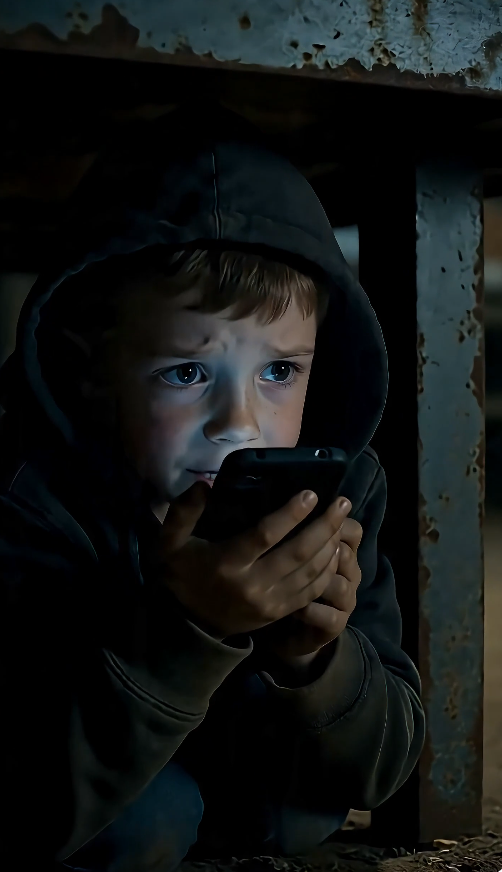
The warehouse door exploded open just as the kidnapper bent down to look under the table.
The boy stopped breathing.
His small hand clamped over his mouth.
Dust burned his eyes.
His phone was still pressed against his chest, the call connected, his father’s voice silent on the other end now because silence was the only thing keeping him alive.
A boot kicked the chair beside him so hard it crashed against the concrete wall.
“Come out, kid. Your father can’t hear you.”
The boy shook under the table, tears sliding down his face without sound.
“Dad… I’m under the table. Please hurry.”
Across the dark warehouse, the kidnapper shouted to the others.
“Search every corner!”
Then the father’s voice came through the tiny speaker, cold enough to make even the boy freeze.
“Stay quiet. I’m already inside.”
The boy did not understand at first.
Then the lights outside the broken windows vanished one by one.
Black cars surrounded the warehouse.
Men moved like shadows behind the stacks of wooden crates.
The kidnappers turned too late.
A bodyguard’s voice cut through the darkness from the doorway.
“Boss, all exits are sealed.”
The kidnapper lifted his gun toward the table.
The father stepped into the warehouse.
He was not alone.
And the boy finally saw why every cruel man in the city feared his father’s name.
That afternoon, seven-year-old Ethan Vale had left school wearing a blue backpack and a paper crown from art class.
He had drawn stars on it with a silver marker.
His teacher said he wore it proudly because it made him look like a king.
Ethan did not feel like a king.
He felt like a boy who missed his mother and waited every day for his father’s black car to arrive exactly at three.
His father, Adrian Vale, was known in the city as a dangerous man.
Some called him a businessman.
Some called him a crime boss.
Some whispered his name and crossed the street.
But Ethan knew another version of him.
The father who cut sandwiches into triangles because Ethan refused squares.
The father who sat through cartoons he hated.
The father who kept every drawing Ethan made in a locked drawer beside contracts and weapons.
The father who never missed pickup.
Until that day.
A substitute driver arrived instead.
He wore the right suit.
He knew Ethan’s name.
He knew the password Adrian had created for emergencies.
Butterfly moon.
Ethan climbed into the car because children trust passwords more than instincts.
Ten minutes later, the doors locked.
The car changed direction.
The driver removed his cap and smiled into the rearview mirror.
Ethan understood too late.
He was taken to an abandoned warehouse near the river, where rainwater dripped through the roof and rats scratched behind the walls.
They tied his hands loosely because they thought a child could not do much.
They took his backpack.
They took his shoes.
They took his watch.
They did not find the tiny phone sewn inside the pocket of his school jacket.
Adrian had placed it there after Ethan once got lost at a museum for six terrifying minutes.
Ethan had complained that the pocket felt bumpy.
Adrian had kissed his forehead and told him that love sometimes feels uncomfortable before it saves you.
Now Ethan was hiding under a rusted metal table, pressing the tiny emergency phone with both thumbs.
He had called the only number it could call.
His father answered before the first full ring ended.
Ethan did not scream.
Adrian had taught him that panic feeds danger.
So the boy whispered everything he could.
Warehouse.
River smell.
Broken windows.
Men arguing.
One red chair.
A dog barking far away.
A train horn every few minutes.
Adrian did not ask useless questions.
He listened.
His voice was steady when he told Ethan to crawl under the nearest table and stay small.
Then the kidnappers noticed the loose rope.
They realized he was gone.
That was when the search began.
Ethan saw boots crossing the concrete.
He saw flashlight beams cutting through dust.
He saw one man overturn a crate and curse.
Another man laughed and said they should have taken the boy’s jacket.
Ethan pressed the phone to his chest and tried not to sob.
He had never been so cold.
He had never been so afraid.
But the fear became worse when one kidnapper stopped beside the table.
The chair flew across the floor.
“Come out, kid. Your father can’t hear you.”
Ethan could not stop the whisper.
“Dad… I’m under the table. Please hurry.”
Then Adrian answered.
Not loudly.
Not with panic.
Not with comfort that would waste time.
“Stay quiet. I’m already inside.”
The words sounded impossible.
But Adrian Vale had built his life on reaching places before enemies understood they had been found.
He had received Ethan’s call in the middle of a meeting with men who thought money mattered more than blood.
The moment he heard his son whisper, Adrian stood.
No one in the room questioned him.
They had seen anger before.
This was not anger.
This was a father becoming a storm.
His security chief, Marcus, traced the emergency phone through three bouncing signals.
His drivers spread across the warehouse district.
His contacts listened for train horns, barking dogs, and river traffic.
A retired dockworker remembered an old storage building with broken windows near a rusted rail line.
Adrian reached it in twelve minutes.
He did not wait for the police before surrounding the building.
But he did call them.
For his son, he wanted justice clean enough to last in court.
For the kidnappers, he wanted every exit closed before anyone could turn the child into a shield.
Inside the warehouse, the kidnappers were getting nervous.
Their leader, Roman Krell, had expected fear from Adrian.
He had expected negotiations.
He had expected money.
He had not expected silence.
The phone they used to send demands had stopped working.
Their lookout outside was no longer answering.
Their van tires had been quietly disabled.
The side door had been locked from the outside.
Roman felt the trap only when it had already closed.
Then the front door burst inward.
“Boss, all exits are sealed.”
Marcus stood in the doorway with a team behind him.
Adrian stepped through the dust and shadow in a dark coat soaked with rain.
His eyes moved once across the room.
One glance.
Every threat.
Every corner.
Every possible line of fire.
Then his gaze dropped to the table.
Ethan’s small fingers were visible near the table leg.
Adrian’s face did not change, but something in the room did.
Even the kidnappers understood they were no longer hunting a boy.
They were standing between a father and his child.
Roman grabbed the nearest weapon and raised it toward the table.
Adrian’s men moved faster.
No shots were fired near Ethan.
No one was allowed to risk him.
A bodyguard slammed into Roman from the side and forced him away from the table.
Another kidnapper ran toward the back door and found two officers already entering.
Police lights flashed through the cracked windows.
The warehouse filled with commands, boots, and the sharp sound of men surrendering because courage leaves quickly when escape disappears.
Ethan stayed under the table until he saw his father’s shoes.
Not the polished black shoes from business meetings.
The older pair Adrian wore when he expected to run.
Then Adrian dropped to his knees.
The dangerous man the city feared lowered himself onto the filthy floor without caring who saw.
Ethan crawled out.
For one second, he looked smaller than he had ever looked.
Then he ran into his father’s arms.
Adrian caught him so tightly that Ethan’s paper crown crumpled between them.
He did not speak.
He pressed one hand to the back of Ethan’s head and the other around his shoulders.
His entire body shook once.
Only once.
Then he held still for his son.
Ethan buried his face in Adrian’s chest.
The smell of rain, leather, and home made him finally cry aloud.
Adrian let him.
Around them, kidnappers were cuffed and dragged to police vehicles.
Marcus recovered Ethan’s backpack from a crate.
The blue paper crown had torn, but the silver stars still shone.
A paramedic checked Ethan’s wrists, his breathing, his eyes, and the bruise forming near his elbow.
Adrian watched every movement.
When the paramedic said Ethan was safe, Adrian closed his eyes.
The world returned to him one breath at a time.
But the night was not over.
Because Roman Krell began shouting from the back of a police car.
He said Adrian should ask his own house who sold the route.
He said someone close had given them the password.
Butterfly moon.
Adrian turned slowly.
Only four people knew that password.
Adrian.
Marcus.
Ethan’s nanny, Mrs. Bell.
And Adrian’s younger brother, Luca Vale.
The thought was so painful that Adrian did not accept it immediately.
Luca had grown up in Adrian’s shadow.
He had wasted money, failed businesses, and resented every locked door Adrian refused to open for him.
But he was family.
And family was the last place Adrian wanted to find betrayal.
At the estate, Luca was waiting with false worry already prepared on his face.
He rushed toward Ethan when they arrived.
Ethan flinched.
It was small.
Almost invisible.
But Adrian saw it.
Fathers see the movements fear leaves behind.
Ethan whispered that Uncle Luca had asked him last week whether he still remembered the emergency password.
He had said it was a game.
Adrian felt the last piece fall into place.
Marcus checked Luca’s phone.
The messages were there.
A deleted thread recovered from the cloud.
A school schedule.
The driver replacement plan.
The password.
The warehouse location.
Luca had not planned for Ethan to be hurt, he claimed.
He only wanted money from Adrian.
He only wanted leverage.
He only wanted to be taken seriously.
Adrian looked at him across the hall where family portraits lined the walls.
The same hall Ethan had learned to walk in.
The same hall where Luca had once carried him on his shoulders.
Adrian’s voice was quiet when he told Marcus to call the detectives back.
Luca laughed at first.
He said blood should stay out of police files.
Adrian looked down at Ethan, who was gripping his coat with both hands.
Then he looked back at his brother.
Blood had been under that table.
Blood had been crying in a warehouse.
Blood had been sold for money.
By sunrise, Luca Vale was in custody as an accessory to kidnapping.
The city expected Adrian to handle betrayal in his own way.
He did not.
He let the law take every man involved.
Not because he had become gentle.
Because Ethan deserved a world where monsters were not hidden in basements and whispered rumors.
He deserved court records.
Sentences.
Names.
Proof that what happened to him was not a nightmare adults would deny.
The trial lasted months.
Ethan testified through a recorded interview with a child psychologist.
He did not have to face the men in court.
Adrian made sure of that.
Roman Krell and his crew were convicted.
Luca’s lawyers tried to frame it as a family misunderstanding.
The recovered messages destroyed that lie.
Mrs. Bell cried through the sentencing because she had blamed herself for not noticing.
Ethan held her hand and told her the phone pocket worked.
That was the closest he came to saying he forgave the world.
After the trial, Adrian changed everything.
Not by building higher walls.
He already had walls.
He changed the way Ethan lived inside them.
He hired a therapist who specialized in childhood trauma.
He reduced his public business.
He stopped holding meetings at dinner time.
He learned that saving a child from danger is not the same as helping him feel safe afterward.
For weeks, Ethan slept under the dining table.
Not in his bed.
Not on the couch.
Under the table, wrapped in a blanket, where he could see every footstep.
The first night Adrian found him there, he nearly broke.
But he did not pull him out.
He brought a pillow and lay down on the floor beside him.
The second night, he brought two flashlights.
The third night, he brought sandwiches cut into triangles.
Little by little, the table stopped being only a hiding place.
It became a fort.
Then a memory.
Then a story Ethan could tell without shaking.
The tiny emergency phone was placed in a glass case in Adrian’s study, beside the torn paper crown.
Visitors thought it was strange.
Adrian did not explain.
Some objects are not trophies.
They are reminders of the seconds that separate loss from rescue.
A year later, Ethan returned to school full time.
He wore a new blue backpack.
Inside, hidden in a pocket, was another emergency phone.
This time, Ethan knew it was there.
He touched the pocket every morning before leaving the car.
Adrian never told him not to.
Trust grows slowly after fear.
On the anniversary of the rescue, Adrian took Ethan to the river district.
The warehouse was gone.
Adrian had bought the property after the trial, but he did not leave it as a scar.
He turned it into a children’s safety center.
It offered after-school care, counseling, self-protection education, and emergency support for children in danger.
The building had bright windows now.
A playground.
A library.
A room where children could call safe adults without asking permission.
Ethan stood in the doorway holding his father’s hand.
He asked if bad things could become good places.
Adrian looked at the sunlight on the new floor where dust and fear had once lived.
He told Ethan that good places are sometimes built by people who refuse to let bad things have the final word.
Ethan thought about that.
Then he walked inside.
Years passed.
The story of the boy under the table became a rumor in the city.
People told it in harsher ways.
They made Adrian sound like thunder and the kidnappers sound like shadows.
They forgot the small parts.
The paper crown.
The whispered call.
The father lying on the floor beside his son for weeks afterward.
But Ethan remembered.
At sixteen, he volunteered at the safety center.
He helped younger children with homework.
He showed them the phone room.
He told nervous kids that being scared did not make them weak.
He knew because he had once been so scared he could barely breathe.
On the wall of the center hung a framed sentence Adrian had written himself.
No child should have to shout to be found.
Below it was a small drawing of a table, a phone, and a crown with silver stars.
Ethan had drawn it.
Adrian kept the original in his locked drawer beside every drawing his son had ever made.
On Ethan’s eighteenth birthday, Adrian gave him the torn paper crown from the glass case.
It had been repaired carefully.
The fold lines remained.
The silver stars were faded but visible.
Ethan laughed when he saw it.
Then he cried.
Adrian did too, though he tried to hide it.
Ethan placed the crown on his father’s head as a joke.
For the first time in years, Adrian laughed loudly enough for the guards outside the room to hear.
The boy had hidden under the table while kidnappers searched for him.
His father had already been inside.
May you like



But the real ending was not the rescue, the sealed exits, or the arrests.
The real ending was a child learning that fear could be survived, a father learning that protection meant staying afterward, and a dark warehouse becoming a place where lost children would always be heard.







