“The boy hid inside the restaurant pantry… and called the most feared man in the city.”
The entire restaurant bowed the moment Dante Romano stepped through the front doors.
The kidnappers froze in the kitchen hallway.
Only minutes earlier, they had been tearing through the restaurant like wolves, opening freezer doors, kicking over crates, and searching behind stacks of food.
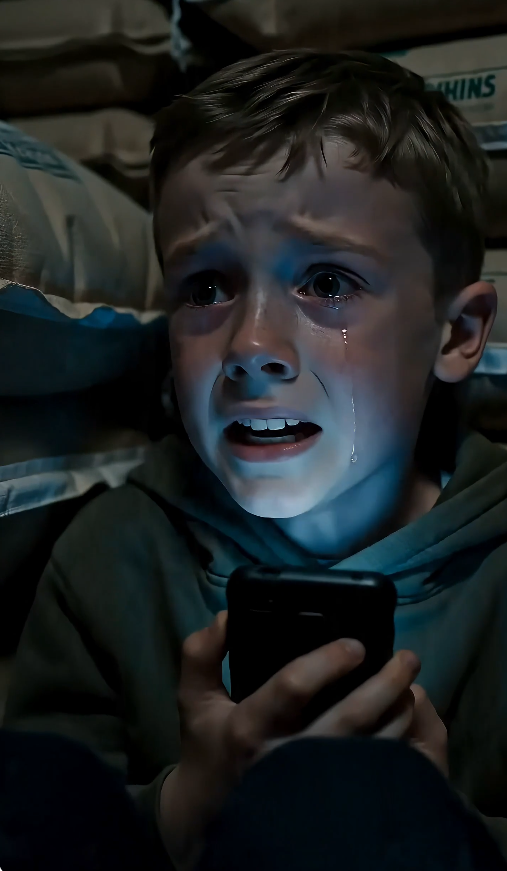
Inside the cold pantry, eight-year-old Luca Romano sat behind flour bags with both knees pressed to his chest.
His phone shook in his small hands.
The air smelled of garlic, metal shelves, and fear.
Outside the pantry door, a kidnapper shouted into the kitchen.
“Open every door. He’s here somewhere.”
Luca swallowed a sob and whispered into the phone.
“Dad… I’m behind the flour bags.”
On the other end of the line, his father’s voice came low and steady.
“Close your eyes and stay low.”
The pantry door opened.
A white beam of light swept across canned tomatoes, sacks of rice, and the flour bags hiding Luca’s tiny shoes.
Luca squeezed his eyes shut.
“Are you really coming?”
Then the restaurant’s main door opened.
The dining room went silent.
The head chef lowered his knife.
The waiters stepped back.
The security guards bowed their heads.
Even the dishwasher near the sink stood straighter.
Every person in that restaurant knew Dante Romano.
Not because they feared him.
Because, years ago, each of them had survived because of him.
The chef stepped forward, face pale but loyal.
“Boss, your son is in the pantry.”
Dante’s eyes moved to the kitchen hallway.
Then to the kidnapper holding the flashlight.
The man suddenly understood the mistake.
He had chosen a restaurant full of people who owed Dante their lives.
But when Dante reached the pantry door, he saw something on the floor beside the flour bags.
A silver reservation token.
Private dining access.
Only one person outside the family had permission to issue it.
Four hours earlier, Luca had been sitting in the back seat of a black car, drawing a dragon on the fogged window with one finger.
He had just finished piano practice.
He hated piano practice.
Not because he hated music, but because every teacher looked nervous when his father’s men stood outside the studio.
Luca wanted to be normal.
He wanted to walk to the corner bakery like other children.
He wanted to carry his own backpack without two bodyguards checking the street first.
But Dante Romano did not live in a normal world.
The city called him the most feared man alive.
Politicians avoided saying his name on television.
Businessmen laughed too loudly at his jokes.
Criminals crossed themselves before betraying him.
Yet at home, Dante was the father who warmed milk too hot, burned pancakes, and let Luca keep a stray kitten in a silk-lined shoe box.
Luca’s mother had died when he was three.
Since then, Dante’s entire heart lived in one small boy with dark curls and serious eyes.
That was why he had rules.
Passwords.
Drivers.
Safe routes.
Hidden phones.
Emergency signals.
Luca complained about all of them until the day the wrong driver arrived.
The man had the right car.
The right suit.
The right school pass.
He even knew the code phrase Dante used when plans changed.
Red candle.
Luca hesitated.
The man smiled gently.
He said Dante had sent him because the usual driver was sick.
Luca climbed in because children trust adults who know secret words.
Ten minutes later, the car turned away from home.
The door locks clicked.
The driver’s smile disappeared.
Two men in the front seat put on gloves.
Luca reached into his sleeve and pressed the tiny emergency button sewn beneath the cuff.
Dante answered before Luca could even breathe.
At first, the call was only static and muffled voices.
Then Luca whispered where he was.
A car.
Not home.
Smells like onions.
Near water.
Men are angry.
Dante was in a private meeting when the call came.
His lawyers were speaking about a harbor contract.
His accountant was explaining numbers.
His cousin Marco was pouring coffee.
The moment Dante heard Luca whisper, every man at the table went still.
Dante raised one hand.
The room fell silent.
He asked Luca to describe anything he could see.
Luca told him about a paper bag on the floor.
A restaurant logo.
A blue fish inside a circle.
Dante knew it immediately.
La Stella.
A restaurant near the river.
One of his restaurants.
One of the first businesses he had ever saved.
The kidnappers dragged Luca through the back service entrance and into the kitchen.
They argued in rough whispers.
They were not professionals.
Professionals would never hide Dante Romano’s son inside a place Dante owned.
But desperate men can mistake boldness for intelligence.
The restaurant was closed for a private event that night.
Or so the kidnappers believed.
The private event was fake.
The reservation had been placed under the name Moretti.
The payment came through a card tied to a shell account.
The access token had been issued from inside Dante’s own network.
That meant betrayal.
Dante did not tell Luca that.
He only told him to stay small.
When the kidnappers turned their backs, Luca slipped from the chair, crawled beneath a prep table, and ran into the pantry.
He hid behind flour bags because they were heavy enough to stop the door from opening all the way.
He held the phone against his chest and tried not to breathe too loudly.
Outside, the kidnappers realized he was gone.
“Open every door. He’s here somewhere.”
One man kicked the freezer door.
Another overturned a basket of onions.
The youngest kidnapper panicked and said they should leave.
The leader told him they could not leave without the boy.
The money was in the boy.
The trade was in the boy.
The threat was in the boy.
Inside the pantry, Luca began to cry without sound.
He had never understood what it meant to be his father’s weakness until that moment.
Dante was already moving.
He called the police commander who owed him nothing but respected the line Dante had drawn years ago.
No children.
No schools.
No hospitals.
No innocents.
Dante told him his son had been taken and that he wanted arrests, not rumors.
Then he called Chef Matteo Ricci.
Matteo had once been a young cook with gambling debts and a broken hand.
Dante paid the debt, bought the restaurant from the men who owned Matteo, and gave him the kitchen keys.
Matteo never forgot.
That night, when Dante’s call reached him, Matteo did not ask questions.
He locked the front doors.
He moved loyal staff into position.
He sent the guests home through the side exit.
He told the waiters to keep their jackets on and their heads down until Dante arrived.
Every person in La Stella had a reason to stand with him.
The waitress Elena had received surgery money for her son from Dante’s charity account.
The dishwasher Niko had been given a job after prison when no one else would hire him.
The security guard Abel had once been saved from a street beating by Dante’s men and later trained legally to protect others.
Even the pianist in the corner, old Carlo, had played at Dante’s wedding and still remembered the way Dante cried when his wife walked down the aisle.
They were not an army.
They were something stronger in that moment.
People who remembered mercy.
The kidnappers did not notice until the lights in the dining room dimmed and every staff member stopped pretending.
Then the main door opened.
Dante walked in alone at first.
Rainwater dripped from his black coat.
His face was calm in a way that made the kidnappers step back.
Behind him came his men.
Behind them came uniformed police moving quietly through the entrance.
No one shouted.
No one fired.
The restaurant itself seemed to hold its breath.
The chef stepped forward.
“Boss, your son is in the pantry.”
Dante did not thank him yet.
His gratitude had to wait until Luca was breathing against him.
He walked through the kitchen slowly.
One kidnapper tried to run toward the rear exit.
Abel blocked him before he reached the hallway.
Another grabbed a knife from the counter.
Matteo slammed a steel pan onto the counter so hard the man flinched and dropped it.
Police moved in from both doors.
The kidnappers were surrounded between the stoves and the pantry.
Dante reached the pantry.
He opened the door.
The flour bags shifted.
For one second, all he saw was white dust, tins of tomatoes, and a trembling sleeve.
Then Luca crawled out.
His face was streaked with flour and tears.
Dante dropped to one knee before the boy reached him.
Luca threw himself into his father’s arms.
Dante held him so tightly the child’s phone fell to the floor and cracked.
He pressed one hand to the back of Luca’s head and closed his eyes.
He did not care who saw him shake.
He did not care that the city’s most feared man was kneeling on a restaurant floor with flour on his coat.
His son was alive.
That was the only empire that mattered.
The kidnappers were handcuffed in the kitchen.
The leader kept shouting that he had not planned to hurt the boy.
Dante did not answer him.
He looked at Luca’s bare feet, at the rope mark on one wrist, and at the pantry shelf where his son had hidden between food sacks like a frightened animal.
His silence was worse than any threat.
Then Marco, Dante’s cousin and closest advisor, entered through the side door, breathing hard.
He said he had come as soon as he heard.
He reached toward Luca.
Luca stiffened.
It was small.
Almost nothing.
But Dante felt it through the child’s body.
He looked down.
Near the flour bags lay the silver reservation token.
Dante picked it up.
La Stella used those tokens only for trusted private guests.
Each one carried a hidden mark identifying who issued it.
Dante turned the token over.
The mark was a tiny carved M.
Marco.
Dante looked at his cousin.
For a moment, the restaurant vanished.
They were boys again in a narrow apartment, sharing bread, promising they would never abandon each other.
Marco had been at Dante’s wedding.
Marco had carried Luca when he was born.
Marco had stood beside Dante at Elena’s grave.
And Marco had sold the door through which kidnappers carried his son.
Dante’s men saw his face and reached for their weapons.
Dante lifted one hand.
No blood in front of Luca.
Not ever.
The police commander stepped forward.
Dante handed him the token.
Then he handed over the reservation logs, the security footage, and the false payment record Matteo had already printed from the office.
Marco laughed once.
A broken, ugly sound.
He said Dante had everything.
Restaurants.
Loyalty.
Fear.
Respect.
He said no one remembered that Marco had built the early routes, made the first calls, paid the first bribes, bled for the family.
He said he only wanted enough money to leave.
Dante looked at Luca, who had buried his face in his coat.
Then he looked back at Marco.
You chose a child as your exit.
That was the only sentence Dante gave him.
Marco was arrested with the kidnappers.
The kitchen watched in silence as he was taken out the same service door he had opened for them.
No one bowed to him.
No one cursed him.
He left without the dignity he had spent years demanding.
The trial became the story the city could not stop whispering about.
Not because Dante Romano’s son had been taken.
Because Dante let the courts handle every man involved.
People expected revenge.
They expected bodies in rivers and midnight rumors.
Instead, there were police reports, witness statements, access logs, call records, and a child psychologist protecting Luca from the worst of the courtroom.
Dante sat through every hearing.
Luca did not.
That was one more door Dante refused to make his son walk through.
Marco received the longest sentence because the court considered his betrayal the reason the kidnapping was possible.
The kidnappers tried to blame one another.
The token blamed all of them better than their mouths could.
After the trial, Dante closed La Stella for one month.
Not because he blamed the restaurant.
Because every corner still held Luca’s fear.
He brought in painters.
Carpenters.
Lighting crews.
He replaced the pantry door.
He widened the hallway.
He installed a child-safe emergency room behind the kitchen for anyone in danger.
He asked Luca what color the pantry should be.
Luca said yellow because yellow looked less like hiding.
The new pantry had warm lights, low shelves, and a painted mural of blue fish swimming toward sunlight.
Luca visited it with his therapist first.
Then with Dante.
He stood behind the flour bags and touched the wall.
Dante waited outside the door, exactly where Luca asked him to stand.
After a minute, Luca stepped out.
He said the room did not feel like a monster anymore.
Dante had to turn away before his son saw his tears.
Healing came slowly.
Luca slept with the lights on for months.
He hated flour for a while.
He could not enter restaurants through back doors.
When waiters moved too quickly, he reached for Dante’s hand.
Dante changed too.
He stopped pretending protection ended when danger ended.
He canceled late dinners.
He took Luca to school himself.
He learned to sit beside a child’s bed without checking his phone.
He learned that the most feared man in the city could still be helpless against a nightmare.
One night, Luca asked why all the restaurant workers had bowed.
Dante told him the truth carefully.
He had helped them once.
Luca thought about that.
Then he asked whether helping people made them family.
Dante said sometimes.
Luca asked whether Marco had been family.
Dante looked at the bedroom wall for a long time.
He said family is not the person allowed close to you.
Family is the person who protects the door once they are inside.
Luca remembered that.
Years later, La Stella became famous for more than food.
People knew it as a place where lost children could ask for help.
A small symbol appeared on the menu.
A blue fish inside a circle.
Children in danger could show it to any staff member.
No questions in public.
No delay.
They would be taken to the yellow room behind the kitchen and given a phone, water, and a safe adult.
The program spread to every restaurant Dante owned.
Then to restaurants he did not own.
He funded training anonymously at first, but people guessed.
They always guessed when mercy came with no invoice.
Chef Matteo became the program’s public face.
He said a kitchen should feed fear out of people, not chase them into corners.
The line appeared in newspapers.
Matteo hated newspapers.
Luca loved teasing him about it.
On Luca’s twelfth birthday, Dante brought him to La Stella after closing.
No guests.
No cameras.
Only the staff who had been there that night.
Matteo made Luca’s favorite pasta.
Elena the waitress brought a cake shaped like a blue fish.
Niko the dishwasher played music badly on a tiny speaker.
Abel stood by the door even though everyone told him to sit down.
Dante gave Luca a small box.
Inside was the cracked emergency phone.
It had been repaired but not restored.
The crack remained across the screen like a lightning mark.
Luca touched it gently.
He asked why his father kept broken things.
Dante said some broken things prove the rescue happened in time.
Luca placed the phone on the table beside the cake.
Then he walked to the pantry.
Everyone fell quiet.
Luca opened the door himself.
He looked at the yellow walls, the blue fish, and the flour bags now stacked neatly on the lower shelf.
He stepped inside.
Then he stepped out again smiling.
The room applauded.
Not loudly.
Softly.
The way people applaud courage when they know how much it cost.
Years passed, and the city kept calling Dante Romano feared.
Luca knew better.
Fear was only the language strangers used because they did not know what else to call power.
Inside La Stella, power looked like a chef standing between a boy and danger.
A waitress hiding trembling hands so a child would feel calmer.
A security guard blocking an exit.
A father kneeling in flour and broken glass, whispering against his son’s hair that no one would make him hide again.
When Luca turned eighteen, he did not join Dante’s darker businesses.
He studied child psychology and hospitality safety.
He returned to La Stella not as a frightened boy, but as the director of the Blue Fish program.
On his first day, he trained new staff in the yellow room.
He told them children rarely ask for help loudly.
Sometimes they whisper.
Sometimes they hide.
Sometimes they call from behind flour bags.
The job of adults, he said, is to hear them before fear becomes silence.
Dante watched from the doorway.
Older now.
Quieter.
Still feared by some.
Loved by the people who mattered.
After the training, Luca walked to his father and placed the old silver reservation token in his hand.
The evidence had been released after Marco’s final appeal failed.
Dante looked at it without anger for the first time.
Luca told him to melt it down.
They did.
Matteo turned the silver into a small bell for the yellow room.
Every time a child reached safety there, the bell was rung once after they left.
Not for celebration.
For witness.
A sound that said someone was heard.
The boy had hidden inside the restaurant pantry and called the most feared man in the city.
His father came.
May you like



But the real ending was not the bowed heads, the sealed kitchen, or the kidnappers in handcuffs.
The real ending was a pantry becoming a safe room, a betrayal becoming proof, and a frightened child growing into the kind of man who made sure no other child had to hide behind flour bags and wonder whether anyone was really coming.







