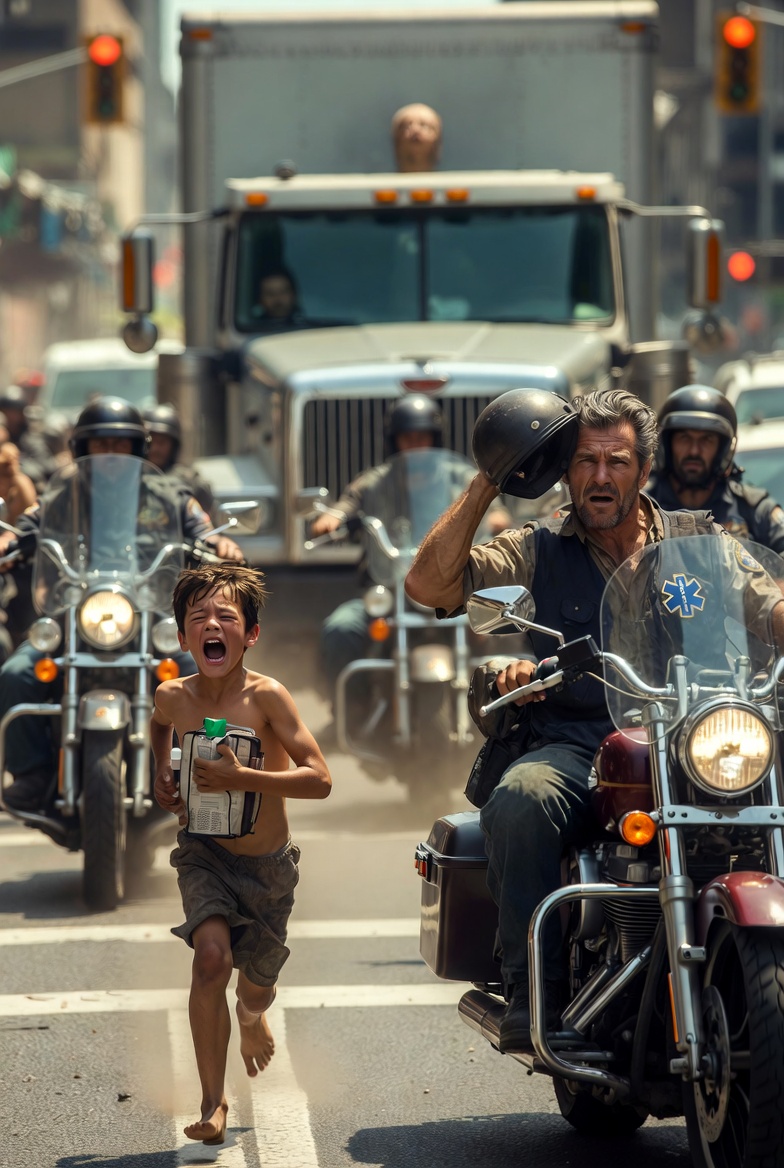
“The bikers blocked traffic… when they saw the boy running barefoot.”
“Please!”
“My little sister can’t breathe!”
The boy’s scream cut through the roar of afternoon traffic before anyone understood where it came from.
He was running barefoot down the middle of the street, clutching a small pharmacy bag against his chest as if it were the only thing holding his world together.
His dirty T-shirt stuck to his back.
His face was streaked with tears.
His feet slapped against the hot asphalt without slowing.
A delivery truck barreled toward the intersection behind him, horn blaring.
Cars swerved.
Someone shouted from a sidewalk café.
The boy did not look left or right.
He only kept running.
Then twelve motorcycles thundered around the corner.
The lead biker saw the child first.
His name was Caleb “Bear” Morrison.
He was fifty-eight years old, broad-shouldered, gray-bearded, and built like the kind of man most people crossed the street to avoid.
His leather vest was cracked with age.
His gloves were worn.
A faded emergency medical patch was sewn near his heart.
Caleb hit his brakes so hard the rear tire screamed.
The bikers behind him reacted instantly.
Motorcycles angled across the lanes one after another, forming a wall of steel between the boy and the truck.
The truck stopped inches behind the last motorcycle.
Its horn blasted long and furious.
Caleb ripped off his helmet and stepped into the street.
The boy nearly collapsed against him.
“My sister,” the child sobbed.
“She can’t breathe.”
“I got the medicine, but she’s not moving right.”
Caleb’s face changed.
The roughness stayed.
The hesitation vanished.
He crouched in front of the boy.
“What’s your name?”
“Eli.”
“How old is your sister?”
“Six.”
“Is she awake?”
Eli shook so hard the pharmacy bag crinkled in his hands.
“She was trying to talk.”
“Then she stopped.”
Caleb took the bag and looked inside.
An inhaler.
A spacer still in plastic.
A prescription label.
Maya Ortiz.
Caleb’s fingers tightened slightly around the name.
For half a second, something old and painful crossed his face.
Then he pushed it away.
“Show me where she is.”
Eli looked up at him through tears.
That was when he noticed the patch.
It was faded, but the symbol was clear.
A blue star of life.
Below it were stitched words almost worn away by time.
Paramedic Unit 17.
Eli stared.
“You were an EMT?”
Caleb held his gaze.
“A long time ago.”
The boy swallowed.
“My dad was too.”
The words struck Caleb harder than the truck horn.
Before he could ask anything, Eli pointed down the street.
“Three blocks.”
“Apartment above the laundromat.”
Caleb turned to the other bikers.
“Rico, hold the truck.”
“June, call 911 and tell them pediatric respiratory distress.”
“Everybody else, clear me a path.”
No one questioned him.
The biker crew, who had been mistaken for trouble on more streets than they could count, moved like a rescue unit.
One bike rolled forward to block the left lane.
Another crossed the intersection.
Two riders stood between cars and raised their hands until traffic froze.
Caleb lifted Eli onto the back of his motorcycle.
“Hold the strap with one hand and the medicine with the other.”
Eli climbed on, shaking.
Caleb looked over his shoulder.
“You point.”
Eli nodded.
The motorcycle shot forward.
Behind them, drivers leaned on horns and shouted curses.
Then they saw the boy’s bare feet, the pharmacy bag, and the look on Caleb’s face.
One by one, the noise died.
The motorcycle cut between stopped cars, turned hard beside a bus, and climbed the curb near a narrow alley.
Eli pointed with both hands.
“There!”
The laundromat sign flickered above a row of cracked windows.
Caleb killed the engine before the bike fully stopped.
He lifted Eli down and ran with him toward a side stairwell.
The building smelled of detergent, old smoke, and summer heat.
They reached the second-floor landing.
A woman from the hallway stood crying outside an open apartment door.
“I didn’t know what to do,” she said.
“She just kept wheezing.”
Caleb entered without asking permission.
A little girl lay on the sofa beneath a thin blanket.
Her eyes were half-open.
Her chest pulled in sharply with each breath.
A small stuffed rabbit lay beside her hand.
Her lips had begun to lose color.
Caleb dropped to one knee.
“Maya.”
“My name is Caleb.”
“I’m going to help you breathe.”
The girl’s eyes moved weakly toward him.
Eli stood frozen in the doorway.
Caleb opened the inhaler and spacer.
His movements were fast, controlled, and practiced in a way that made the frightened neighbor stop crying for a moment.
He checked the prescription label, shook the inhaler, fitted it into the spacer, and held it gently to Maya’s mouth.
“Slow breath, sweetheart.”
“Just one.”
Maya struggled.
Caleb watched her chest.
He pressed once.
“Good.”
“Again.”
Eli covered his mouth.
The neighbor whispered a prayer.
Outside, motorcycles blocked the street as if guarding the building from the whole city.
Caleb kept his voice low.
He counted breaths.
He checked Maya’s pulse.
He asked Eli when the symptoms started.
He asked whether Maya had allergies, fever, or had been hospitalized before.
Eli answered through panic.
“She had asthma.”
“Mom was at work.”
“The old inhaler was empty.”
“The pharmacy said insurance was delayed.”
“I ran.”
Caleb’s jaw tightened, but his hands stayed gentle.
Sirens appeared in the distance.
Maya took another breath.
Then another.
The tight sound in her chest began to loosen.
Her eyes focused more clearly.
Eli took one step forward.
“Is she going to die?”
Caleb looked at him.
“No.”
The boy broke.
He fell to his knees beside the sofa and sobbed into the blanket.
Caleb placed one hand on his shoulder but kept watching Maya.
The ambulance arrived four minutes later.
Two paramedics rushed in with oxygen and a pediatric bag.
One of them stopped in the doorway when he saw Caleb.
“Bear?”
Caleb did not look up.
“Don’t stand there, Tommy.”
“She needs oxygen and transport.”
The young paramedic moved instantly.
He had trained under men who had trained under Caleb Morrison.
Every old medic in the city knew the name.
Bear Morrison had once been the kind of paramedic who could walk into chaos and make everyone else breathe slower.
Then he disappeared.
Some said he burned out.
Some said he lost his license.
Some said a bad call finally broke him.
None of them knew the truth.
Caleb rode in the ambulance because Maya would not let go of his sleeve.
Eli rode beside him with the pharmacy bag clutched in his lap.
The biker crew followed in formation behind the ambulance, no longer blocking traffic, but keeping close enough that every driver noticed them.
At the hospital, Maya was taken into a treatment room.
Eli refused to sit until a nurse promised he could see her again.
Caleb stood near the wall, hands stained with dust from the stairwell, vest still marked by years of sun and road.
A police officer approached.
“We had reports of motorcycles blocking lanes.”
Caleb looked at him.
“You did.”
The officer glanced through the glass at the little girl receiving treatment.
Then he put his notebook away.
“Good.”
Eli’s mother arrived twenty minutes later in a grocery store uniform, still wearing her name tag.
Her name was Rosa Ortiz.
She ran into the waiting area and nearly fell when Eli threw himself into her arms.
“My baby,” she cried.
“I tried to call you,” Eli sobbed.
“My phone died.”
“I got the medicine.”
Rosa held him so tightly he could barely breathe.
Then she saw Caleb.
Her face went still.
Not confused.
Recognizing.
She stood slowly.
“You.”
Caleb’s body stiffened.
Rosa stepped closer.
“You’re Bear Morrison.”
Caleb looked at the floor.
“I was.”
Rosa’s eyes filled.
“My husband used to talk about you.”
Caleb did not answer.
He had already known from the prescription label.
Ortiz.
There had been many Ortiz families in the city.
But the moment Eli said his father had been an EMT, Caleb knew the old wound had found him.
“Rafael Ortiz,” Rosa said.
Caleb closed his eyes.
“I’m sorry.”
Rosa shook her head.
“No.”
“You don’t get to disappear inside that word.”
Eli looked between them.
“You knew Dad?”
Caleb’s voice became rough.
“He was my partner.”
The waiting room seemed to move farther away.
Rafael Ortiz had been twenty-nine when he joined Caleb’s ambulance unit.
He was fast, funny, stubborn, and brave in the reckless way young medics sometimes were before the job taught them what courage truly cost.
He and Caleb spent five years together.
They delivered babies, held pressure on wounds, restarted hearts, and sat in silence after calls neither man wanted to remember.
Then came the bridge collapse.
A storm.
A school bus.
A crushed minivan hanging half over the water.
Caleb went into the wreckage first.
Rafael followed.
A second section of concrete gave way.
Rafael pushed a trapped child toward Caleb and took the fall meant for both of them.
The child lived.
Rafael died before the rescue crew could lift the slab.
Caleb resigned three weeks later.
He never attended another department ceremony.
He never answered Rosa’s calls.
He kept the paramedic patch because he could not forgive himself enough to remove it.
Now Rafael’s son stood barefoot in a hospital waiting room.
And Rafael’s daughter was breathing in the next room because a biker crew had blocked traffic.
Rosa wiped her face.
“He told me once that if everything went wrong, I should find Bear.”
Caleb swallowed.
“I wasn’t there for you.”
“No,” Rosa said softly.
“You weren’t.”
The honesty hurt.
Then she looked through the glass toward Maya.
“But today, you were.”
A doctor came out before Caleb could answer.
“Maya is stable.”
“She will need monitoring overnight, but she responded well.”
Rosa covered her mouth and cried.
Eli collapsed into a chair like his bones had finally remembered he was nine.
Caleb stepped back.
The moment was becoming too full.
Too intimate.
Too undeserved.
He turned toward the exit.
Eli noticed.
“Don’t go.”
Caleb stopped.
The boy stood.
“You saved her.”
Caleb shook his head.
“You saved her.”
“You ran barefoot through traffic for medicine.”
“I only followed you.”
Eli looked down at his dirty feet.
“I was scared.”
“That doesn’t mean you weren’t brave.”
Rosa reached into her purse.
“I have something.”
She removed an old envelope, folded soft from years of handling.
Caleb stared at it as though it were alive.
Rosa held it out.
“Rafael wrote this after Eli was born.”
“He said I should give it to you when you were ready to stop running.”
Caleb did not take it.
“I’m not sure I am.”
Rosa’s voice trembled.
“Then take it anyway.”
His hand shook when he accepted the envelope.
Inside was a photograph of Caleb and Rafael standing beside Ambulance 17.
Both men were younger.
Both were laughing.
Rafael had one arm around Caleb’s shoulders and the other hand raised in a ridiculous thumbs-up.
On the back, Rafael had written one sentence.
If my kids ever need help, Bear will come, even if he has to fight traffic, guilt, and God himself to get there.
Caleb read it once.
Then again.
His face broke in a way none of the bikers had ever seen.
He sat down hard in the chair nearest him.
For twelve years, he had believed Rafael died saving a child while Caleb survived by mistake.
He had built a life around punishment.
Lonely roads.
Loud engines.
No sirens.
No calls.
No families who could lose him.
But Rafael had not written like a man blaming him.
He had written like a man trusting him.
Eli sat beside him quietly.
After a while, the boy placed one small hand on Caleb’s leather vest, right over the faded paramedic patch.
“Can I tell Maya you’re Dad’s friend?”
Caleb looked through the glass.
Maya was sitting up now, an oxygen mask over her face, clutching the stuffed rabbit while Rosa held her hand.
“Yes,” he said.
His voice was barely there.
“Tell her I’m her dad’s partner.”
The biker crew remained outside the hospital until sunset.
They bought Eli shoes from a nearby store.
They paid the pharmacy bill before Rosa could argue.
June spoke to a social worker about medication assistance.
Rico fixed the broken lock on Rosa’s apartment door the next morning.
And Caleb returned to the hospital with a small toy ambulance for Maya.
Maya held it against her chest.
“Mom said you used to help people breathe.”
Caleb smiled faintly.
“Sometimes.”
“Do you still?”
He looked at Eli.
Then at Rosa.
Then at the patch on his vest.
“I think I’m starting again.”
Six months later, Caleb and the biker crew formed a volunteer emergency response group for neighborhoods where ambulances often lost time in traffic.
They did not pretend to replace paramedics.
They delivered medication.
Cleared intersections.
Taught parents how to use inhalers and spacers.
Raised money for children whose insurance delays turned prescriptions into emergencies.
On the back of every vest, beneath the motorcycle club name, they added a small stitched line.
Ride for Rafael.
Eli attended the first training day wearing new sneakers and carrying a notebook.
Maya sat nearby with Rosa, breathing easily, holding her toy ambulance.
When Caleb demonstrated how to stay calm during a breathing emergency, Eli raised his hand.
“What’s the first rule?”
Caleb looked at him.
The boy already knew the answer.
But he asked anyway.
Caleb smiled.
“You don’t waste time judging who needs help.”
Eli nodded seriously.
“You move.”
Years later, people in the city still told the story of the day bikers blocked traffic for a barefoot boy.
Some remembered the truck horn.
Some remembered the motorcycles angled like a shield.
Some remembered the old biker lifting the child and saying, “Show me where she is.”
But the part Caleb remembered most was the sentence on the back of Rafael’s photograph.
It had waited twelve years inside an envelope.
It had waited through guilt, silence, and every mile Caleb rode trying to outrun the man he used to be.
And when the boy ran barefoot into traffic, carrying medicine in shaking hands, Caleb finally understood why Rafael had written it.
May you like



His old partner had not left him a goodbye.
He had left him a call to answer.







