“She tore the bride’s wedding dress… then the venue manager bowed to the bride.”
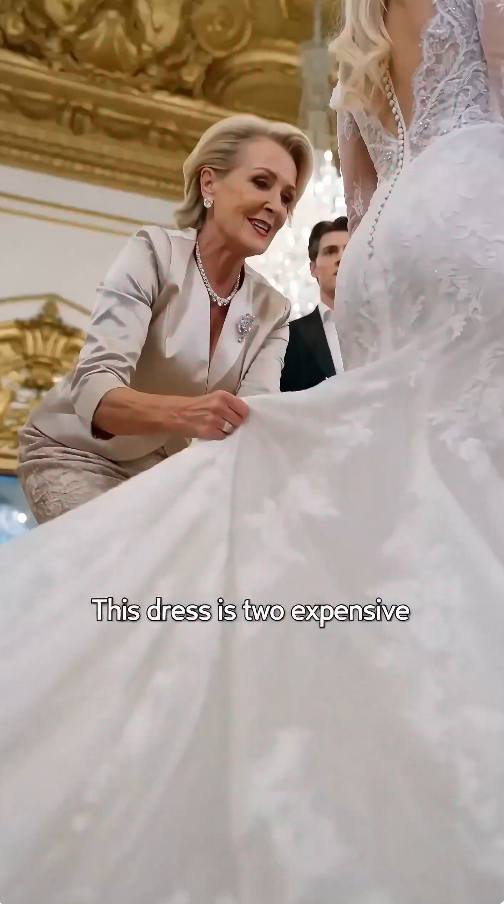
The mother-in-law tore the bride’s wedding dress in front of three hundred guests, and the bride did not cry until the venue manager bowed to her.
The silk ripped like a scream across the marble aisle.
White fabric fell from the train of the gown and slid beneath the flower arch.
The guests gasped.
The groom stood beside the altar, silent.
His mother, Patricia Whitlock, still had one fist wrapped around the torn lace.
“This dress is too expensive for someone like you.”
The bride, Clara Mason, looked down at the ruined gown that had taken six months to design.
Then she looked at the woman who had hated her since the engagement dinner.
“You don’t know what I paid for.”
Whispers moved through the luxury wedding hall.
Patricia smiled as if humiliation were part of the ceremony.
The groom, Andrew Whitlock, finally stepped forward, but not toward his bride.
“Just apologize to my mother.”
Clara turned toward him slowly.
“For letting her ruin my wedding?”
Before Andrew could answer, the main doors opened.
The venue manager rushed in with two assistants behind him and a leather folder in his hands.
He stopped in front of Clara, lowered his head, and held out the ownership contract for the entire estate.
“Madam, your entire venue is ready.”
The ballroom froze.
Patricia’s face went pale.
Andrew looked from the folder to Clara as if seeing her for the first time.
Because the bride his mother had called too poor to wear silk was the owner of the wedding venue.
And the torn dress was not the only thing Patricia had destroyed.
Clara Mason had not been born into money.
She had been born in a county hospital with no father listed on the form and a mother who disappeared before Clara learned her voice.
At six years old, she arrived at St. Agnes Children’s Home carrying one plastic bag, one pair of shoes, and a teddy bear with one button eye.
She learned early that rich people loved charity dinners more than they loved children.
They came in December with cameras.
They brought toys wrapped in shiny paper.
They posed beside children like proof of goodness.
Then they left before dinner because the dining room smelled of soup and old radiators.
Clara did not hate them.
She studied them.
She studied dresses.
Manners.
Signatures.
Names on plaques.
She studied how people with money entered rooms without asking permission.
At seventeen, she worked as a waitress at weddings.
At twenty-two, she became an event coordinator.
At twenty-eight, she opened a small planning company with borrowed chairs, unpaid sleep, and a talent for seeing what made people feel important.
Her company grew because Clara remembered every detail.
A grandmother’s wheelchair access.
A grieving father’s quiet seat.
A bride’s fear of being laughed at.
She built events around dignity, not decoration.
That was how she first saw Rosemont Hall.
It was the most beautiful wedding estate in the state.
Crystal chandeliers.
A garden maze.
A marble staircase.
A ballroom that looked like a movie dream.
But Clara hated it the first time she entered.
When she was twelve, St. Agnes had brought children to Rosemont Hall for a charity Christmas performance.
They sang carols for donors in the ballroom.
After the performance, the children were told to eat in the kitchen hallway because their clothes did not fit the photographs upstairs.
Clara never forgot sitting on a milk crate with a paper plate while laughter spilled from the ballroom beyond the closed doors.
She promised herself that one day, if she ever had power, no child would be fed in a hallway like an embarrassment.
Years later, when Rosemont Hall quietly went into debt, Clara bought it through her company.
She kept the purchase private while renovations continued.
She planned to announce the new ownership after her wedding to Andrew.
More importantly, she planned to turn the annual wedding season profits into a foundation for foster and orphaned children.
The first night of that foundation was supposed to be her wedding reception.
Every uneaten plate from the luxury dinner had already been matched with transportation to bring children from three homes to eat at the ballroom after the guests departed.
Clara had ordered extra desserts.
Extra coats.
A small orchestra performance.
A magician.
A table of art supplies.
She wanted the children to enter through the front doors.
She wanted them seated under chandeliers.
She wanted them to know beauty could belong to them too.
Andrew knew some of this.
Not all.
He knew Clara had grown up in foster care.
He knew she had built her company herself.
He knew she was private about money because she disliked how quickly people changed around it.
But he did not know she owned Rosemont Hall.
Clara wanted to surprise him after the ceremony.
She thought marriage meant building a life with someone who would be proud of the woman she had become.
She had mistaken Andrew’s politeness for courage.
His mother, Patricia, had never made that mistake.
Patricia Whitlock believed family names were inherited, not earned.
She smiled at Clara in public and questioned her in private.
She asked which relatives would sit on Clara’s side.
She asked whether Clara’s company had real clients or merely social media attention.
She asked whether Andrew had considered what marrying someone without roots might do to the Whitlock image.
Clara answered with grace at first.
Then silence.
Andrew always apologized afterward.
He never defended her during.
That should have told Clara the truth.
But love often turns warnings into background noise.
On the wedding day, Patricia arrived early and inspected the ballroom as if she owned it.
She criticized the flowers.
She corrected the seating cards.
She told the photographer to avoid wide shots of Clara’s empty family section.
Clara heard none of it until later.
She was in the bridal suite, pinning a small silver charm inside her gown.
The charm had belonged to Sister Margaret from St. Agnes.
It was shaped like a tiny door.
Sister Margaret had given it to Clara when she left the home.
She told Clara that every closed door teaches a child to dream of keys.
Clara wore it for courage.
Her dress was not expensive because she wanted to impress the Whitlocks.
It was expensive because she had paid every seamstress properly.
It was handmade by women from the job-training program she funded for former foster youth.
The lace was stitched by a nineteen-year-old girl named Maya who once told Clara she had never made anything beautiful before.
Clara had cried at the final fitting.
The dress carried more than fabric.
It carried proof that survival could become elegance.
When Clara stepped into the aisle, the ballroom lights softened.
Guests stood.
Andrew smiled.
For one moment, Clara believed everything painful had led somewhere gentle.
Then Patricia stepped from the front row.
Her face was tight with anger.
She had just overheard two women whispering that Clara’s dress looked custom-made and wondered who paid for it.
Patricia could tolerate Clara being pretty.
She could tolerate Clara being useful.
She could not tolerate Clara looking worthy.
She grabbed the train of the gown.
The first pull made Clara stumble.
The second ripped the lace.
The sound stopped the music.
“This dress is too expensive for someone like you.”
Every eye in the room turned toward Clara.
For a second, she was twelve again.
Standing in a kitchen hallway.
Holding a paper plate.
Knowing the ballroom was not meant for her.
Then she felt the silver door charm against her skin.
“You don’t know what I paid for.”
Andrew’s silence hurt more than the torn dress.
He looked embarrassed.
Not angry.
Not protective.
Embarrassed.
The same expression he wore whenever Patricia crossed a line and expected everyone else to step back.
“Just apologize to my mother.”
That sentence ended the wedding before Clara removed the ring.
“For letting her ruin my wedding?”
The doors opened before the answer could come.
Mr. Bennett, the venue manager, hurried down the aisle.
He was a careful man who had worked at Rosemont Hall for fifteen years.
He had watched owners change, staff disappear, and wealthy guests treat service workers like furniture.
When Clara bought the estate, she kept every employee and raised their wages.
Mr. Bennett had cried in her office.
Now he carried the ownership folder because Clara had instructed him to prepare the post-ceremony transition announcement.
He arrived too late to prevent the humiliation.
But not too late to reveal the truth.
He stopped before Clara and bowed.
“Madam, your entire venue is ready.”
The guests looked at one another.
Patricia’s hand slipped from the torn lace.
Andrew stared at the contract.
Clara took the folder.
Her name was printed across the top.
Clara Mason Holdings.
Owner of Rosemont Hall.
Owner of the land.
Owner of the kitchen, the ballroom, the garden, the chandeliers, and the front doors Patricia had believed Clara should feel lucky to enter.
Clara opened the folder and saw the second document clipped inside.
The children’s foundation agreement.
The first event schedule.
The bus arrival times.
The menu she had chosen for children who had been fed leftovers for too much of their lives.
Her eyes burned.
Not from shame now.
From clarity.
Andrew reached for her hand.
She stepped back.
He looked frightened.
Only now.
Only when her power became visible.
Clara removed the wedding ring he had placed on her finger during the rehearsal photos.
She set it on the torn piece of lace on the floor.
The guests watched in absolute silence.
Patricia tried to speak, but no sentence could save her.
Clara turned to Mr. Bennett.
She asked him to cancel the marriage ceremony, keep the kitchen open, and prepare the ballroom for the children as planned.
Mr. Bennett nodded immediately.
Staff members moved with quiet purpose.
The string quartet lowered their instruments.
The caterers stopped serving champagne and began resetting tables with smaller plates, warm bread, and fresh desserts.
Clara looked at the ruined dress.
Then she looked at Andrew.
She did not need revenge.
The truth had already removed him from her future.
Security approached Patricia and Andrew with professional calm.
Patricia tried to protest that she was the groom’s mother.
Mr. Bennett answered that she was no longer a guest of the venue.
Andrew looked at Clara as if asking her to stop this.
She did not.
He had asked her to apologize for being attacked.
That was enough.
The Whitlock family was escorted out through the same grand doors Patricia had wanted Clara to feel unworthy of.
Some guests left with them.
Most stayed, stunned and ashamed.
Clara did not care which group anyone chose.
She walked upstairs to the bridal suite with Maya, the young seamstress, who had been crying silently near the back.
Maya touched the torn lace with trembling fingers.
She apologized as if the rip were her failure.
Clara took her hands.
She told Maya the dress was beautiful because it had been made with dignity, and no cruel woman could tear that out of it.
Maya cried harder.
Together, they removed the heavy overskirt and repaired the shoulder enough for Clara to move freely.
The dress became simpler.
Shorter.
Less perfect.
More true.
When Clara returned to the ballroom, the luxury wedding had transformed.
The flower arch remained.
The chandeliers shone.
But the head table was gone.
Long tables now filled the floor.
Staff placed crayons beside crystal glasses.
Chefs arranged pasta, roasted chicken, fruit, cupcakes, and warm soup.
At six o’clock, buses arrived.
The first child stepped into Rosemont Hall wearing sneakers with untied laces and a coat too big for him.
Then came another.
Then dozens.
Children from St. Agnes.
Children from Northview Home.
Children from the county emergency shelter.
They walked through the front doors slowly, suspicious of beauty because beauty had so often come with rules.
Clara stood at the entrance in her torn wedding dress and welcomed every one of them.
A little girl asked if they were allowed to sit in the big room.
Clara knelt in front of her.
She told her the big room had been waiting for them.
The girl smiled.
That smile saved the day more completely than any wedding vow could have.
Some of the original guests stayed to help.
Not with cameras.
Not with speeches.
They served plates.
Pulled out chairs.
Carried trays.
A wealthy aunt who had never spoken to Clara before sat with three boys and helped them choose desserts.
A retired judge folded napkins into swans.
Mr. Bennett personally opened the front doors each time another group arrived.
The orchestra began playing songs the children recognized.
Then the magician performed near the dance floor.
Laughter filled the ballroom.
Not polite laughter.
Real laughter.
The kind that made the chandeliers feel less like decorations and more like stars.
Clara stood beside the staircase watching it all.
Her dress was torn.
Her wedding was over.
Her heart was bruised.
But the room finally looked the way she had dreamed it might when she was twelve.
No child in the hallway.
No shame at the door.
No one measuring worth by fabric, family name, or polished shoes.
Later that night, Andrew called.
Clara did not answer.
Patricia sent a message first blaming stress, then misunderstanding, then Clara’s secrecy.
Clara deleted it.
By morning, the video of the torn dress and the venue manager’s bow had spread across social media.
People argued about wealth, class, cruelty, and revenge.
Clara made one public statement.
She said Rosemont Hall would no longer host events where dignity was optional.
She announced the creation of the Open Doors Foundation, funded by the venue’s profits, supporting foster youth, orphanages, job training, and celebration events for children who rarely received them.
She did not mention Andrew.
She did not mention Patricia.
Their absence said enough.
In the months that followed, Rosemont Hall changed.
The staff no longer feared rich guests.
Every contract included a dignity clause.
Any guest who abused workers, vendors, or vulnerable invitees could be removed without refund.
The policy became famous.
Some clients complained.
Better clients replaced them.
Maya became head of the bridal atelier Clara opened inside the estate’s old carriage house.
Former foster youth trained there as seamstresses, stylists, florists, and event assistants.
The first dress they displayed was Clara’s repaired gown.
Not hidden.
Not restored to perfection.
Displayed with the torn lace carefully preserved and framed beside it.
Under the glass was a small plaque.
What was meant to shame her opened the door for others.
A year later, Clara hosted the first annual Open Doors Gala.
No velvet ropes.
No VIP tables.
The front row was reserved for children from care homes, social workers, nurses, teachers, foster parents, and the kitchen staff who fed everyone.
Sister Margaret attended in a wheelchair.
Clara rolled her to the center of the ballroom.
The old nun looked up at the chandeliers and squeezed Clara’s hand.
She said the room had learned manners at last.
Clara laughed through tears.
During the gala, Mr. Bennett presented Clara with the original key to Rosemont Hall.
She refused to keep it alone.
She had copies made for every department head, every senior staff member, and one symbolic key for St. Agnes Children’s Home.
She said doors only matter when they open from both sides.
Years passed.
Andrew eventually married someone from his mother’s circle.
Clara heard about it from a magazine headline and felt nothing but a distant sadness for the woman who would have to live between his silence and Patricia’s pride.
Clara never hated him.
Hatred would have kept him too close.
She built instead.
She built scholarships.
Celebration funds.
Emergency housing.
A kitchen training program.
A prom dress closet.
A birthday hall where children in foster care could choose their own cake, music, and decorations without being told to be grateful for whatever was donated.
On the fifth anniversary of the ruined wedding, Clara stood again in the Rosemont ballroom.
This time, the room was full of young adults who had aged out of care and were receiving grants from the foundation.
Maya presented the first fashion line created by the atelier graduates.
Mr. Bennett announced that Rosemont Hall had funded ten thousand meals and hundreds of milestone celebrations.
A little girl from St. Agnes, now twelve, walked up to Clara and asked whether the torn wedding dress story was real.
Clara smiled.
She led the girl to the display case.
The torn lace was still there.
The girl stared at it for a long time.
Then she asked if something broken could still be beautiful.
Clara looked around the ballroom.
At the staff.
At the children.
At the repaired dress.
At the front doors standing wide open.
She told the girl that sometimes broken things stop pretending and start telling the truth.
The girl nodded as if that made perfect sense.
That night, Clara danced in the ballroom where she had once been humiliated.
Not as a bride.
Not as a victim.
As the owner.
As the child who had once eaten in the hallway.
As the woman who bought the room and opened it to everyone told they did not belong.
She tore the bride’s wedding dress, then the venue manager bowed to the bride.
May you like



But the real ending was not that the mother-in-law and groom were escorted out of the venue Clara owned.
The real ending was that a room built for luxury became a home for dignity, a ruined wedding became a feast for forgotten children, and the girl once kept outside the ballroom grew up to own the doors.







