“She threw wine at the quiet woman… then the entire ballroom stood up.”
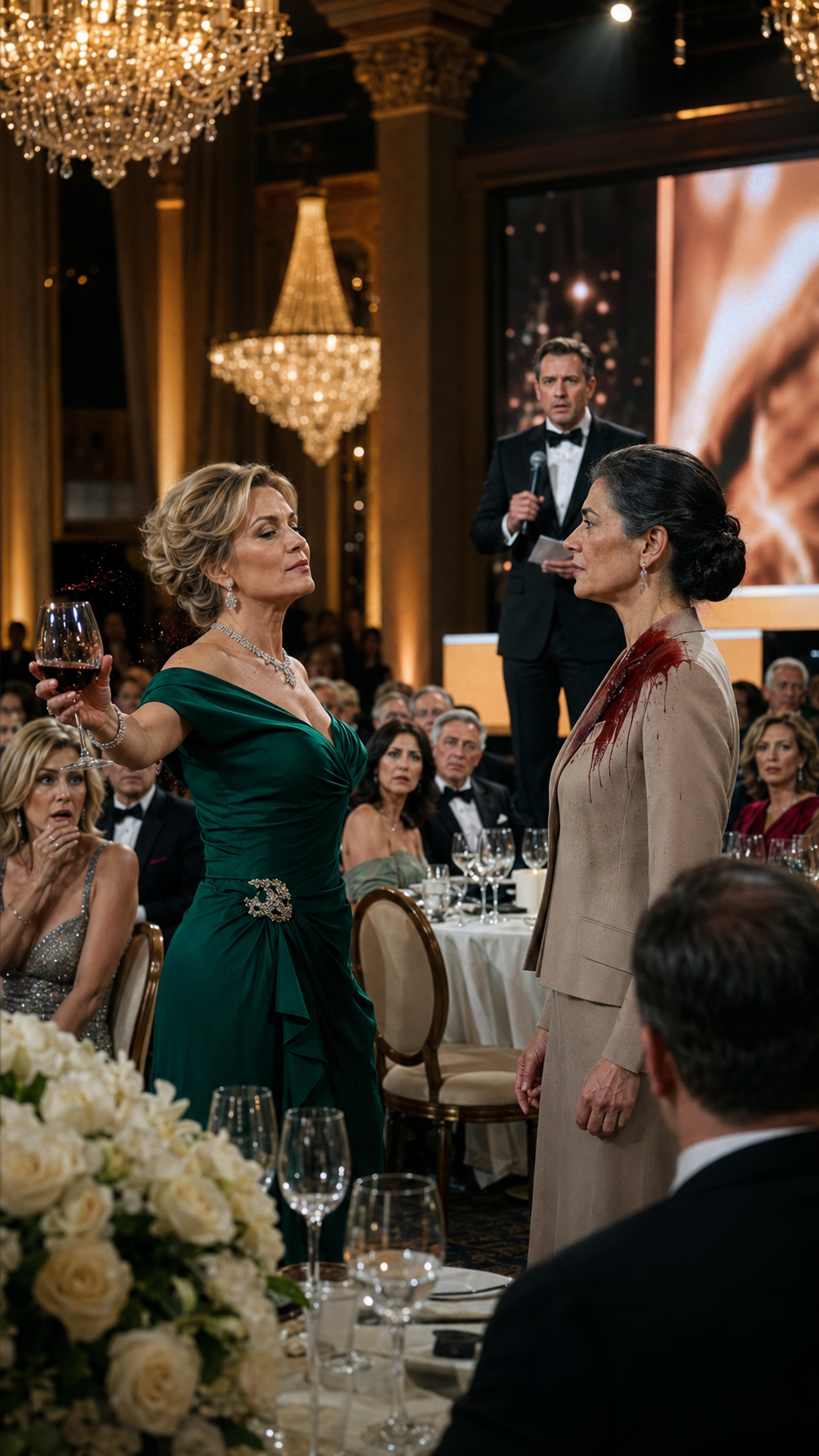
“She threw wine at the quiet woman… then the entire ballroom stood up.”
“People like you should enter through the service door.”
Celeste Ward smiled as she emptied her glass of red wine across the quiet woman’s face.
The liquid ran down Miriam Cole’s cheeks, stained the collar of her simple navy dress, and dripped onto the marble floor.
The charity ballroom went silent.
A string quartet stopped in the middle of a song.
Waiters froze beside tables covered with crystal glasses and white roses.
Nearly three hundred wealthy guests turned to watch.
Miriam did not raise her voice.
She did not wipe the wine away immediately.
She only looked at Celeste with calm, wounded eyes.
Celeste stood before her in a silver designer gown, diamonds shining at her throat.
She had spent the evening greeting politicians, business owners, and television cameras as chairwoman of the St. Matthew Children’s Hospital gala.
To Celeste, every person in the room belonged to one of two groups.
Those who could improve her reputation.
And those who should remain invisible.
Miriam’s modest dress, old handbag, and lack of jewelry had placed her in the second group.
“I was invited,” Miriam said quietly.
Celeste laughed.
“Everyone says that after they sneak past security.”
She gestured toward Miriam’s stained clothing.
“At least now the staff will know where to take you.”
A few guests smiled nervously.
Most looked away.
No one stepped forward.
That silence hurt Miriam more than the wine.
She had spent her entire life learning how quickly people protected cruelty when the cruel person was wealthy enough.
Onstage, the emcee had been preparing to announce the evening’s largest contributor.
He glanced toward the disturbance.
Then he saw Miriam.
His cue cards slipped slightly in his hands.
He lowered them and stepped toward the microphone.
“Ladies and gentlemen,” he said.
His voice cut through the whispers.
“Please remain standing for a very special introduction.”
Celeste turned toward the stage, irritated that the program was continuing before security removed the stranger.
The emcee stared directly at Miriam.
“Please welcome the anonymous donor who funded this entire gala.”
No one moved at first.
The sentence seemed too impossible to understand.
Then the hospital director rose from the front table.
The surgeons beside him stood.
Board members followed.
Within seconds, every person in the ballroom was on their feet.
The applause began cautiously.
Then it spread through the room like thunder.
Celeste’s smile disappeared.
She looked from the standing guests to Miriam’s wine-soaked dress.
“No,” she whispered.
The emcee continued.
“Mrs. Miriam Cole has donated forty million dollars to create the new pediatric cardiac center.”
“She also paid every expense for tonight’s event so that all proceeds from the auction could go directly to children who cannot afford treatment.”
Celeste went pale.
She had spent months telling guests that her committee had secured the funding.
She had allowed newspapers to photograph her beside the hospital plans.
She had even accepted an award for “visionary leadership.”
But she had never asked for the donor’s name.
She cared only that the donation made her gala look successful.
Miriam finally lifted a napkin from the table and wiped the wine from her face.
The ballroom was still applauding.
She raised one hand.
The room became silent again.
“Please sit down,” she said.
Her voice was gentle.
Everyone obeyed.
Everyone except Celeste.
She seemed unable to move.
Miriam looked at her.
“You believed I entered through the wrong door.”
Celeste’s lips trembled.
“I made a terrible mistake.”
Miriam glanced at the red stain spreading across her dress.
“A mistake is using the wrong fork.”
“You chose to humiliate someone because you believed she had no power.”
Celeste lowered her voice.
“I did not know who you were.”
“That is the problem.”
Miriam turned toward the guests.
“None of you knew who I was.”
“But all of you knew what was happening.”
Several guests dropped their eyes.
A waiter who had been ordered not to interfere stared at the floor.
The hospital director looked deeply embarrassed.
Miriam continued.
“This gala claims to exist for children who arrive at the hospital without money, influence, or important names.”
“Yet the people in this room just watched a woman be publicly degraded because she appeared to have none of those things.”
No one applauded now.
No one even shifted in their chair.
Celeste reached for Miriam’s arm.
Miriam stepped back before she could touch her.
“Please,” Celeste whispered.
“Let me explain.”
“You believed I was poor.”
Celeste said nothing.
“You believed I was staff.”
Again, Celeste remained silent.
“And that made cruelty acceptable?”
Celeste’s eyes filled with tears.
“No.”
“But it made it easy,” Miriam replied.
The hospital director approached them.
“Mrs. Cole, we are profoundly sorry.”
Miriam looked at him.
“Were you sorry before the emcee said my name?”
He stopped.
That answer existed in his hesitation.
Miriam picked up her old handbag.
Celeste panicked.
“You are leaving?”
“Yes.”
“What about the announcement?”
“The donation?”
“The hospital wing?”
A murmur moved through the ballroom.
Miriam looked toward the architectural model displayed beside the stage.
It showed bright surgical rooms, family sleeping areas, and a garden for recovering children.
For ten years, she had imagined that building.
She had never imagined walking away from it because of a glass of wine.
“The children will still receive the hospital,” she said.
Relief moved across the room.
“But the money will no longer be controlled by this gala committee.”
Celeste’s face collapsed.
Miriam turned toward the hospital director.
“Tomorrow, my attorneys will create an independent board.”
“Half of its members will be nurses, cleaners, patient parents, cafeteria workers, and former patients.”
“The people most often ignored will decide how the money is used.”
The director nodded quickly.
“And Mrs. Ward?” he asked.
Miriam looked at Celeste.
“She will have no position on the board.”
Celeste inhaled sharply.
The gala chair title had become the center of her social life.
Losing it in front of the entire city felt like losing the identity she had built.
“You cannot do this to me,” she said.
The words escaped before she could stop them.
Miriam’s expression changed.
Not to anger.
To sadness.
“You threw wine at a stranger because you thought she could do nothing to you.”
“Now you are frightened because you discovered she can.”
Celeste looked around the room.
The cameras she had invited were still recording.
The guests she wanted to impress were watching her fall apart.
She lowered her head.
“I am sorry.”
Miriam studied her carefully.
“Are you sorry for what you did?”
“Or for who you did it to?”
Celeste could not answer.
Miriam walked toward the ballroom doors.
The crowd parted for her.
This time, no one suggested she use the service entrance.
The emcee stepped away from the microphone.
The quartet remained silent.
At the doorway, Miriam paused.
She looked back at the room.
“Do not stand for me because I gave money.”
“Stand next time someone is being treated as though they have no value.”
Then she left.
The ballroom remained silent for nearly a minute after the doors closed.
The auction continued, but the celebration was gone.
Every expensive gown and polished speech suddenly felt hollow.
Celeste left before the final item was sold.
By morning, the video of the incident had spread across the city.
The hospital board requested her resignation.
Sponsors removed her name from their events.
Friends who had laughed beside her stopped answering calls.
For several days, Celeste blamed Miriam.
Then she watched the recording without sound.
Without her voice, there were no excuses.
She saw her own smile before the wine left the glass.
She saw Miriam standing motionless.
She saw dozens of people turning away.
And she saw herself looking satisfied.
Celeste switched off the screen and became sick.
One week later, she went to St. Matthew Children’s Hospital.
She did not wear diamonds.
She did not ask for the director.
She stood at the volunteer desk and filled out an application.
The coordinator recognized her immediately.
“We do not need another public apology,” he said.
“I know.”
“We do not allow cameras in the children’s wards.”
“I understand.”
“And you will not be given a title.”
Celeste looked down at the form.
“That may be what I need.”
She was assigned to the family laundry room.
For the first month, she washed blankets and folded hospital gowns.
No one applauded.
No one photographed her.
Some parents recognized her and turned away.
Some staff refused to speak beyond necessary instructions.
Celeste kept returning.
She cleaned spilled food from tables.
She carried bags for exhausted families.
She learned the names of nurses she had once treated as decorations at fundraising dinners.
She learned that one cleaner worked nights so his daughter could attend college.
She learned that the cafeteria woman she had ignored for years secretly bought meals for parents who had no money.
And she learned that dignity was usually protected by people whose names never appeared on donor walls.
Miriam heard about Celeste’s volunteering.
She gave no response.
The new pediatric center moved forward without delay.
Construction began under the independent board Miriam had promised.
Parents helped design the waiting rooms.
Nurses chose safer equipment.
Cleaners corrected plans that would have made infection control difficult.
The building became better because the people once excluded were finally heard.
Six months later, Celeste wrote Miriam a letter.
She did not ask for forgiveness.
She described the families she had met and the shame she now understood.
She ended with one sentence.
I thought charity meant being admired for giving to people below me.
Now I know it means refusing to place anyone below me at all.
Miriam read the letter twice.
Then she placed it inside a wooden box in her desk.
She still did not reply.
A year after the gala, the Miriam Cole Pediatric Cardiac Center opened.
Miriam had refused to let the hospital use her name.
The board ignored her.
They said children deserved to know that one quiet woman had changed thousands of lives without demanding attention.
The opening ceremony was small.
There were no luxury tables or champagne towers.
Doctors stood beside cleaners.
Donors sat beside patient families.
Every person entered through the same front doors.
Miriam wore the same simple navy dress.
The wine stain had been removed, but a faint shadow remained near the collar.
She had chosen not to replace it.
Celeste stood at the back in a volunteer uniform.
She did not approach Miriam.
She did not believe she had earned that right.
During the ceremony, the hospital director unveiled a wall displaying photographs of children whose lives had inspired the center.
One photograph showed a little girl with dark curls sitting in a hospital bed, holding a paper heart.
Miriam’s breath caught.
The child was her daughter, Emily.
Emily had died at age seven from a correctable heart condition because the nearest hospital lacked the equipment she needed.
Miriam had been a school cafeteria worker then.
She and her husband spent years paying debts from a surgery that arrived too late.
After her husband died, Miriam discovered that he had quietly invested in a small medical technology company.
Those shares eventually became worth millions.
She sold them and created the anonymous fund.
Every dollar came from the life they had built after losing Emily.
Miriam approached the photograph.
Beneath it was a small metal plaque.
For every child whose help should never arrive too late.
Celeste watched from the back of the room.
Something about the photograph unsettled her.
She had seen that child before.
After the ceremony, she returned to her apartment and searched through a locked drawer containing papers from twenty years earlier.
At the bottom was an old hospital envelope.
Her hands began to tremble.
Inside was a photograph of her own son, Jacob, recovering from heart surgery when he was four.
Beside it was a letter Celeste had written to an unknown benefactor.
At the time, her husband’s company had failed.
They had no insurance.
An anonymous fund paid for Jacob’s emergency operation.
Celeste had written:
To the stranger who saved my son, I may never know your name, but I will spend my life proving your kindness was not wasted.
She stared at the sentence until tears blurred the ink.
The fund’s emblem at the bottom of the hospital receipt was a small paper heart.
The same heart Emily held in the photograph.
Celeste understood.
Miriam had not only funded the gala.
She had saved Jacob’s life twenty years earlier.
And Celeste had thrown wine at her.
The following morning, Celeste went to Miriam’s modest house.
She carried the old letter and nothing else.
When Miriam opened the door, Celeste could barely speak.
“You saved my son.”
Miriam looked at the envelope.
Then she nodded.
“You knew?” Celeste asked.
“I recognized your name on the gala committee.”
“Why didn’t you tell me?”
Miriam looked at her calmly.
“Because gratitude that depends on knowing the giver’s name is only another kind of transaction.”
Celeste began to cry.
“I promised I would prove your kindness was not wasted.”
“I became the opposite of everything I wrote.”
Miriam stepped aside and allowed her into the house.
On the table sat the letter Celeste had written six months earlier.
“You changed after the gala,” Miriam said.
“I was waiting to see whether the change would survive after everyone stopped watching.”
Celeste looked at her.
“Did it?”
Miriam did not answer immediately.
Instead, she placed the old thank-you letter beside the newer apology.
The two pages had been written twenty years apart.
One came from a frightened mother receiving mercy.
The other came from a humbled woman finally understanding it.
Miriam folded both letters together.
“Your son’s life was never a debt you owed me,” she said.
“But every kindness we receive becomes a responsibility for how we treat the next person.”
Celeste nodded through tears.
She continued volunteering at the hospital.
Years later, she became coordinator of the family assistance program.
She never returned to the gala circuit.
She never wore the silver gown again.
Miriam visited the cardiac center every Friday.
She sat with frightened parents, read stories to recovering children, and always entered through the same doors as everyone else.
The stained navy dress was eventually placed in a glass case near the hospital lobby.
Beside it hung no photograph of Celeste throwing the wine.
There was only a copy of her first letter.
To the stranger who saved my son…
Visitors often assumed the letter had been placed there to honor Miriam.
But beneath it was a final line written in Miriam’s hand.
The true test of gratitude is how we treat the stranger whose name we do not yet know.
And only Celeste understood why the woman she had humiliated had kept her identity hidden until the ballroom stood.
May you like



Miriam had never needed their respect after they learned she was powerful.
She had been waiting to see whether they could respect her when they believed she was nobody.







