“She threw water at the maid… then the broken necklace revealed everything.”
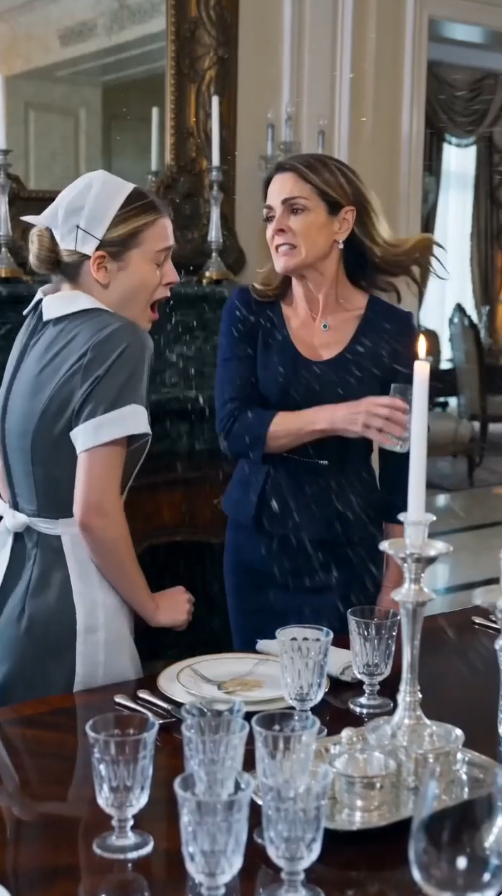
The glass shattered before anyone at the dinner table could pretend not to hear it.
Cold water splashed across the marble floor.
A crystal tumbler rolled beneath the carved dining chair.
In the center of the Worthington mansion dining room, a young maid named Hannah stood frozen with both hands shaking at her sides.
Across from her, Margaret Worthington rose from her seat in a silk evening dress, lifted a full glass of water, and threw it into Hannah’s face.
The water struck her cheeks, soaked her collar, and ran down the front of her black uniform.
The family guests fell silent.
Margaret’s son lowered his fork.
Her sister looked away.
The old butler, Mr. Bennett, stood near the service door with a silver tray in his hands and pain in his eyes.
Margaret stared at Hannah as if one broken glass had confirmed everything she believed about people beneath her.
“You ruin everything you touch.”
Hannah lowered her head.
Her lashes were wet.
Her hands still trembled.
“I’m sorry, ma’am. My hands were shaking.”
The broken glass had cut the chain around Hannah’s neck.
A small pendant slipped free from beneath her uniform and swung against her chest.
Mr. Bennett saw it first.
The tray nearly fell from his hands.
His face went pale.
“Madam, look at her necklace.”
Margaret turned with irritation.
Then she saw the pendant.
The room changed.
It was an old gold locket shaped like a small rose.
One side was dented.
The clasp was cracked.
On the back, in tiny letters, was the name Lily.
Margaret’s breath stopped.
“That pendant belonged to my daughter.”
Hannah looked down at the necklace she had worn since childhood, the only thing she had ever owned before the orphanage gave her a name.
With shaking fingers, she opened the locket.
Inside was a faded baby photograph.
“The orphanage said I had it when I was found.”
Margaret’s hand covered her mouth.
The woman who had just thrown water at the maid was staring at the daughter she had lost twenty years ago.
Twenty years earlier, Margaret Worthington had been a different woman.
Not gentle exactly.
She had always been proud.
But grief had not yet hardened her into someone who mistook distance for dignity.
She lived in the same mansion then, but the dining room sounded different.
There was laughter.
There were toys beneath the sideboard.
There was a baby girl named Lily sleeping in a nursery painted pale yellow.
Lily was Margaret’s second child.
Her first child, Andrew, was already nine and loved showing visitors how carefully he could hold his baby sister.
Margaret’s husband, Thomas, adored Lily in a way that softened everyone around him.
Every night, he carried Lily through the mansion and showed her the portraits, the staircase, the garden windows, and the chandelier that scattered light across the ceiling.
He said the house finally felt alive.
When Lily was six months old, Thomas gave her the gold rose pendant.
It had belonged to Margaret’s mother.
Inside he placed a tiny photograph of Lily wrapped in a white blanket.
On the back, he had her name engraved.
Margaret had laughed at first because a baby could not wear a necklace safely.
Thomas said the pendant was not for wearing yet.
It was for belonging.
He placed it in a velvet box in the nursery drawer.
One week later, Lily vanished.
It happened during a winter charity dinner at the mansion.
Snow covered the lawn.
Guests filled the ballroom.
A temporary nanny had been hired through an agency because Margaret’s regular nurse was ill.
By midnight, the nanny was gone.
So was Lily.
The nursery window was open.
The velvet box was empty.
The police searched.
Private investigators searched.
Thomas searched until exhaustion broke his health.
The nanny’s identity turned out to be false.
The agency records had been altered.
A hospital bracelet was later found near a bus station, but no child was with it.
Months became years.
Lily became a framed photograph on Margaret’s piano.
Thomas never recovered from the loss.
He died five years later after a stroke, leaving Margaret with a mansion, a son, and a hole in her life that no money could fill.
Margaret changed after that.
She dismissed staff for small mistakes.
She locked rooms.
She stopped giving interviews.
She stopped visiting the nursery.
She donated money to children’s hospitals but never walked into the wards.
She could write checks for suffering children.
She could not look at them.
Andrew grew up under the weight of a missing sister.
He learned not to mention Lily during dinner.
He learned that his mother’s grief could turn any room cold.
Mr. Bennett, the butler, remained because Thomas had trusted him.
He had been in the house the night Lily disappeared.
He had searched the grounds with a flashlight until dawn.
He had found one thing near the service gate before police arrived.
A torn piece of blue ribbon from the velvet box.
He gave it to investigators.
They logged it badly.
Years later, the evidence folder was misplaced during a county storage transfer.
Mr. Bennett never forgave himself for not holding on to it.
He also never forgot the pendant.
He had polished it for Thomas before it was placed in the nursery.
He remembered the rose shape.
The dent near the clasp.
The engraved name.
The pendant had been missing with Lily for twenty years.
Then Hannah came to work at the mansion.
She arrived through a staffing agency after Margaret fired another housemaid for placing white lilies in the blue room.
Hannah was twenty.
Quiet.
Careful.
Too thin in the way of people who learned early to make meals last.
Her paperwork said she had grown up at St. Agnes Home for Children in Pennsylvania.
She had no known parents.
No family records.
No birth certificate from infancy.
The orphanage had given her the last name Miller after the nurse who found her on the church steps.
She remembered almost nothing before St. Agnes.
Only flashes.
A warm room.
A woman singing.
Snow.
A rose shape in her hand.
The sisters at the orphanage told her she had been found at about one year old wrapped in a blanket, feverish and silent, with a broken gold locket tied to the blanket ribbon.
They kept the locket safe until she was old enough to wear it.
Hannah never took it off.
It was not valuable to her because of gold.
It was valuable because it proved she had once belonged somewhere.
At the Worthington mansion, Hannah worked harder than anyone.
She learned the dining service.
She cleaned the silver.
She memorized Margaret’s preferences.
No lilies.
No lavender soap.
No nursery corridor.
No questions about the locked yellow room on the second floor.
Mr. Bennett noticed how Hannah flinched whenever Margaret raised her voice.
He also noticed something else.
Margaret was strangely disturbed by Hannah.
Not because the girl made many mistakes.
She did not.
Because Hannah’s presence unsettled the house.
Her eyes looked familiar.
Her smile, when it appeared, was painfully familiar.
Once, Andrew saw Hannah carrying folded linens across the hall and stopped as if he had seen a ghost.
He shook it off.
Everyone in that house had ghosts.
The night everything changed was Margaret’s sixty-first birthday dinner.
She did not want a party, but Andrew insisted on a family meal.
The dining room was set with crystal, silver, and white roses because no one had remembered roses were safe and lilies were not.
Hannah was nervous from the start.
Her hands shook because the agency had warned her that one more complaint from Margaret could cost her the position and the small room she rented above a laundromat.
She had already sent part of her wages back to St. Agnes to help with repairs.
She could not lose the job.
During the soup course, Margaret’s sister made a careless comment about how difficult it was to find good household help anymore.
Margaret agreed without looking at Hannah.
Andrew said nothing.
Mr. Bennett tightened his jaw.
Hannah carried the water pitcher around the table.
Her fingers slipped on condensation.
A glass fell.
It struck the floor and shattered.
The sound was small compared to the storm it unleashed.
Margaret stood.
For one second, everyone saw the old grief behind her anger.
Then the grief became cruelty.
She threw the water.
“You ruin everything you touch.”
Hannah absorbed the words like someone who had heard versions of them before.
“I’m sorry, ma’am. My hands were shaking.”
The broken glass had sliced through the thin chain at the back of Hannah’s neck.
The pendant slipped out.
Mr. Bennett saw the rose.
He was no longer in the dining room.
He was twenty years younger, standing in a nursery doorway while Thomas showed him a locket meant for a baby girl.
“Madam, look at her necklace.”
Margaret looked.
The locket swung against Hannah’s soaked uniform.
Old gold.
Rose shape.
Dented clasp.
Engraving on the back.
Lily.
“That pendant belonged to my daughter.”
Hannah’s fingers shook harder as she opened it.
The tiny photograph inside was faded from time, but the baby’s face remained.
Round cheeks.
Dark eyes.
White blanket.
“The orphanage said I had it when I was found.”
No one moved.
Margaret reached for the back of a chair and missed.
Andrew stood so fast his chair fell backward.
Mr. Bennett stepped forward, then stopped, as if afraid the truth might vanish if touched too quickly.
Margaret stared at Hannah’s face.
Not the uniform.
Not the water.
Not the servant she had insulted.
The face.
The eyes were Thomas’s.
The chin was hers.
The small scar near Hannah’s left eyebrow matched a mark Lily had received when Andrew accidentally dropped a wooden rattle onto her forehead as a baby.
Margaret had forgotten that detail until she saw it again.
The dining room became unbearable.
Hannah backed away.
Her whole life had been built around not knowing.
Now everyone was looking at her as if she were someone else.
As if the name she had carried through orphanage halls, cheap apartments, and staff entrances might not be her first name at all.
Mr. Bennett called the family attorney before Margaret could speak again.
The attorney arrived within an hour.
A doctor was called for DNA collection.
The old missing child file was retrieved from the private archive Margaret had kept locked for two decades.
Photographs were spread across the library table.
Baby Lily with the locket box.
Baby Lily in Thomas’s arms.
Baby Lily beside Andrew.
Hannah sat at the edge of an armchair wrapped in Margaret’s coat.
Margaret had placed it over her shoulders after the dining room incident, but the gesture felt too small for the harm already done.
Still, Hannah did not remove it.
She was cold.
Or maybe shock felt like cold.
The preliminary DNA test came back first.
Strong maternal match.
Then the certified results arrived the next morning.
Hannah Miller was Lily Worthington.
Margaret’s missing daughter.
Andrew’s sister.
Thomas’s lost child.
Margaret collapsed when she heard it.
Not elegantly.
Not like a woman in control.
She fell to her knees in the library, clutching the locket and making a sound that had been trapped inside her for twenty years.
Hannah stood across from her, unable to move.
Everyone expected the reunion to become instant joy.
It did not.
Truth does not erase pain on command.
Hannah had been humiliated by her own mother before being recognized by her.
Margaret had spent twenty years grieving a baby and then wounded the woman that baby became.
Andrew wanted to hug his sister, but did not know whether he had the right.
Mr. Bennett wept privately in the pantry.
The police reopened the case.
The old nanny’s false identity was matched to a woman named Carol Vance, who had worked briefly in domestic placement scams across several states.
She had died in prison years earlier for unrelated fraud.
Investigators believed she had taken Lily from the mansion during the snowstorm and later abandoned her near St. Agnes when the search grew too dangerous.
There would be no living kidnapper to confront.
No courtroom confession.
Only records, evidence, and the brutal fact that a stolen child had spent her life cleaning the house where she had been born.
That detail nearly destroyed Margaret.
For weeks, Hannah did not move into the mansion.
She stayed in her rented room and met the Worthingtons in the attorney’s office, then in a therapist’s office, then in small meetings at a park near the river.
She needed neutral places.
Margaret accepted that because she had finally learned that wanting a daughter back did not give her the right to demand closeness.
She began with actions instead of speeches.
She paid St. Agnes for years of repairs anonymously first, then openly when Hannah gave permission.
She arranged for Hannah’s legal identity to include Lily Worthington only if Hannah chose it.
She dismissed the staffing agency that had treated young women like replaceable furniture.
She created a formal apology letter for every employee she had mistreated and offered severance, references, and back pay for those unfairly fired.
Andrew changed too.
He admitted that silence had been his role in the family’s cruelty.
He had watched their mother become harsh and called it grief.
He had let staff absorb it because confronting Margaret felt harder than protecting people with less power.
Hannah listened.
She did not comfort him.
That was important.
The wounded person is not responsible for making the guilty feel human again.
Months passed before Hannah returned to the mansion for more than an hour.
When she did, Margaret opened the locked yellow nursery.
The room had been preserved like a shrine.
Dust lay over the crib.
A faded mobile hung motionless above it.
The wallpaper was still pale yellow.
Hannah stood in the doorway.
She felt nothing at first.
Then she saw a small embroidered blanket folded over the rocking chair.
Her hands reached for it before memory arrived.
When she touched the fabric, she began to cry.
Not because she remembered everything.
Because some part of the body remembers softness before the mind has language.
Margaret did not touch her.
She stood behind her and cried silently.
The first time Hannah allowed Margaret to hug her happened in that room.
It lasted only a few seconds.
But it was real.
Over the next year, Hannah rebuilt her life slowly.
She stopped working as a maid.
Margaret offered money immediately.
Hannah refused immediate dependence.
So Margaret funded a scholarship in Hannah’s name instead, one Hannah could accept because it also supported other young adults leaving orphanages.
Hannah enrolled in social work courses.
She wanted to help children who had no documents, no family history, and no one asking the right questions.
She kept the name Hannah Miller Worthington.
Hannah for the life she survived.
Miller for the nurse who found her.
Worthington for the family stolen from her.
Margaret began attending therapy twice a week.
She learned that grief may explain cruelty, but it does not excuse it.
She learned to apologize without asking whether she was forgiven yet.
She learned to sit with Hannah’s anger without defending herself.
That was harder for her than writing checks.
But it mattered more.
Mr. Bennett remained in the house, though he finally reduced his duties.
Hannah asked him one day why he had recognized the necklace so quickly.
He showed her an old photograph from Thomas’s desk.
In it, Thomas held the pendant between two fingers, smiling like a proud father with a secret gift.
Mr. Bennett told Hannah that Thomas had loved her before she could remember him.
Hannah carried that sentence for a long time.
On the first anniversary of the dinner, Margaret did not host a family party.
Instead, she invited former staff members back to the mansion.
Not as workers.
As guests.
The dining room table was set simply.
No crystal performance.
No hierarchy.
Rosa, a former housekeeper Margaret had once dismissed over a stain, sat beside Andrew.
A retired gardener sat at Margaret’s right.
Mr. Bennett sat at the head of the table because Hannah insisted.
Margaret stood before dinner and acknowledged what she had done in that room.
She did not dramatize herself.
She did not ask for applause.
She apologized for treating service as inferiority and grief as permission.
Then she looked at Hannah.
Her voice broke, but no direct quotation was needed to understand it.
She was sorry for the water.
For the words.
For the years.
For not recognizing humanity before recognizing blood.
Hannah did not forgive her publicly that night.
She only nodded.
That was enough.
Years later, the Worthington mansion became the Lily House Center for Missing and Found Children.
Hannah led the program.
It helped adults raised without records search for identity.
It funded DNA testing for families with missing children.
It supported orphanages, foster youth, and domestic workers who had been exploited by wealthy households.
Margaret donated the mansion but remained in a small apartment in the west wing.
She answered phones twice a week.
At first, callers were startled by her formal manner.
Then they learned she stayed on the line as long as grieving mothers needed.
The dining room where she had thrown water became a family reunification hall.
The broken glass was not preserved.
Hannah refused to turn humiliation into decoration.
But the repaired pendant was displayed in a case near the entrance.
Beside it was Thomas’s photograph of baby Lily.
Below it was a simple line.
Found does not erase lost, but it gives love somewhere to go.
On Hannah’s thirtieth birthday, Margaret gave her the velvet box that once held the pendant.
Inside was the blue ribbon from the night Lily disappeared, the only piece of evidence Mr. Bennett had regretted giving away.
It had been recovered when the police reopened the archived file.
Hannah held it carefully.
Then she placed the broken necklace inside the box for one night only.
The next morning, she put the pendant back around her neck.
The chain was stronger now.
The clasp repaired.
The dent remained.
She wanted the dent.
It proved the necklace had survived the same way she had.
Not untouched.
Not ruined.
Still here.
Margaret never again allowed anyone in her home to call staff invisible.
She learned the names of every worker.
She attended graduations.
She visited St. Agnes every winter.
She brought coats, books, and legal advocates instead of cameras.
Hannah sometimes went with her.
Sometimes she did not.
Their relationship was not a fairy tale.
It was better than that.
It was chosen repeatedly after truth made pretending impossible.
One evening, years after the reveal, Hannah stood in the old nursery with Margaret.
The room had become a counseling space for children waiting on family search results.
The yellow walls remained, but the crib was gone.
There were soft chairs now.
Books.
A rug with stars.
Margaret asked, gently and without expectation, whether Hannah ever wished the necklace had broken sooner.
Hannah touched the pendant.
She thought about the orphanage.
The mansion.
The water.
The humiliation.
The years stolen by one woman’s crime and another woman’s grief.
Then she looked at Margaret.
She did not answer quickly.
Some questions are too heavy for simple mercy.
At last, she said nothing aloud.
She only took Margaret’s hand.
For Margaret, that was more grace than she believed she deserved.
She threw water at the maid.
Then the broken necklace revealed everything.
May you like



But the real ending was not the shock in the dining room, the old butler’s discovery, or the wealthy woman realizing the servant she humiliated was her lost daughter.
The real ending was that a broken pendant forced a broken family to stop hiding behind grief, and the girl once found outside an orphanage door grew up to open doors for others still waiting to be found.







