“She poured wine on the bride… then saw the birthmark she lost twenty years ago.”
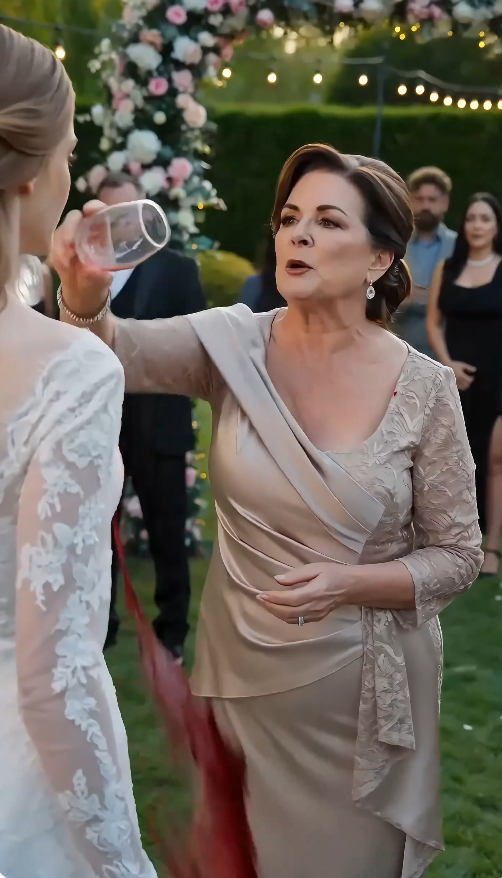
The red wine struck the bride’s white dress like a wound opening in front of the entire chapel.
It ran down the lace bodice, soaked through the silk, and dripped onto the marble steps beneath the altar.
The guests gasped, but no one moved.
At the front row, Victoria Ashford stood with the empty glass in her hand and hatred in her eyes.
She was the groom’s mother, elegant, wealthy, and feared by everyone who wanted a place near her family name.
The bride, Amelia Ross, stood frozen beside the altar flowers while the stain spread across the gown she had saved for two years to buy.
Her veil trembled against her shoulders.
Her hands shook around the bouquet.
Victoria’s voice cut through the chapel like a blade.
“My son will never marry a girl with no family.”
Amelia took one step back.
The words hurt almost as much as the wine.
Her eyes filled, but she did not run.
“I lost my family when I was five.”
The groom, Daniel Ashford, finally stepped forward.
His face was pale with shock as he reached for his mother’s wrist.
“Mom, stop humiliating her!”
Victoria tried to pull away.
Her hand caught Amelia’s sleeve.
The wet lace slipped down the bride’s shoulder.
A small star-shaped birthmark appeared beneath the candlelight.
Victoria stopped breathing.
The glass fell from her fingers and shattered near her shoes.
Her eyes locked on the mark.
It was not a bruise.
It was not a scar.
It was the same star she had kissed on her baby daughter’s shoulder twenty years ago.
Her voice broke into something almost unrecognizable.
“That birthmark… where did you get it?”
Amelia touched her shoulder, confused and trembling.
She had never known why that mark made older women at the orphanage look sad.
She only knew it was the one thing nobody could take from her.
“It was the only thing they found on me.”
Victoria fell to her knees in the spilled wine.
The woman who had just shamed the bride was staring at the daughter she had lost twenty years ago.
Twenty years earlier, Victoria Ashford had a daughter before she ever had a son.
Her name was Lily.
She was born in a private hospital outside Boston during a snowstorm that covered the city in white.
Victoria remembered the first sound Lily made.
It was not a cry.
It was a tiny angry gasp, as if the baby had arrived already offended by the world.
Her husband, Jonathan, laughed until he cried.
Lily had dark hair, a soft round face, and a star-shaped birthmark on her left shoulder.
Victoria called it her little star.
Jonathan said the mark looked like the sky had signed the child before sending her down.
For five years, the Ashford house was full of color.
Lily ran through the halls with ribbons in her hair.
She painted stars on every scrap of paper.
She slept with one hand tucked near her shoulder as if protecting the mark.
Victoria was not yet the cold woman society would later fear.
She was a mother who sang at bedtime.
She was a wife who danced barefoot with her child in the kitchen.
She was a woman who believed wealth could protect anything if used carefully enough.
Then Lily vanished.
It happened at a winter charity fair sponsored by the Ashford Foundation.
The event was crowded with families, donors, photographers, and children from local shelters.
Victoria had insisted Lily attend because she wanted her daughter to grow up understanding service.
For three minutes, Lily was beside the puppet stage holding a paper star.
For three minutes, Victoria turned to speak with a donor.
When she looked back, Lily was gone.
The security cameras near the east exit failed.
A woman in a volunteer coat was seen carrying a crying child toward a service stairwell.
The coat was later found in a trash bin.
Lily’s scarf was found in the parking garage.
Her small shoe was found near a delivery door.
But Lily was not found.
The police searched for months.
Private investigators searched for years.
Jonathan spent his fortune chasing rumors.
Victoria spent her heart paying ransom scammers who knew how to describe grief better than truth.
No body was ever found.
No confession came.
No ending arrived.
Jonathan broke first.
He blamed himself because he had missed the fair for a business meeting.
He blamed the foundation.
He blamed the city.
He blamed God and then stopped praying.
Two years later, he died after his car struck a tree on a rainy night.
The official report called it an accident.
Victoria never believed accidents were that neat.
After Jonathan’s death, the mansion became silent.
Lily’s room remained locked.
Her drawings stayed taped to the wall.
Her little shoes stayed beside the bed.
Victoria moved through life like a woman wearing armor made of money.
She donated to children’s charities but refused to attend events with children present.
She paid for orphanage renovations but never visited the orphanages.
She could write checks for lost children as long as she did not have to see a face that might become Lily in her mind.
Then Daniel came into her life.
He was three years old when Victoria met him.
He lived in a private children’s home with quiet rooms and careful paperwork.
He had been placed there after a failed adoption and had no living relatives recorded in the file.
He did not cry when Victoria entered.
He only watched her with serious eyes and held a broken wooden horse.
Victoria had not planned to adopt.
She had not planned to love anyone again.
But Daniel handed her the broken horse, and something inside her moved.
She took him home within six months.
She raised him as her son.
She loved him fiercely.
But fear twisted the shape of that love.
She chose his schools.
She approved his friends.
She controlled every door he walked through.
She told herself she had lost one child to chaos and would not lose another to freedom.
Daniel grew up kind in spite of her.
He became patient where she was sharp.
He became gentle where she was suspicious.
He worked with children because he understood what it meant to be chosen and still feel watched.
He knew he was adopted, but Victoria told him very little about his early file.
She said the past was painful and the future was enough.
Daniel accepted that as a child.
As a man, he began to wonder what silence had cost him.
He met Amelia Ross at a hospital fundraiser for foster youth.
Amelia was not glamorous.
She wore a simple blue dress and helped children with art supplies while wealthy guests argued over auction numbers.
She had grown up in care after being found at age five near an abandoned highway rest stop.
She remembered smoke.
Cold air.
A woman’s voice telling her to be quiet.
Then nothing clear.
Her records said she had no confirmed name and no family match.
The orphanage named her Amelia because she did not answer to the name found on no document.
She had only one identifying detail.
A star-shaped birthmark on her left shoulder.
Daniel loved her before he could explain why.
He loved the way she sat on floors beside frightened children.
He loved how she never spoke about survival as if it made her noble.
He loved that she understood loneliness without making a performance of it.
When he brought her home, Victoria saw danger.
A woman with no family.
No history.
No records.
No social protection.
Victoria did not see resilience.
She saw uncertainty.
Uncertainty had taken Lily.
So Victoria hated Amelia before she knew her.
At dinners, she asked where Amelia came from.
Amelia answered honestly when she could.
At luncheons, Victoria introduced her without warmth.
At fittings, she commented on how expensive the dress looked for someone with no parents to impress.
Daniel defended Amelia sometimes.
Not enough.
That failure grew quietly between them.
Amelia noticed.
She loved Daniel, but she also saw how quickly he softened when his mother disapproved.
Still, she wanted the wedding.
Not for status.
Not for money.
Not for revenge against a lonely childhood.
She wanted a promise witnessed in daylight.
On the morning of the ceremony, Amelia dressed alone except for her friend Clara and an old locket from the orphanage director.
There were no parents to walk her down the aisle.
There were no childhood photographs on the welcome table.
There was only a small card that said the bride remembered those she never got to know.
Victoria saw that card before the ceremony and thought it looked pathetic.
She did not know it was the first thing that should have made her pause.
The chapel filled with white flowers and winter light.
Daniel stood at the altar with tears in his eyes.
For one moment, Amelia believed love might be enough to soften everyone.
Then Victoria stood during the opening prayer.
She took a glass of red wine from a tray near the side aisle, walked forward, and emptied it over Amelia’s dress.
“My son will never marry a girl with no family.”
The room gasped.
The officiant froze.
Daniel stepped forward too late.
Amelia’s voice trembled but held.
“I lost my family when I was five.”
“Mom, stop humiliating her!”
Victoria jerked away from Daniel’s hand.
Her fingers caught Amelia’s sleeve.
The wine-heavy lace slid down.
The birthmark appeared.
Small.
Dark.
Star-shaped.
Exactly where Lily’s had been.
Time stopped for Victoria.
She was back at the charity fair.
Back at the puppet stage.
Back with Lily’s paper star in one tiny hand.
Back hearing a scream that might have been memory or imagination.
“That birthmark… where did you get it?”
“It was the only thing they found on me.”
Those words broke what the wine had not.
Victoria dropped to her knees.
The guests watched the woman who ruled rooms with pride fold into the stained silk at the bride’s feet.
Amelia did not understand at first.
She thought Victoria was ill.
Daniel looked between them, horrified.
Then Victoria reached toward Amelia’s shoulder but stopped herself before touching it.
Even in shock, some part of her understood that the hand that had poured wine had no right to claim.
The wedding stopped immediately.
The guests were asked to leave.
Phones disappeared into purses.
No one wanted to be the person who turned that moment into gossip before the truth could breathe.
In a small room beside the chapel, Amelia sat wrapped in Daniel’s jacket while Victoria stood across from her, shaking so badly that Clara had to guide her into a chair.
The Ashford family lawyer was called.
So was the retired investigator who had worked Lily’s disappearance.
By evening, old files lay across a table.
Missing child reports.
Charity fair maps.
Security stills.
Photographs of Lily at age five.
In every photograph, the star-shaped birthmark was visible when her shoulder was bare.
Amelia stared at one picture until her eyes blurred.
The child in the image had her eyes.
Her mouth.
Her mark.
The DNA test was ordered that night.
The preliminary result came back fast.
Strong maternal match.
The certified result came two days later.
Amelia Ross was Lily Ashford.
Victoria’s biological daughter.
Missing for twenty years.
Found as a child with no memory, no documents, and only the birthmark on her shoulder.
Daniel’s adoption file was opened next.
It confirmed what Victoria had always known but had hidden from the world.
Daniel was adopted.
He and Amelia shared no blood.
That fact prevented the most terrible possible ending.
It did not make the truth painless.
The wedding remained canceled.
Amelia needed time.
Daniel needed time.
Victoria needed to understand that finding a daughter did not erase what she had done to the woman that daughter became.
Amelia refused to move into the Ashford mansion.
She stayed at Clara’s apartment for weeks.
Victoria sent letters but did not demand answers.
The first letter contained only apology and facts.
Not excuses.
Not pleas.
Not the word daughter used as a claim.
Victoria wrote that she had poured wine on a woman she should have protected.
She wrote that her grief had become cruelty and that cruelty had found the worst possible target.
Amelia read the letter twice.
Then she folded it and placed it beside the DNA report.
She did not forgive Victoria that day.
She did not hate her either.
She felt too many things for one name.
Daniel visited when invited.
At first, they sat on opposite sides of Clara’s kitchen table.
The engagement ring stayed in a small glass bowl between them.
They talked about love, blood, adoption, lies, and the strange map their lives had become.
Daniel said through actions more than words that he would not rush her.
Amelia needed that.
Victoria reopened Lily’s room.
She did not invite Amelia immediately.
She only unlocked the door and sat inside for the first time in years.
The room still held faded star drawings on the wall.
A small wooden bed.
A box of ribbon hair clips.
A paper crown Lily had worn at her fifth birthday party.
Victoria cried until the housekeeper found her asleep on the floor.
When Amelia finally visited the mansion, she went to that room first.
She touched nothing for a long time.
Then she saw a drawing taped near the window.
A child had drawn a woman, a man, a little boy-shaped figure, and stars above them.
The drawing was dated two weeks before Lily vanished.
Amelia’s knees weakened.
She did not remember making it.
But her hand moved toward the paper as if the child inside her did.
Victoria stood in the hallway.
She did not enter until Amelia turned and nodded.
The first hug did not happen that day.
It happened months later, outside a courthouse after the kidnapping investigation was officially reopened.
The woman who took Lily had been part of a child trafficking network that moved children through false abandonment claims.
She had died years earlier.
Several records were gone.
One old accomplice admitted that a five-year-old girl had been abandoned near a highway after becoming too old and too recognizable to sell quietly.
That girl became Amelia Ross.
Amelia heard the confession summary and walked out into the rain.
Victoria followed but stayed several feet behind.
For the first time, Amelia reached back.
Victoria took her hand and broke.
Their hug was not clean.
It was full of anger, grief, apology, and twenty missing years.
But it was real.
Daniel and Amelia did not marry immediately.
They kept the wedding paused because both understood that truth deserved space.
Daniel confronted Victoria about the adoption secrecy.
Not because adoption was shameful.
Because secrecy had made everyone vulnerable to pain.
Victoria admitted that she had treated Daniel like something she could keep by controlling his story.
Daniel told her through distance that love without truth becomes another kind of cage.
That sentence changed her.
The Ashford Foundation shifted its mission.
Victoria placed Amelia in charge of a new program for missing children, foster youth, and adults searching for lost identities.
Amelia refused at first.
She said she was not a symbol.
Victoria accepted that.
Months later, Amelia returned with conditions.
The program would not center the Ashford name.
It would fund real searches, therapy, legal records, and reunions that did not always look beautiful.
It would also support people who found painful truths or no answers at all.
Victoria agreed.
They named it The Star Door Project.
The name came from Lily’s old drawings.
The first public event was held in the same chapel where the wedding had stopped.
No wedding decorations remained.
Only chairs, caseworkers, foster families, adoptees, and parents still searching.
Amelia stood near the altar in a simple navy dress with her birthmark visible.
Victoria sat in the front row.
Daniel stood near the back, letting the day belong to Amelia.
The stained wedding dress was displayed only after Amelia chose it.
Not as humiliation.
As evidence that truth can arrive through cruelty and still become a doorway.
The plaque beneath it read that no person should have to prove their worth through blood before being treated with dignity.
Years passed.
Amelia became Amelia Lily Ross Ashford.
She kept Amelia because that was the name that carried her through orphanage halls and adult survival.
She kept Lily because the stolen child deserved to be named.
She kept Ross because not all found lives should erase the lives lived while lost.
She accepted Ashford only after Victoria stopped trying to rush it.
Daniel and Amelia eventually married in a quiet garden behind The Star Door Project office.
There were no society guests.
No staged grandeur.
No red wine.
No mother-in-law testing the bride.
Victoria walked Amelia halfway down the path, then stopped because Amelia wanted to walk the final steps alone.
Daniel waited beneath an arch covered in white flowers and small gold stars.
The vows were private.
The truth was not.
At the reception, Victoria did not give a speech.
She had learned that some apologies must be lived more than spoken.
She sat beside Daniel and Amelia, not at the head of the table, but where they placed her.
That placement meant more than honor.
It meant permission.
On their first anniversary, Amelia visited the old charity fairground where she had disappeared.
The puppet stage was gone.
The parking garage had been rebuilt.
The service stairwell was sealed.
Victoria stood beside her with a folded paper star in her hand.
She had made it from one of Lily’s old drawings.
Amelia took it and placed it under a tree near the entrance.
She did not remember the day she vanished.
But she had spent her life remembering the absence it created.
That was enough.
The Star Door Project helped hundreds of families.
Some found children.
Some found graves.
Some found forged adoption papers.
Some found siblings.
Some found only confirmation that they had not imagined the missing piece of themselves.
Amelia learned that reunion was not always a happy ending.
Sometimes it was a beginning full of sharp edges.
That made her kinder.
Victoria worked quietly behind the scenes.
She answered phones.
She funded searches.
She sat with mothers who had become unbearable versions of themselves after loss.
She never told them grief excused cruelty.
She told them grief needed somewhere honest to go before it destroyed what remained.
On the twentieth anniversary of Lily’s disappearance, the family gathered in the chapel.
The same chapel.
The same aisle.
But no wine stained the floor now.
Amelia wore a sleeveless white dress by choice.
The star birthmark showed clearly on her shoulder.
Daniel held her hand.
Victoria stood before them with a small box.
Inside was a paper star Lily had made at age five before the charity fair.
Victoria placed it in Amelia’s palm.
No one spoke for a long time.
Then Amelia leaned her head against Victoria’s shoulder.
For Victoria, that was more forgiveness than she believed she deserved.
She poured wine on the bride, then saw the birthmark she lost twenty years ago.
May you like



But the real ending was not the ruined dress, the stopped wedding, or the shocking truth that the bride was her missing daughter and the groom was adopted.
The real ending was that a star-shaped mark survived what memory could not, and the woman once rejected for having no family became the person who taught that family how to stop hiding behind grief and begin telling the truth.







