“She poured wine on the bride and then saw the birthmark she lost twenty years ago.”
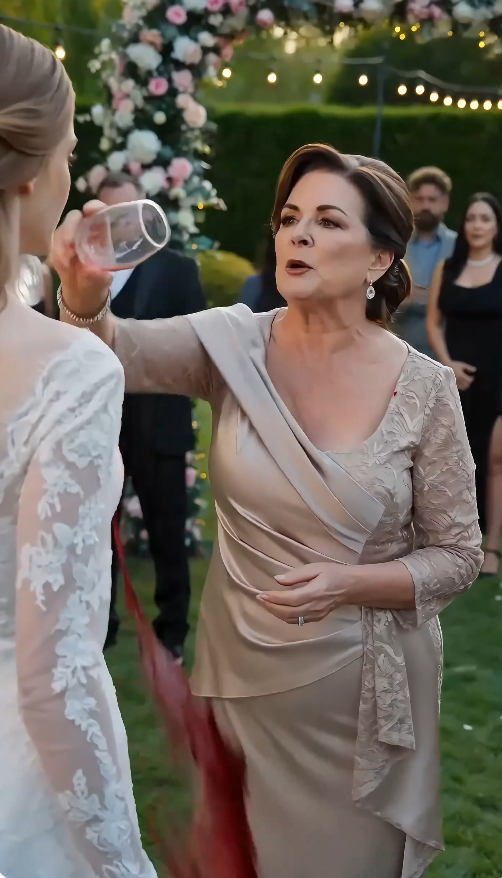
The red wine hit the bride’s white dress before the priest could finish the blessing.
It splashed across the lace, bled down the silk, and stained the gown like an open wound.
The chapel went silent.
Every guest turned toward the altar.
The bride stood frozen with her bouquet shaking in both hands.
Across from her, the groom’s mother, Evelyn Montgomery, lowered the empty glass with a face full of cold pride.
She had waited until the room was quiet.
She had waited until the cameras were pointed forward.
She had waited until Clara Bennett had nowhere to hide.
“My son will never marry a girl with no family.”
The words cut through the chapel harder than the wine.
Clara stepped back, her eyes shining, her breath trapped in her throat.
She had endured months of insults from Evelyn.
She had endured the questions about her childhood, the comments about her cheap apartment, and the way Evelyn looked at her empty side of the guest list as if loneliness were a crime.
But she had never imagined the woman would ruin her wedding dress in front of everyone.
Clara touched the red stain with trembling fingers.
“I lost my family when I was five.”
The groom, Daniel Montgomery, rushed forward at last.
His face was pale with horror.
He reached for his mother’s arm while Clara stood dripping wine beneath the altar lights.
“Mom, stop humiliating her!”
Evelyn jerked away from him.
Her hand caught the damp lace sleeve of Clara’s gown.
The fabric slipped off Clara’s shoulder.
A small star-shaped birthmark appeared under the soft chapel light.
Evelyn stopped moving.
The empty wine glass fell from her hand and shattered beside her shoes.
The guests forgot to breathe.
Evelyn stared at the mark as if the world had split open beneath it.
It was the exact shape she had kissed every night on her daughter’s shoulder.
A little dark star.
A mark she had searched for in hospitals, orphanages, police files, and strangers’ faces for twenty years.
Her voice shook.
“That birthmark… where did you get it?”
Clara covered her shoulder, confused and terrified.
She did not understand why the woman who had just humiliated her now looked as if she had seen a ghost.
She only knew the mark had been with her longer than any name, any home, or any memory.
“It was the only thing they found on me.”
Evelyn dropped to her knees in the wine-stained aisle.
The bride she had called a girl with no family was the daughter she had lost twenty years ago.
Twenty years earlier, Evelyn Montgomery had not been the woman people feared at charity dinners.
She had been a young mother with tired eyes and a laugh that filled the house.
Her daughter’s name was Lily.
Lily had been born on a rainy April morning in Boston.
She was small, loud, and stubborn from her first breath.
On her left shoulder was a star-shaped birthmark.
Evelyn called it her lucky star.
Her husband, Robert, said the child had arrived with her own piece of heaven printed on her skin.
For five years, Lily was the center of the Montgomery home.
She chased butterflies through the rose garden.
She drew stars on the margins of every book.
She hid under the dining table when adults talked too long.
Evelyn sang to her every night and kissed the birthmark before turning off the nursery lamp.
Then Lily disappeared.
It happened during a holiday charity fair hosted by the Montgomery Foundation.
The ballroom was crowded with donors, staff, children, and photographers.
Lily had been standing near a puppet stage with a silver ribbon tied in her hair.
Evelyn looked away for less than two minutes to greet a hospital director.
When she turned back, Lily was gone.
At first, people said she must have wandered.
Then security found Lily’s ribbon near a service door.
A camera near the loading area had failed during a power surge.
A woman in a volunteer coat was seen leaving with a crying child.
No one found the woman.
No one found Lily.
The case consumed Evelyn’s life.
Police searched.
Private detectives searched.
Robert hired investigators in three states.
Every call brought hope.
Every false lead ruined them again.
A year passed.
Then five.
Then ten.
Robert died from a heart attack before Lily’s fifteenth birthday.
Evelyn buried him beside the empty grave marker she had refused to place Lily’s name on.
She would not bury a child without proof.
After Robert’s death, Evelyn’s grief hardened into control.
She closed Lily’s bedroom and kept the key on a chain around her neck.
She dismissed staff for small mistakes.
She stopped attending events where children would be present.
She donated millions to missing children’s charities but never stayed long enough to meet the families.
She could fund hope from a distance.
She could not survive looking at it too closely.
Then Daniel came into her life.
He was four years old when she met him at a private children’s home.
He had dark hair, serious eyes, and a file filled with gaps.
His first adoption placement had failed.
No relatives had claimed him.
He did not speak much.
He only held a wooden horse with one broken leg.
Evelyn had not planned to adopt.
She believed adoption would feel like betraying Lily.
But Daniel looked at her with the quiet exhaustion of a child who had already learned not to expect anyone to stay.
Evelyn took him home within six months.
She loved him.
That was true.
But she loved him with fear wrapped around every choice.
She chose his school.
She chose his tutors.
She chose his friends.
She chose the families he could visit.
She told herself she had lost one child to the world and would not lose another.
Daniel grew up knowing he had been adopted, but he never knew the full story of his own file.
Evelyn told him the past was painful.
She told him the present was enough.
He believed her until he became old enough to understand that silence often protects the person keeping the secret, not the person living inside it.
Daniel became a pediatric physical therapist.
He worked with children who had survived accidents, surgeries, neglect, and abandonment.
That was where he met Clara Bennett.
Clara worked as a case advocate for foster youth aging out of care.
She was gentle with frightened children and unafraid of powerful adults.
She had grown up in the system after being found at age five near an abandoned rest stop outside Hartford.
Her records were thin.
No birth certificate.
No confirmed family.
No memory clear enough to trust.
Only a small star-shaped birthmark on her left shoulder.
The state had named her Clara after the nurse who sat with her the first night.
Clara kept the name because it was the first one that stayed.
Daniel fell in love with her slowly.
He loved the way she listened before speaking.
He loved that she carried granola bars for hungry kids and extra bus cards for teenagers too proud to ask.
He loved that she never treated her pain like a costume.
When he introduced her to Evelyn, the room turned cold before Clara even sat down.
Evelyn saw a woman with no family, no clean history, and no respectable name to present to society.
She did not see what Daniel saw.
She saw danger.
She saw uncertainty.
She saw the same kind of unknown that had swallowed Lily.
From that day forward, Evelyn studied Clara like a threat.
She asked about her parents at every dinner.
She asked about her records.
She asked why nobody had ever come looking for her.
Clara answered as honestly as she could until honesty began to feel like bleeding for someone else’s comfort.
Daniel defended her sometimes.
Not strongly enough.
He told Clara that his mother needed time.
Clara told herself that love required patience.
She did not yet understand that patience becomes self-betrayal when the other person keeps handing the knife back to the one cutting you.
The wedding was supposed to be small.
Clara had no parents to invite.
She had two friends from the foster youth center, one former caseworker, and a handful of children she had once helped who begged to see her dress.
Daniel wanted something warmer, simpler, and private.
Evelyn insisted on a grand chapel ceremony.
She said Montgomery weddings were not hidden.
Clara agreed because she hoped public acceptance might soften Evelyn.
She was wrong.
On the morning of the wedding, Clara dressed in a small bridal room at the back of the chapel.
Her gown was not extravagant, but it was beautiful.
Simple white silk.
Soft lace sleeves.
Tiny hand-sewn stars near the waist, added by a seamstress who knew Clara’s story.
Clara had chosen the stars because they made the birthmark feel less like evidence of abandonment and more like something she could claim.
Her friend Maya adjusted the veil and told her she looked like someone who had survived every storm just to stand in sunlight.
Clara smiled, but her hands shook.
She had dreamed of this day because it promised belonging.
A vow.
A family.
A name chosen in love.
The chapel filled with flowers, candles, and whispers.
Evelyn sat in the front row wearing silver silk and diamonds.
She watched Clara walk down the aisle alone.
That seemed to offend her most.
A bride with no father.
No mother.
No family side full of proud relatives.
Only empty seats covered with white roses.
To Evelyn, the emptiness looked like shame.
To Clara, it looked like everything she had lost.
Daniel’s eyes filled when Clara reached him.
For one moment, she believed they might make it.
Then Evelyn stood.
No one expected it.
She took a glass of red wine from a tray waiting near the side aisle for the toast.
She walked to the altar.
Daniel whispered for her to sit, but she ignored him.
Then she poured the wine down Clara’s dress.
“My son will never marry a girl with no family.”
The room gasped.
Clara stepped back as the wine spread over the tiny stitched stars at her waist.
“I lost my family when I was five.”
“Mom, stop humiliating her!”
The struggle was brief.
The sleeve slipped.
The birthmark appeared.
The star on Clara’s shoulder shone dark against her pale skin.
And Evelyn’s entire life changed.
“That birthmark… where did you get it?”
“It was the only thing they found on me.”
The words took Evelyn back to the charity fair.
To the missing ribbon.
To the service door.
To Lily’s small shoulder.
To the mark she had pressed her lips against every night.
Evelyn reached toward Clara, then stopped.
Some part of her understood that the hand that had poured wine had no right to claim what the heart had just recognized.
The officiant closed the wedding book.
Guests were escorted out in stunned silence.
Maya wrapped Clara in Daniel’s suit jacket.
Daniel stood between Clara and Evelyn, but his face showed he no longer understood what side the word family meant.
The family lawyer was called first.
Then the retired detective who had handled Lily’s disappearance.
By evening, the chapel office table was covered in old files.
Photographs of Lily at age five.
A missing child report.
A charity fair map.
Police notes.
A picture of Lily in a sleeveless yellow dress, her star-shaped birthmark visible on her shoulder.
Clara stared at the photograph until her vision blurred.
The child looked like her.
Not just similar.
Her.
The same eyes.
The same chin.
The same mark.
The DNA test was ordered that night.
The preliminary result came quickly.
Strong maternal match.
The certified result arrived two days later.
Clara Bennett was Lily Montgomery.
Biological daughter of Evelyn and Robert Montgomery.
Missing for twenty years.
Found at age five with no memory and no documents.
Daniel’s sealed adoption file was opened next.
It confirmed he was not Evelyn’s biological son.
He had been adopted at age four from a private children’s home.
He and Clara shared no blood.
That truth saved them from one horror.
It did not save the wedding.
The wedding remained canceled.
Clara needed space from Daniel, from Evelyn, from the chapel, and from the world that suddenly wanted to call her lucky.
She did not feel lucky.
She felt stolen twice.
Once by whoever took her from the charity fair.
Once by a woman who rejected her before recognizing her.
She stayed with Maya for several weeks.
Evelyn sent no gifts.
No jewels.
No keys to the mansion.
Only letters.
In the first letter, Evelyn did not call her Lily.
She wrote Clara’s name.
She admitted what she had done.
She admitted that grief had made her cruel to a woman who deserved protection.
She admitted that finding her daughter did not erase humiliating the woman her daughter had become.
Clara read the letter in silence.
Then she folded it and placed it in a drawer.
Daniel came only when Clara invited him.
At first, they sat at Maya’s kitchen table and talked like strangers holding the remains of a life they had planned.
They were not related by blood.
That mattered.
But everything around their love had changed.
Daniel had become Evelyn’s adopted son in a truth he had never fully understood.
Clara had become Evelyn’s lost daughter in a truth that arrived through pain.
They loved each other.
They also needed to know whether love could survive the shape of the revelation.
No one could answer that for them.
The investigation into Lily’s disappearance reopened.
The woman in the volunteer coat had likely been part of a trafficking network that moved children through false abandonment claims.
Old files connected several missing children to the same collapsed charity staffing agency.
The woman believed to have taken Lily had died years earlier under another name.
There would be no trial that could give Clara the satisfaction of seeing her kidnapper answer.
There would only be truth.
Truth was heavier than revenge because it had to be carried after the room went quiet.
Evelyn unlocked Lily’s bedroom for the first time in years.
She did not ask Clara to come immediately.
She only opened the curtains, removed the dust covers, and sat on the floor beside the little bed.
The walls still had faded star stickers.
A toy music box sat on a shelf.
A small drawing showed three people holding hands under a sky full of stars.
Clara visited the room a month later.
She stood in the doorway for twenty minutes before stepping inside.
She did not remember the bed.
She did not remember the wallpaper.
But when the music box played, she began to cry.
The melody was not a memory.
It was something beneath memory.
A bruise in the heart recognizing the shape of an old touch.
Evelyn stood in the hallway and did not enter until Clara nodded.
That was how they began.
Not as mother and daughter restored overnight.
As two wounded women negotiating the distance between blood and trust.
Daniel confronted Evelyn about his own adoption file.
He was angry that she had hidden so much.
Not because adoption was shameful.
Because silence had made his identity something controlled by another person.
Evelyn listened.
Really listened.
For the first time, she heard how grief had turned love into ownership.
She apologized without asking him to comfort her.
That restraint became the first sign that she could change.
Months passed.
Clara legally added Lily as a middle name, but she kept Clara.
Clara Lily Bennett Montgomery.
Clara for the girl who survived.
Lily for the child who was taken.
Bennett for the name that carried her through foster homes, schools, and lonely birthdays.
Montgomery only after Evelyn learned to stop demanding it.
The wedding was not rescheduled for a long time.
Clara and Daniel entered counseling separately and together.
They placed the rings in a small box and agreed not to touch them until they could decide from peace instead of shock.
They worked with investigators, missing child advocates, and foster youth attorneys to create a new foundation.
Clara named it The Star Found Project.
It helped adults with missing identities, suspected illegal adoptions, and broken childhood records.
Evelyn funded it.
Clara led it.
Daniel worked with the medical records team.
One rule was written into the foundation charter because Clara insisted on it.
No reunion would ever be treated as automatically happy.
People needed support for anger, grief, confusion, and the right to walk away.
That rule saved many families from pretending.
The stained wedding dress was eventually displayed at the foundation for one month only.
Clara chose the display.
The red stain remained.
The slipped sleeve revealed where the birthmark had been.
Below it was a plaque.
A person should not need to be recognized as blood before being treated with dignity.
Visitors cried in front of it.
Evelyn cried hardest the first time she saw it.
Not because she wanted pity.
Because she understood the plaque was about her.
Years later, Clara and Daniel chose to marry again.
They did not return to the grand chapel.
They married in the garden behind The Star Found Project office.
There were no society guests.
No chandeliers.
No red wine.
Children from the foster youth program placed paper stars along the path.
Evelyn walked Clara halfway down the aisle, then stopped.
Clara had asked to walk the final steps alone.
Daniel waited beneath a wooden arch.
His adoption file, Clara’s DNA report, and Lily’s missing child record were sealed in the foundation archive that morning.
The truth had been faced.
It no longer needed to interrupt the vows.
At the small reception, Evelyn did not give a speech.
She had learned that some love speaks better through quiet service.
She sat at the same table as Clara and Daniel, not at the head, not in control, simply invited.
When Clara reached over and placed her hand on Evelyn’s, the older woman lowered her head and wept.
Forgiveness had not erased the wine.
It had not erased the years.
It had simply opened a door where punishment alone would have built a wall.
The Star Found Project grew across the country.
Some families reunited.
Some discovered painful truths.
Some found no answers at all.
Clara stayed with them through every kind of ending because she knew truth did not always arrive wrapped in joy.
Sometimes it arrived stained, broken, and late.
Evelyn spent her remaining years answering calls from mothers still searching.
She never told them time healed everything.
She told them grief had to be watched carefully because it could become cruelty if left alone too long.
On the twentieth anniversary of Lily’s disappearance, Clara returned to the old charity hall with Evelyn and Daniel.
The puppet stage was gone.
The service door had been replaced.
The floor was new.
But Clara stood in the center of the room and touched her shoulder.
For most of her life, the birthmark had been the only thing anyone found on her.
Now it was the thing that had found its way back.
Evelyn placed a paper star on the floor where Lily had last been seen.
Clara placed another beside it.
Daniel placed a third.
Three stars.
Lost.
Found.
Chosen.
They stood there quietly until the afternoon light moved across the floor.
She poured wine on the bride, then saw the birthmark she lost twenty years ago.
May you like



But the real ending was not the ruined dress, the stopped wedding, or the shocking truth that the bride was her missing daughter and the groom was adopted.
The real ending was that a star-shaped mark survived what memory could not, and the woman once rejected for having no family became the person who taught that family how to tell the truth, repair what could be repaired, and never again confuse grief with love.







