“She insulted the old delivery man… without knowing he owned the company.”
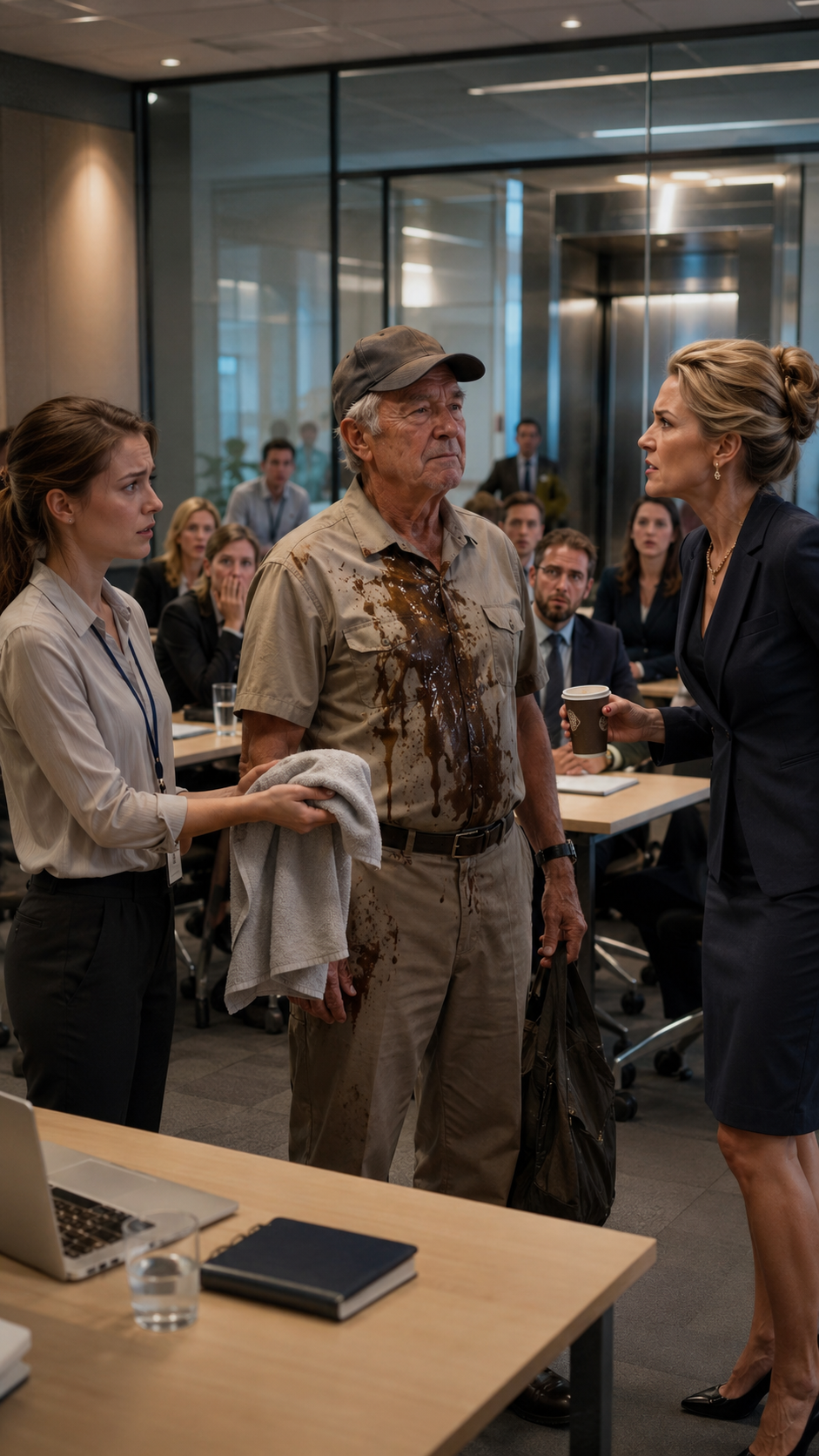
“She insulted the old delivery man… without knowing he owned the company.”
“Use the back door.”
“People like you don’t belong here.”
The coffee struck Samuel Whitaker’s delivery uniform and spread across the faded blue fabric in a hot brown stain.
The training room went silent.
Thirty new employees sat frozen in sleek conference chairs beneath glass walls, motivational posters, and a giant screen displaying the words Respect Builds Leadership.
The woman holding the empty cup was Cassandra Vale.
She was the company’s training director, polished, confident, and feared by almost everyone below the executive floor.
Her heels clicked once as she stepped closer to the elderly man in the delivery cap.
Samuel did not flinch.
He only looked down at the stain on his uniform.
Then he lifted his eyes to her.
“Is this how you treat people?”
His voice was quiet.
It carried no anger.
That somehow made the question heavier.
Cassandra gave a thin smile.
“Only those below me.”
A few trainees looked at the floor.
One young man swallowed hard.
No one laughed.
No one defended the old man either.
That silence was the part Samuel noticed most.
He had seen cruelty before.
Cruelty was simple.
What frightened him was the number of people who had already learned to survive it by pretending not to see.
Cassandra turned toward the trainees.
“This is your first lesson in corporate environment control.”
“People who do not belong must be redirected before they make the room uncomfortable.”
The old man stood near the coffee station with a cardboard package tucked under one arm.
His shoes were old.
His delivery cap was creased.
His hands were large, scarred, and steady.
To Cassandra, he looked like a minor inconvenience.
To Maya Ellis, he looked like someone’s grandfather being humiliated in front of strangers.
Maya was twenty-four, the youngest intern in the room, and the only person sitting near the back without a company badge printed in gold.
She had been at Whitaker Global for eight days.
In those eight days, she had learned to arrive early, speak softly, and never question Cassandra in public.
But the old man’s sleeve was soaked.
His hand trembled just slightly as he held the package.
Maya stood.
Her chair scraped the floor.
Every head turned.
She grabbed a clean towel from the coffee station and walked toward him.
Her hands shook as badly as her voice.
“Sir, I’m very sorry.”
Samuel accepted the towel with a small nod.
“Thank you.”
Cassandra’s face hardened.
“You’ll be fired too if you help him.”
Maya froze.
The threat struck exactly where Cassandra intended.
Maya needed this internship.
Her mother’s medical bills were stacked on the kitchen table at home.
Her rent was late.
Her student loans had begun calling before breakfast.
This job was not a stepping stone to her.
It was oxygen.
She looked at Cassandra.
Then she looked at the old man.
Coffee was dripping from his sleeve onto the polished floor.
Maya took one breath and stepped beside him anyway.
“Then fire me.”
The room changed.
Not loudly.
Not visibly.
But every trainee felt something shift.
Samuel looked at her for a long moment.
For the first time, his expression softened.
Cassandra laughed once.
It was a sharp, ugly sound.
“You think kindness is courage?”
Maya kept her voice low.
“I think cruelty is weakness wearing expensive shoes.”
Several trainees looked up.
Cassandra’s eyes flashed.
“You are finished.”
She reached for the tablet on the conference table, probably to send the message before anyone could calm her down.
Before she touched it, the VIP elevator at the far end of the room chimed.
No one had expected that elevator to open.
It connected only to the top floor.
Board level.
Executive conference suites.
Private offices where ordinary employees were not invited without an escort.
The doors slid apart.
The entire board of directors stepped out.
Eight men and women in tailored suits entered the training room in a line.
Behind them came the company’s general counsel, the chief operating officer, and two senior human resources officers.
Cassandra’s anger vanished into confusion.
Then confusion became alarm.
The chairwoman of the board, Evelyn Grant, stopped in front of Samuel.
She lowered her head.
“Mr. Whitaker.”
One by one, the others bowed slightly.
The trainees stared.
Cassandra took a step back.
“No.”
Samuel removed his delivery cap.
His silver hair was flattened beneath it.
The room saw his face clearly for the first time.
It was the same face that hung in the lobby portrait downstairs.
Older now.
Thinner.
More tired.
But unmistakable.
Samuel Whitaker.
Founder and majority owner of Whitaker Global.
The man whose name was printed on every employee handbook in the building.
The old delivery uniform suddenly looked different.
Not cheap.
Historic.
A relic from the beginning of the company.
Cassandra’s lips parted.
“Mr. Whitaker, I didn’t realize—”
Samuel raised one hand.
“You did realize everything you thought mattered.”
Her face went pale.
The words landed with surgical precision.
“You saw an old man.”
“You saw a uniform.”
“You saw someone you believed had no power.”
He looked at the coffee stain.
“Then you showed me exactly who you are when you think no one important is watching.”
Cassandra swallowed.
“This is a misunderstanding.”
Samuel turned slightly toward Maya.
“This young woman understood the situation perfectly.”
Maya’s eyes widened.
She was still holding the edge of the towel.
Samuel faced Cassandra again.
“Your replacement is standing next to me.”
The room went completely still.
Cassandra looked as if someone had removed the floor beneath her.
Maya shook her head.
“Sir, I’m only an intern.”
Samuel looked at her.
“That is a temporary condition.”
Then he turned to the board.
“Is the emergency resolution prepared?”
Evelyn Grant stepped forward with a leather folder.
“It is.”
Cassandra’s voice cracked.
“Emergency resolution?”
The general counsel opened the folder.
“Cassandra Vale, effective immediately, you are suspended pending investigation into employee intimidation, retaliation, discriminatory conduct, falsified training reports, and misuse of authority.”
Cassandra stared at him.
“You cannot do this in front of trainees.”
Samuel’s eyes sharpened.
“You humiliated a delivery worker in front of trainees.”
“You taught the lesson publicly.”
“We are correcting it publicly.”
The trainees sat straighter.
Some looked shocked.
Some looked relieved.
One young employee near the front began crying silently.
Cassandra noticed.
Her expression twisted.
“Oh, please.”
“Now you all pretend you were afraid?”
The young employee raised her eyes.
“We were.”
That single answer destroyed more of Cassandra’s power than the board had.
A murmur moved through the room.
Another trainee spoke from the second row.
“You told me I would never be promoted if I reported the warehouse incident.”
A man near the aisle added, “You made the janitorial staff wait in the service hall until executives left.”
A woman whispered, “You called my accent embarrassing.”
The room became a dam breaking.
Cassandra looked around, stunned by the number of people who had been waiting for someone else to speak first.
Samuel did not interrupt them.
He listened.
That was something Cassandra had never done.
The HR officers began taking notes.
The general counsel recorded statements.
Cassandra tried to reach the door.
Evelyn Grant blocked her path with calm authority.
“You will remain until security escorts you to collect your personal belongings.”
Cassandra’s face flared red.
“I built this department.”
Samuel looked at the screen behind her.
Respect Builds Leadership.
“No.”
“You built fear.”
He walked slowly to the front of the room.
Each step carried the weight of a man returning to a house he had trusted others to protect.
He set the cardboard package on the table.
It was damp from his coffee-stained sleeve.
“I founded this company forty-one years ago with one van, one route, and one rule.”
He opened the package.
Inside was an old delivery ledger with cracked leather corners.
“My wife wrote our first employee policy on the back page of this ledger.”
Samuel turned the pages carefully.
His fingers stopped near the end.
He read aloud.
“No person who carries our name shall be treated as invisible because of the work they do.”
The words seemed too simple for the modern glass room.
That made them more painful.
Samuel closed the ledger.
“She wrote that after a client told me to use the kitchen entrance.”
He looked toward Cassandra.
“I was thirty-one.”
“I had borrowed my brother’s shoes for that delivery because mine had holes.”
“Your words were not new.”
“Only disappointing.”
Maya lowered her eyes.
The trainees were silent now for a different reason.
They were no longer watching a reversal.
They were witnessing a grief that had taken forty-one years to return to the room wearing a delivery cap.
Samuel continued.
“Six months ago, I received the first anonymous complaint about this department.”
Cassandra stiffened.
“Anonymous complaints are unreliable.”
Samuel looked at her.
“So I came as the kind of person you would never try to impress.”
He touched the coffee stain.
“You confirmed every word.”
Maya’s face changed slightly.
Samuel noticed.
“You know something about those complaints.”
Maya hesitated.
Cassandra turned toward her with sudden hatred.
“You.”
Maya’s hands tightened around the towel.
Samuel’s voice softened.
“Miss Ellis.”
“Tell the truth.”
Maya swallowed.
“My mother wrote the first complaint.”
Cassandra laughed bitterly.
“Of course.”
“Another victim story.”
Maya’s face went pale, but she did not stop.
“She was a night cleaner here for eleven years.”
“She reported that your staff locked the training room cabinets and blamed cleaning crews when supplies went missing.”
“She was transferred after that.”
Samuel’s expression darkened.
Maya continued.
“She died three months later.”
The room went still.
“She left me a copy of the complaint because she thought someone should know she tried.”
Samuel closed his eyes for a moment.
When he opened them, they were wet.
“What was her name?”
“Lena Ellis.”
Samuel turned to Evelyn.
“Find every record connected to Lena Ellis before close of business.”
Evelyn nodded.
“It will be done.”
Maya looked shaken.
“I didn’t know who you were when I handed you the towel.”
“I know.”
“I didn’t do it to get a promotion.”
“I know that too.”
Samuel looked toward the trainees.
“That is why she is qualified to begin fixing this room.”
Cassandra’s voice rose.
“You are handing my job to a girl because she gave you a towel?”
Samuel turned back to her.
“No.”
“I am removing you because a towel frightened you.”
The room absorbed the line in silence.
Cassandra had no answer.
Security entered moments later.
This time, no one used force.
No one needed to.
Her authority was gone before anyone touched her.
As she passed Maya, Cassandra whispered, “You will fail.”
Maya looked at her.
“Maybe.”
“But I won’t make people afraid to tell me when I do.”
Cassandra was escorted out through the same main door she had told Samuel not to use.
The symbolism was not lost on anyone.
After she was gone, Samuel faced the trainees again.
“The first training session under new leadership begins now.”
Maya looked terrified.
“Sir, I don’t know how to lead this.”
Samuel smiled faintly.
“Good.”
“People who think they already know everything are usually dangerous.”
He handed her the old ledger.
“Start by asking the room what they were afraid to say.”
Maya held the ledger as if it were heavier than any promotion.
For the next two hours, no one discussed corporate branding, executive presence, or customer-class management.
They discussed fear.
They discussed silence.
They discussed the back doors employees had been trained to use without realizing the company had built them in their minds.
Samuel stayed for all of it.
He sat in the back row, coffee still drying on his uniform, taking notes in a small pocket notebook.
By the end of the day, three more formal complaints had been filed.
Two managers resigned.
The board ordered a review of every promotion Cassandra had blocked.
Lena Ellis’s transfer was found to have been retaliatory.
Her family received a public apology, back pay owed from withheld hours, and a scholarship fund established in her name for children of hourly employees.
Maya did not become training director overnight.
Samuel refused to turn justice into a fairy tale that would set her up to fail.
She became acting culture officer under direct mentorship from the board.
Six months later, after completing leadership training and earning the trust of the employees Cassandra had terrified, Maya accepted the permanent role.
Her first rule was simple.
No employee orientation could begin until the cleaning crew, security staff, delivery workers, interns, and executives entered through the same door.
Her second rule was stranger.
Every manager had to spend one day per quarter in a uniform from the department they supervised.
Not as punishment.
As memory.
The old delivery uniform was cleaned but never repaired.
Samuel kept the coffee stain.
He had it sealed beneath glass in the training room beside his wife’s handwritten policy.
Employees stopped in front of it often.
Some smiled.
Some cried.
New hires always asked why the stain had been preserved.
Maya always answered the same way.
“That is what disrespect looks like before someone powerful admits it matters.”
One year after the incident, Samuel returned to the training room for the dedication of the Lena Ellis Leadership Center.
Maya stood beside him, no longer trembling, wearing a simple navy suit and her mother’s silver bracelet.
The board attended.
So did janitors, drivers, warehouse workers, assistants, interns, executives, and security guards.
There were no reserved front rows.
Samuel stepped to the podium.
“I thought I came here that day to test a director,” he said.
He looked at Maya.
“I was wrong.”
“I came to find out whether this company still had one person willing to lose something in order to do what was decent.”
Maya lowered her eyes.
Samuel reached into his pocket and removed the old delivery cap.
Inside the lining was a folded note that no one had seen before.
“My wife put this in the cap the week before she died.”
His voice became rough.
“I found it only after the coffee dried.”
The room went silent.
He unfolded the note.
If they ever forget the people below them, Samuel, go back as one of them.
The people who still see you will know what to do.
Samuel looked at Maya.
Then at the employees filling the room.
For years, he had believed his wife left him a memory.
Only at the end did he understand she had left him a map.
Cassandra had seen a delivery man and found someone to step on.
Maya had seen a person and found the courage to stand beside him.
That was why the company changed.
May you like



Not because the owner returned.
But because one intern handed a towel to a stranger before she knew he owned anything at all.







