“His own son called him a beggar… then the black card proved who owned the company.”
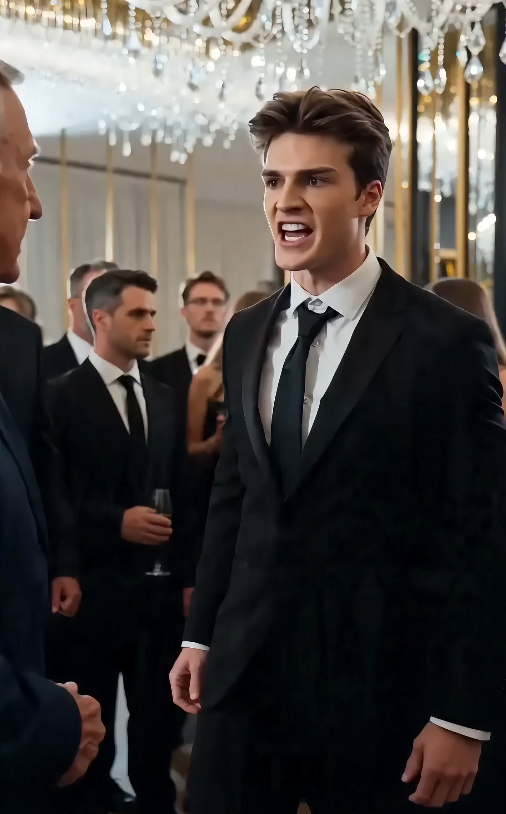
The old man reached for his son in the middle of the investment gala, and the son pushed his hand away.
Champagne glasses stopped halfway to mouths.
The ballroom of Sterling Dynamics glittered with silver lights, black marble, and giant screens showing the company’s new billion-dollar expansion plan.
Investors stood around crystal tables.
Reporters waited near the stage.
At the center of it all stood Brandon Sterling, the young CEO, smiling like a king before his coronation.
Then the old man in the worn gray coat stepped onto the red carpet.
His beard was untrimmed.
His shoes were scuffed.
His hands trembled slightly, not from weakness alone, but from the weight of what he had come to see.
He was Harold Sterling.
The founder of the company.
The father of the CEO.
But Brandon looked at him as if he were trash dragged in from the rain.
A photographer lifted his camera.
Brandon’s face flushed with embarrassment.
He shoved the old man’s hand down before it could touch his sleeve.
“I don’t know this man.”
Harold looked into the eyes of the son he had raised, taught, forgiven, and trusted too long.
His voice was quiet enough to break the room.
“Not even your father?”
A ripple of shock moved through the investors.
Brandon’s jaw tightened.
He stepped closer, lowering his voice but not his cruelty.
He had spent months telling the market that he had inherited full control of Sterling Dynamics.
He had told investors his father was retired, unstable, and no longer involved.
Now that father stood in front of everyone in an old coat, looking exactly like the shame Brandon wanted to erase.
“Security, get him out.”
A lead investor near the stage turned toward Brandon with narrowed eyes.
“Is he really nobody?”
Harold did not wait for security to touch him.
He reached into the inside pocket of his coat and pulled out a black metal card.
It was not a credit card.
It was Sterling Dynamics’ original owner authorization card, engraved with the founder’s seal and a biometric chip registered to controlling shareholders only.
The family lawyer, Martin Cole, stepped forward from the edge of the stage.
His face was pale.
He had been waiting for Harold to decide whether mercy still had a place in that room.
Harold handed him the card.
Martin scanned it against the secure board tablet.
The ballroom screens flickered.
The expansion slides vanished.
A shareholder record appeared in giant letters.
Harold James Sterling.
Eighty percent controlling owner.
Active.
Untransferred.
Brandon’s face emptied of color.
Martin looked at the son who had called his own father a beggar.
“He never gave you the company.”
Harold Sterling built Sterling Dynamics with a toolbox, a rented garage, and a promise to his wife.
Forty-two years earlier, he had not owned a suit.
He owned a soldering iron, a secondhand drafting table, and a mind that could see machinery before metal existed.
His wife, Ruth, worked nights as a nurse while Harold built small medical monitoring devices for rural clinics.
Their first product saved newborns in underfunded hospitals.
Their second product made home cardiac monitoring affordable for families who could not pay for hospital rooms.
The company grew because Harold believed technology meant nothing if only the rich could touch it.
Ruth believed the same.
She kept a handwritten sign above the garage desk.
Build things that would still matter if nobody knew your name.
That sentence became the soul of Sterling Dynamics.
When Brandon was born, Harold was already working eighteen-hour days.
When Emily was born five years later, the company had its first real office.
Harold loved both children, but he did not love them the same way.
Not because he favored one.
Because they wanted different things.
Brandon wanted the tower before he understood the foundation.
He loved the private elevators, the news cameras, the applause at charity events, and the way people lowered their voices when the Sterling name entered a room.
Emily loved the factory floor.
As a child, she sat beside machinists and asked why parts clicked into place.
She brought cookies to night-shift workers.
She learned the names of cafeteria staff before board members.
Ruth said Emily had inherited Harold’s hands and her conscience.
Brandon inherited Harold’s ambition but not his patience.
As the company expanded, Harold tried to teach him.
He brought Brandon to production meetings.
Brandon asked why workers got so many benefits.
He brought Brandon to rural clinics.
Brandon asked whether free equipment damaged brand value.
He brought Brandon to employee memorials.
Brandon checked his phone.
Harold saw the warning signs.
Ruth saw them sooner.
But parents often confuse disappointment with a phase because the truth is too painful to hold.
When Ruth became ill, the family changed.
Cancer moved through her body slowly and then all at once.
Harold stepped back from public leadership to care for her.
Emily moved home from graduate school and helped manage Ruth’s appointments.
Brandon visited when photographers might be present.
He posted about family strength.
He did not stay for the nights when Ruth could not stop vomiting.
Before she died, Ruth asked Harold not to give the company to the child who wanted the title most.
She asked him to give responsibility to the one who understood service.
Harold promised.
But after Ruth’s funeral, grief made him weak in the place Brandon knew how to reach.
Brandon cried beside the grave.
He said he had been careless.
He said losing his mother had changed him.
He said Harold should rest and let him carry the company name forward.
Harold wanted to believe him.
A father can survive many betrayals before he accepts that his own child has become one.
So Harold appointed Brandon as CEO.
Not owner.
CEO.
The shares stayed in Harold’s name.
Eighty percent.
The remaining shares belonged to employee trusts, early investors, and Ruth’s charitable foundation.
The black owner card stayed in Harold’s safe.
Brandon received salary, authority, and a chance to prove himself.
Emily received no title.
She did not complain.
She became director of the company’s community health division, the least glamorous branch and the one Ruth had loved most.
For a while, Brandon behaved.
Then the cuts began.
Quietly at first.
Employee hardship grants were delayed.
Free clinic programs were called inefficient.
Factory bonuses were reclassified.
Veteran technicians were pushed into early retirement.
Brandon replaced engineers with consultants who spoke beautifully and understood nothing that could break in a patient’s home.
He started hosting investor events that looked more like royal courts than business meetings.
Harold objected.
Brandon called him outdated.
Harold asked to see the books.
Brandon delayed.
Harold asked why Ruth’s foundation payments were late.
Brandon said charity had to wait for growth.
That was the first time Harold understood the company was not drifting.
It was being steered away from everything Ruth had built into it.
Then Harold got sick.
Not dying sick.
But weak enough to need help.
A stroke left his left hand stiff and his speech slower for months.
Brandon moved him into a luxury assisted living facility with marble floors and cameras in every common room.
He said it was for safety.
Emily visited and found her father sitting alone by a window, wearing clothes selected by staff and eating food he did not like.
Harold asked to go home.
Brandon said home was not medically appropriate.
Emily took him home anyway.
She moved into the old family house.
She learned his medication schedule.
She drove him to therapy.
She helped him relearn buttoning shirts.
She sat with him when he woke at night calling Ruth’s name.
Brandon called her sentimental.
He said she was wasting her career changing bandages and cooking soup.
Emily did not answer.
She knew love is often invisible work until the inheritance is read.
During those months, Harold began receiving messages from old employees.
Some came through private emails.
Some through handwritten letters.
Some through Emily’s community clinic partners.
They spoke of layoffs, cruel managers, unpaid grants, and a culture that had become ashamed of the people it was built to serve.
Harold asked Emily whether Brandon still spoke to the factory workers.
Emily told him the truth.
Brandon entered through the executive garage and left through the private elevator.
Harold asked whether Brandon visited clinics.
Emily said only when cameras were scheduled.
Harold asked whether employees still knew Ruth’s sign.
Emily looked down.
That was answer enough.
So Harold created a test.
He did not tell Emily at first.
He opened the safe, took the black owner card, and asked Martin Cole to prepare every controlling document.
Then he put on the worn gray coat he used to wear in the garage when Ruth was alive.
He stopped shaving for a week.
He took the city bus to the company’s old factory gate.
A security guard nearly turned him away until an older machinist recognized his eyes.
The machinist cried.
Harold asked him not to say anything.
He spent the next week moving through the company like a ghost.
At the factory, workers offered him coffee.
At the executive entrance, guards asked if he was lost.
At the clinic division, Emily’s team gave him a chair without asking his name.
At headquarters, a receptionist whispered that the lobby was not open to loiterers.
Harold wrote everything down.
He saw the company’s soul still alive in places Brandon ignored.
He also saw rot spreading from the top.
On the day of the investment gala, Brandon planned to announce a massive pivot.
Sterling Dynamics would sell its low-cost medical device division and focus on luxury hospital systems for private networks.
It would make investors richer.
It would kill Ruth’s dream.
Harold asked Martin whether Brandon had legal authority.
Martin said the board could approve the proposal only if the controlling owner did not object.
Harold asked whether Brandon knew that.
Martin said Brandon had been telling investors the owner was medically incompetent and ready to sign everything over.
Harold smiled sadly.
Then it was time for the final test.
He arrived at the gala through the front entrance, not the private one.
He wanted to see whether his son would recognize him without the suit, the driver, the title, and the money arranged around him like armor.
The answer came quickly.
“I don’t know this man.”
“Not even your father?”
The words did not just expose Brandon.
They exposed Harold too.
They showed every place where a father had mistaken charm for repentance, ambition for leadership, and blood for character.
When Brandon ordered security to remove him, Harold almost stopped.
Not because he was afraid.
Because once he used the card, there would be no going back.
A father can dismiss an employee.
Removing a son is a different kind of funeral.
Then the investor asked the question.
“Is he really nobody?”
Harold thought of Ruth’s sign.
He thought of the nurses who used their monitors.
He thought of workers who had given twenty years to a company now ashamed of them.
He thought of Emily, who was standing near the back of the ballroom in a simple black dress, not seated with executives because Brandon had not included her in the front tables.
Harold pulled out the black card.
Martin scanned it.
“He never gave you the company.”
The screens made denial impossible.
Whispers turned into panic.
Investors checked phones.
Board members went pale.
Brandon stepped toward Martin as if he could intimidate the law into changing.
Martin held up the bylaws.
Harold, as controlling owner, had full authority to remove the CEO for cause, halt the proposed sale, and appoint interim leadership.
Brandon tried to laugh.
He said the old man was confused.
He said the records were outdated.
He said Harold had promised him everything.
Harold listened until the word promised reached him.
Then he walked slowly onto the stage.
Every camera turned.
He placed one hand on the podium Ruth had once used during the company’s first public offering.
His voice was not loud.
It did not need to be.
He announced that Brandon Sterling was removed as CEO effective immediately.
The reason was breach of fiduciary duty, misrepresentation to investors, misuse of company authority, and conduct unbecoming of leadership.
Brandon shouted then.
Not words anyone would remember kindly.
Security moved toward him, but Harold raised his hand.
He would not have his son dragged like he had almost been dragged.
He asked Brandon to leave with dignity while he still had some available.
Brandon did not.
He threw his champagne glass against the stage steps.
It shattered.
That did what Harold had refused to do.
It made the room see the child inside the suit.
Security escorted Brandon out.
No one clapped.
Harold would not allow his son’s downfall to become entertainment.
Then he called Emily Sterling to the stage.
Emily froze.
She had spent years doing the work while her brother performed the power.
Now every investor turned toward her.
Harold said she would serve as interim CEO pending board confirmation.
He said she had protected the company’s mission when those paid to protect it sold pieces of it for applause.
Emily walked to the stage with tears in her eyes.
She did not smile triumphantly.
She looked at her father as if she understood the cost of what he had done.
That night, the expansion plan was canceled.
The sale of the low-cost medical division was halted.
An audit began before midnight.
By morning, three executives resigned.
Two board members were under investigation for approving documents Brandon had misrepresented.
Employee emails poured in.
Some expressed relief.
Some expressed anger that Harold had waited so long.
Harold read those too.
He did not defend himself.
Leadership means hearing the truth even when the truth includes your failures.
Emily’s first act as interim CEO was not a press conference.
She went to the factory floor.
She stood on a metal platform above the assembly line where her father had once trained workers himself.
She announced that no layoffs connected to the canceled sale would proceed.
Then she reinstated the hardship fund and Ruth’s clinic grants.
Workers cried openly.
One old technician removed his cap and held it against his chest.
He had worked for Harold since the garage days.
He said Ruth would have been proud.
Emily nearly broke then, but she held herself together until she reached the parking lot.
Harold was waiting in the old pickup truck.
He had refused the company car.
Emily climbed in and finally cried.
Harold placed his stiff left hand over hers.
They sat there until the factory lights came on for the night shift.
Brandon disappeared for two weeks.
Then he returned with lawyers.
He claimed elder manipulation.
He claimed Emily had turned Harold against him.
He claimed the black card had been misused.
Martin produced years of medical competency evaluations, stock records, emails, and Brandon’s own statements to investors falsely implying transfer of ownership.
The lawsuit died quickly.
The public fallout did not.
News outlets called it the black card scandal.
They showed clips of Brandon denying his father.
They showed the shareholder screen.
They showed Emily accepting the interim role.
Some people loved the drama.
Harold hated that part.
He had not exposed his son to go viral.
He had exposed a lie because the lie was about to destroy the company.
Weeks later, Brandon came to the old family house.
Emily answered the door.
He looked thinner.
Angrier.
Still proud.
He asked to see Harold.
Emily stepped aside but did not leave them alone.
That was new.
For years, she had protected peace by absorbing discomfort.
Now she protected truth.
Brandon did not apologize at first.
He accused.
He minimized.
He said he had only done what modern companies had to do.
Harold listened.
Then he showed Brandon Ruth’s old sign from the garage.
Build things that would still matter if nobody knew your name.
He asked his son when the name had become more important than the thing built.
Brandon had no answer.
He left without reconciliation.
That hurt Harold more than the gala.
But Emily reminded him that consequences are not cruelty.
They are sometimes the last language pride understands.
Months passed.
Emily became permanent CEO after a unanimous board vote.
She restructured executive pay so bonuses depended partly on employee retention, product safety, and community access.
Investors complained.
Then the company stabilized.
The low-cost medical division expanded into rural hospitals across the country.
Profits dipped for two quarters and then rose stronger than before.
The market learned what Ruth and Harold had known.
Trust is not soft.
Trust is infrastructure.
Emily also created a founder’s inspection program.
Executives had to spend one week each year in field clinics, factory lines, service departments, and customer support.
No assistants.
No cameras.
No prepared speeches.
Just work.
Some executives hated it.
Some left.
Emily let them.
She said anyone too important to listen was too dangerous to lead.
Harold never returned to public leadership.
He kept an office in the old factory with Ruth’s sign above the door.
Workers visited him sometimes.
So did young engineers.
He told them stories of mistakes, not victories.
He said every company eventually faces a mirror.
Sterling Dynamics was lucky its mirror came before the damage became permanent.
Brandon’s story did not end cleanly.
He spent years consulting for smaller firms that cared more about image than character.
He remained wealthy.
He remained angry.
Then one day, he appeared at a free clinic opening funded by Sterling Dynamics.
He stood in the back, unnoticed at first.
Emily saw him but did not call him forward.
Harold, older now and walking with a cane, saw him too.
A little boy receiving a heart monitor asked Brandon if he worked there.
Brandon looked at the device.
It was a new version of the first monitor Harold had built in the garage.
Small.
Affordable.
Life-saving.
For the first time in years, Brandon seemed unable to perform.
He left before the ribbon cutting.
A week later, Emily received a letter.
It was not dramatic.
It did not ask for his title back.
It did not ask for money.
It admitted that he had wanted to inherit a throne, not earn a responsibility.
Emily read it to Harold.
Harold closed his eyes.
He did not say forgiveness had arrived.
He said perhaps a door had opened.
That was enough for that day.
On the tenth anniversary of the gala, Sterling Dynamics held a company-wide meeting in the original factory.
No chandeliers.
No red carpet.
No VIP tables.
Employees stood beside engineers, nurses, designers, and community partners.
On the wall behind the stage hung three objects in a glass case.
The worn gray coat.
The black owner card.
Ruth’s handwritten sign.
The plaque beneath them read that ownership is not proven by what you can claim, but by what you refuse to abandon.
Harold sat in the front row beside Emily.
His hair was white now.
His hand still trembled.
But when Emily spoke about the future of the company, his eyes were clear.
She did not thank him for giving her power.
She thanked him for finally trusting the person who had been doing the work without needing the spotlight.
Then she thanked the employees who wrote letters, spoke up, and stayed long enough to fight for the company’s soul.
Brandon attended quietly.
He stood near the back.
No cameras turned toward him.
No one announced his name.
After the meeting, he approached Harold.
For a long moment, father and son looked at each other across everything that had been broken.
Brandon did not offer excuses this time.
He only lowered his head.
Harold reached out his hand.
Brandon took it.
It was not restoration.
It was not inheritance.
It was a beginning too fragile to name.
Emily watched from a distance and did not interrupt.
She had learned that leadership sometimes means knowing which doors to open and which ones to let others walk through on their own.
When Harold died three years later, his will caused no scandal.
Emily remained CEO.
The employee trust expanded.
Ruth’s foundation received permanent funding.
Brandon received enough to live well, but no controlling power.
The black card was deactivated and placed permanently in the company museum.
On the day of the memorial, thousands of employees lined the path outside the factory.
Not investors.
Not reporters.
Workers.
Nurses.
Engineers.
Families from rural clinics.
People whose lives had been touched by machines built under a sign that told the truth.
Brandon stood beside Emily at the service.
He did not stand in front.
He did not speak.
At the end, he helped carry Ruth’s sign into the museum.
That was the closest he came to apology in public.
Emily accepted it for what it was.
Incomplete.
But real.
His own son called him a beggar, then the black card proved who owned the company.
May you like



But the real ending was not the public firing, the eighty percent ownership record, or the son escorted from the gala he thought belonged to him.
The real ending was that Harold Sterling learned blood does not make someone worthy of power, Emily proved care is a stronger qualification than pride, and a company nearly sold for applause found its soul again because one old man wore a beggar’s coat to see who still remembered his name.







